Skip to content
Fairway&Fescue

The Back · Bags, Carts & Getting Round

Three-Wheel vs Four-Wheel Push Carts

Which push cart suits an older walker: the lighter, nimbler three-wheeler or the steadier four-wheeler — decided by your courses, not the marketing.

By Stephen V.Updated How we pick
#ad

We earn a commission when you buy through our Amazon links, at no extra cost to you. It never changes our rankings — and we'll tell you when the cheaper ball or club is the better buy. How this works.

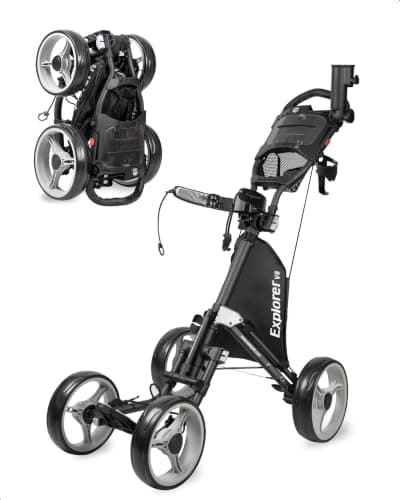
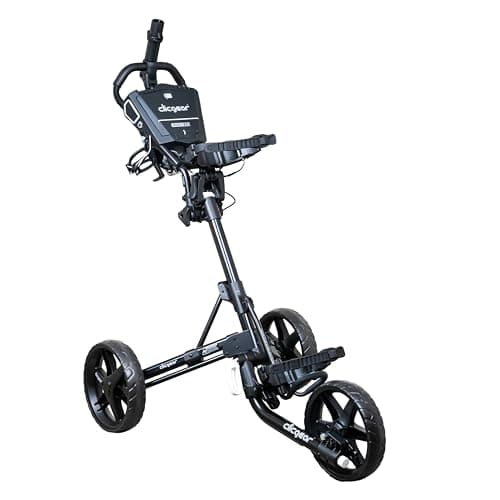
Here’s the honest short version: for most senior walkers on ordinary parkland courses, a three-wheel cart is the sensible default — it’s lighter, turns more easily and folds smaller. A four-wheel cart wins in one situation that matters a lot to some players: hilly, uneven ground, where the fourth wheel adds the stability that unsteady legs like least to be without. To show the choice, we put the three-wheel Clicgear 4.5 next to the four-wheel CaddyTek Explorer V8.

A three-wheel cart pivots on the spot and threads through gates and tee boxes with a nudge, which is genuinely easier on the wrists over a full round. It also packs down smaller for the car boot. A four-wheel cart, by contrast, sits flatter and tracks dead straight across a slope without wanting to drift downhill, so it feels more planted when the ground tilts. Neither is “better” — they’re built for different ground.

Both of these carts do the important job identically: they take the whole weight of the bag off your back for all 18 holes. So the wheel count is a comfort-and-terrain decision, not a health one — the health case for pushing rather than carrying is made in carrying vs pushing and your back. If you’d rather just see the top carts of each type ranked, our best push carts for seniors covers both, and a steady pair from our best golf shoes for seniors makes either cart feel surer underfoot.

The short answer

Quick picks

#ProductBest forScorePrice
01
Clicgear Clicgear 4.5 Push Cart
Clicgear 4.5 Push Cart

The cart that lasts a decade. Clicgear's compact three-wheel fold and near-bulletproof build are why you see them still rolling ten years on — the buy-once option.

Buy-it-once durability
8.3
$339.00Amazon
02
CaddyTek CaddyTek Explorer V8 (4-Wheel)
CaddyTek Explorer V8 (4-Wheel)

A four-wheel cart for the price of many three-wheelers — the extra wheel adds real stability on the hilly, uneven ground that unsteady legs like least.

Stability on hilly courses
8.3
$142.03Amazon

#ad · Live prices from the Amazon Product API, as of Jul 23, 2026. Where we have no verified live price, we show none — we would rather leave a gap than print a number that has rotted.

In detail

The picks, in full

01
Clicgear Clicgear 4.5 Push Cart

Buy-it-once durability

Clicgear 4.5 Push Cart

3-wheelCompact flat foldHand brakeHuge accessory range
8.3/10

The cart that lasts a decade. Clicgear's compact three-wheel fold and near-bulletproof build are why you see them still rolling ten years on — the buy-once option.

Ease on the back
9
Ease of folding
7
Build quality
10
Value
7

Pros

  • Folds compact and flat — genuinely easy to lift into a car boot
  • Built to last many seasons; parts and accessories are easy to find
  • Rock-solid, no-wobble frame that tracks straight

Cons

  • The multi-step fold is fiddlier than a one-pull cart until you learn it
  • Premium price

Skip this if…

stiff hands make a multi-step fold a struggle. The Clicgear folds compact but takes a couple of moves — if that's hard for you, the one-pull Nitron is worth the extra bulk.

$339.00View on Amazon

Price as of Jul 23, 2026. Prices change — Amazon's is the one that counts.

#ad · we may earn a commission from this link to Clicgear 4.5 Push Cart

02
CaddyTek CaddyTek Explorer V8 (4-Wheel)

Stability on hilly courses

CaddyTek Explorer V8 (4-Wheel)

4-wheelOne-click foldFoot brakeValue price
8.3/10

A four-wheel cart for the price of many three-wheelers — the extra wheel adds real stability on the hilly, uneven ground that unsteady legs like least.

Ease on the back
9
Ease of folding
8
Build quality
7
Value
9

Pros

  • Four wheels track dead straight and feel steadier across slopes and cambers
  • One-click fold is simpler than a multi-step cart
  • Excellent value for a full-featured cart

Cons

  • A four-wheel cart is a little bulkier folded than a three-wheeler
  • Slightly harder to spin on the spot than a three-wheel design

Skip this if…

you play flat courses and want the smallest fold. On level ground the third wheel isn't missed, and a three-wheel cart packs down smaller — the four-wheel's edge is hills.

$142.03View on Amazon

$149.995% off

Price as of Jul 23, 2026. Prices change — Amazon's is the one that counts.

#ad · we may earn a commission from this link to CaddyTek Explorer V8 (4-Wheel)

When three wheels win

Choose three wheels if your courses are mostly flat, if you value the smallest fold for a modest car, and if easy one-handed maneuvering matters to your wrists and shoulders. A three-wheeler spins on its own axis, so repositioning it around the green or through a narrow gate is a light push rather than a heave. It’s also the lighter cart to lift, which — as we cover in the push cart roundup— is the weight that actually taxes your back, since the wheels carry the rest on the course.

When four wheels win

Choose four wheels if your home course has real hills, off-camber fairways or soft, uneven turf, or if your balance isn’t what it once was and a rock-steady cart gives you confidence. The fourth wheel keeps the cart from tipping or drifting across a slope and lets it stand flat and stable while you take a club. The cost is modest: a four-wheel cart is a little bulkier folded and doesn’t pivot quite as tightly. For a player who wants maximum steadiness, that’s a trade well worth making, and the Explorer V8 delivers it without a premium price.

What doesn’t actually decide it

Ignore the idea that four wheels are simply “more advanced.” They aren’t — plenty of the most durable, best-loved carts in golf are three-wheelers, and a fourth wheel adds bulk you don’t need on flat ground. Ignore weight comparisons between the two styles too, because the on-course weight is carried by the wheels either way; what you feel is the lift into the car, where the compact three-wheel fold has a small edge. Buy for your terrain and your hands, not for the number of wheels.

Skip this

Don’t buy a four-wheel cart for a flat course just to be safe. On level ground the third wheel isn’t missed, and you’ll have bought extra bulk to fold and store for a stability benefit your course never calls on. And don’t force a three-wheeler onto a genuinely hilly track if it leaves you fighting the cart across every slope — that fight is exactly the strain a cart is supposed to remove. Match the wheels to the ground you actually play, and either cart will serve you for years.

How we picked this

We haven't hit this gear — and we say so

We compiled the published manufacturer specifications — shaft weight and flex, loft, grip diameter, ball compression, cart weight — did the swing-speed and compression arithmetic, cross-read the owner manuals, and scored each pick against a published rubric. The scores are judgments from documented research — they are notlab measurements we took, because we don't have a lab and we're not going to pretend we do. Where somebody has genuinely measured this, we link them. You can check every number we publish.
Questions

Frequently asked

Is a three-wheel or four-wheel push cart better for seniors?
It depends on your courses. Three wheels are lighter, nimbler and fold smaller — ideal on flat ground. Four wheels are steadier on hills and uneven turf, which suits a player who wants maximum stability or whose balance isn’t what it was.
Are four-wheel push carts harder to store?
A little. A four-wheel cart is usually bulkier folded than a comparable three-wheeler, so it takes more room in the car boot. If storage space is tight, that’s a point in favor of a compact three-wheel fold.

Keep reading

Receipts

Sources

We do not run a testing lab, and we do not pretend to. Every spec number here comes from a manufacturer's published sheet or an official standard, cited above. Where we could not verify something, we say so on the page rather than quietly leaving it out. Read our full method.