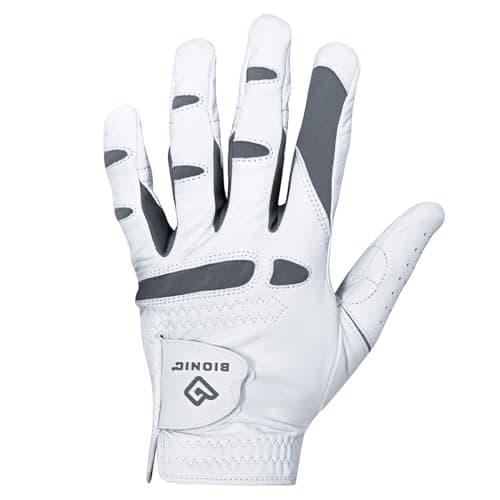
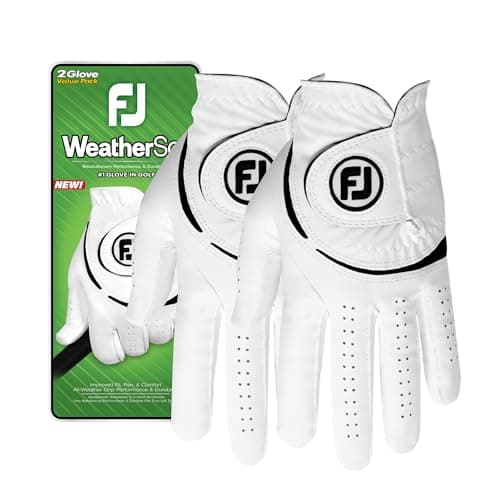
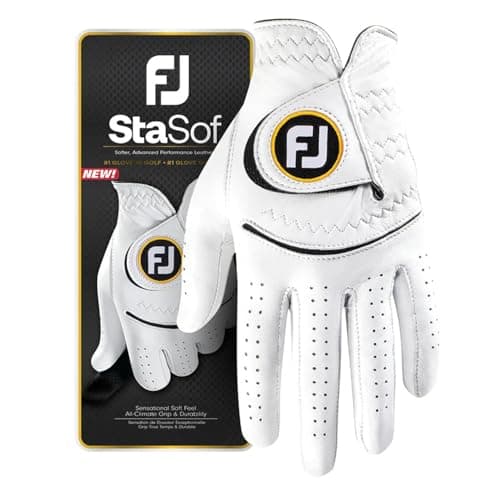
If your glove has loose material at the ends of your fingers but fits across the palm, you do not need a smaller glove — you need a cadet one. That is the single most useful thing on this page, and it is the thing almost nobody is told at the counter. Cadet gloves have a wider palm and shorter fingers than a regular glove in the same stated size, and plenty of older golfers have been buying the wrong one for decades.
A glove that does not fit is not a comfort problem. It is a grip-pressure problem: loose material means the club can move inside your hand, you squeeze harder to stop it, and squeezing harder is precisely what stiff or arthritic hands cannot afford to do. Getting the size right is the cheapest thing on this website.
Which hand, first
The glove goes on your leadhand — the top hand on the club. A right-handed golfer wears a left-hand glove; a left-handed golfer wears a right-hand glove. Retailers label gloves by the hand they fit, so a right-handed player is shopping for “men’s left hand.” If you are buying a glove as a present and cannot ask, check the glove already in their bag before you order anything.
The two measurements
FootJoy’s published fitting method uses two numbers, and the relationship between them is what decides regular against cadet.
Palm width is the circumference of your hand at its broadest point, with the thumb excluded. Finger length is measured from the tip of your middle finger down to the first crease at your wrist. Take both on your glove hand, not your dominant hand, if those differ.
Then apply the test: if your finger-length number is less than your palm-width number, try a cadet glove in your size.That is FootJoy’s own wording, and it is the whole decision in one sentence.
Regular or cadet: the three signs
| What you notice | What it means | What to do |
|---|
| Finger length measures less than palm width | Short fingers, wide palm | Cadet, same stated size |
| Spare material at the fingertips, but the palm fits | The glove is too long, not too big | Cadet, same stated size |
| Sizing down fixes the fingers but the closure will not reach | You have gone too small across the palm | Go back up and switch to cadet |
| Your fingers swell as the round goes on | Common, and it changes the fit you need | FootJoy suggests considering cadet |
That last row is worth dwelling on, because it is the one that applies most often to older hands. Fingers that are fine on the 1st tee and tight by the 12th are not unusual, and a glove sized for your 1st-tee hand will be uncomfortable for two thirds of the round.
What “fits” actually looks like
A correctly sized golf glove is snug like a second skin across the palm and the back of the hand, with no loose material anywhere and no bunching at the base of the fingers. The fingertips should reach the end of the glove without pressing hard into it. The closure tab should land with a bit of the fastening still showing — if the tab is stretched to its limit to close, the glove is too small; if it overlaps a long way, it is too big.
A new glove should feel slightly tight. Leather gloves, in particular, give a little in the first couple of rounds. A glove that feels comfortable in the shop will usually be loose by its third round.
Which gloves are sold in cadet
Not every glove is, which is why the three picks above are the three we would point you at. The FootJoy StaSof and the Bionic PerformanceGrip Pro are both listed in regular and cadet sizes, so if the test above puts you in cadet, those are the premium leather options available to you. The FootJoy WeatherSof is the everyday value glove in a two-pack — the one most golfers get through two of in a season.
If what you actually need is relief rather than fit, the padded gloves are a different category and we rank them separately in best golf gloves for arthritis. The general ranking across all of them, padded and plain, is best golf gloves for seniors.
The glove is only half of the grip
A well-fitted glove stops the club slipping. A well-sized grip stops you having to squeeze it in the first place, and for hands that hurt the grip matters more. The two measurements are different and the two decisions are independent: you can need a cadet glove and a standard grip, or the reverse. Our grip-side equivalents of this page are how to measure golf grip size and the fuller grip size guide. If your hands are stiff in the mornings, read do oversize grips help arthritis? before you spend anything at all.
When to replace it
A glove is a consumable, and the failure mode is gradual enough that most golfers keep one well past its useful life. The tell is the palm: once the leather or synthetic there has gone shiny and smooth, it has stopped gripping and it is doing nothing but keeping your hand warm. Two gloves rotated through a season last longer than one worn every round, because each gets a chance to dry out properly — which is the practical argument for buying the WeatherSof in a two-pack.
How we picked this
We haven't hit this gear — and we say so
We compiled the published manufacturer specifications — shaft weight and flex, loft, grip diameter, ball compression, cart weight — did the swing-speed and compression arithmetic, cross-read the owner manuals, and scored each pick against a published rubric. The scores are judgments from documented research — they are notlab measurements we took, because we don't have a lab and we're not going to pretend we do. Where somebody has genuinely measured this, we link them. You can check every number we publish.