Golf grips come in a handful of standard sizes, and the names sound more exact than they are. This page lays out the tiers — standard, midsize and oversize/jumbo — what each one adds to the diameter, and which hands each suits. If you are shopping around sore or arthritic hands, the size you choose matters as much as the compound, so it is worth getting the language straight before you buy.
Grip diameter is measured relative to a standard grip. Going up a size adds a set amount all the way around, which fills the hand and lets you hold the club with less squeeze. The steps below are the industry-standard conventions used across brands.
| Size | Roughly how much bigger | What it feels like | Who it suits |
|---|
| Standard | Baseline (about 0.900" round core) | The default feel; full wrist and hand action | Healthy hands, or small hands with no joint pain |
| Midsize | +1/16" | A modest fill; slightly calmer hands, most feel kept | Mild soreness, larger hands, or a first step up |
| Oversize / Jumbo | +1/8" or more | A big fill; the lightest hold, hand action noticeably quieted | Stiff, painful, arthritic hands that need maximum relief |
A note on brand names
Here is the confusing part, and it is worth knowing before you order: the size names are not consistent between brands. What one maker calls “oversize” another calls “midsize,” and the diameters overlap. Winn’s “Oversize,” for instance, sits at roughly a midsize step up, while a grip labeled “jumbo” or “arthritic” from a brand like Karma is a genuinely larger, eighth-of-an-inch-plus diameter. Don’t buy on the label alone — check the stated size in inches or the maker’s own chart, and treat the words as a rough guide.
How to know which size you need
There is a traditional hand-measurement method (glove size and finger length), but for a senior shopping around arthritis it is simpler to work from the pain. If your hands are healthy and you just have larger-than-average hands, a midsize can feel more natural. If your hands are sore or stiff, size up until the club sits in the hand without you clamping down — that is the whole point. The Arthritis Foundation lists building up grip size among its suggestions precisely so you can hold on with a looser, less painful grip. Our midsize vs jumbo comparison helps you pick between the two biggest steps.
Building up a grip with tape
The size printed on the package isn’t the only lever. Every grip is installed over double-sided tape, and adding extra wraps of tape under the grip builds up the diameter further — a common way to fine-tune between the standard sizes, or to nudge a midsize toward oversize without buying a different grip. Each extra layer adds a small, consistent amount all the way around. It is the cheapest way to dial in a size, and it happens naturally when you regrip your clubs yourself.
Two grips that anchor the range
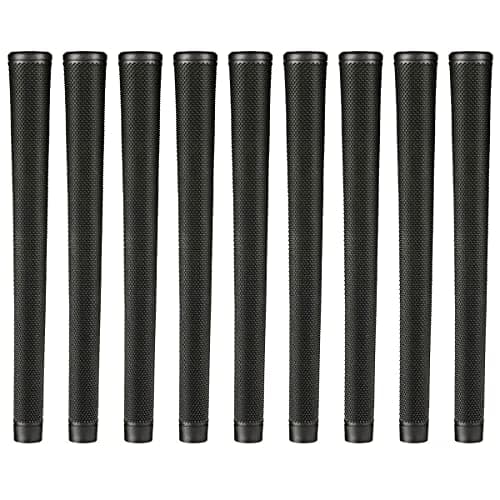
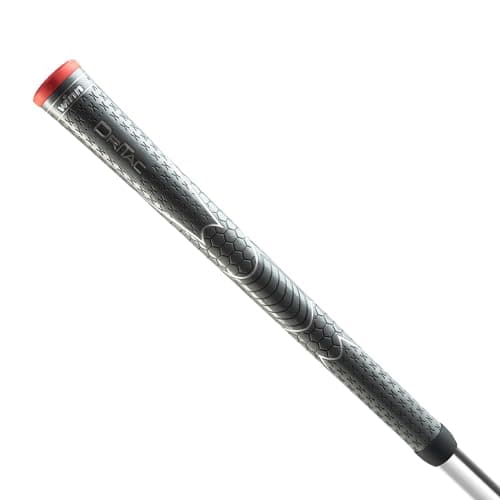
To make the sizes concrete: the standard Winn Dri-Tac sits at the baseline — a soft compound in the size you are probably used to, for mild soreness without a size change — while the Karma Jumbo is a genuine eighth-of-an-inch-plus arthritic grip and the cheapest way to feel what a truly large diameter does for a stiff hand. Trying that one cheap jumbo on a single club is the low-risk way to learn where your hands land before you commit. When you are ready to choose across the whole range, our best grips for arthritis roundup ranks the soft and oversize options, and a lighter set from best clubs for seniors pairs naturally with a bigger grip.
How we picked this
We haven't hit this gear — and we say so
We compiled the published manufacturer specifications — shaft weight and flex, loft, grip diameter, ball compression, cart weight — did the swing-speed and compression arithmetic, cross-read the owner manuals, and scored each pick against a published rubric. The scores are judgments from documented research — they are notlab measurements we took, because we don't have a lab and we're not going to pretend we do. Where somebody has genuinely measured this, we link them. You can check every number we publish.