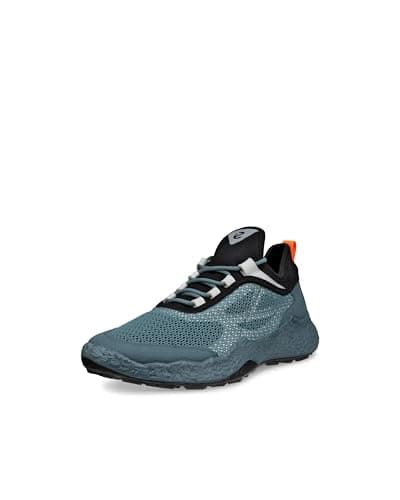
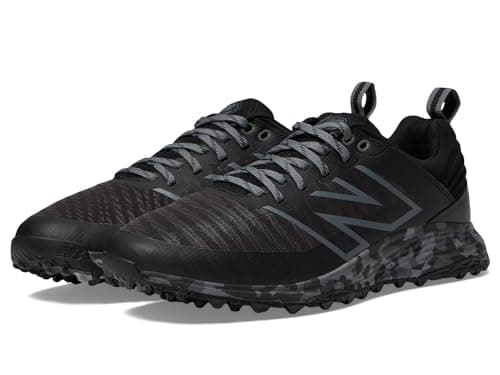
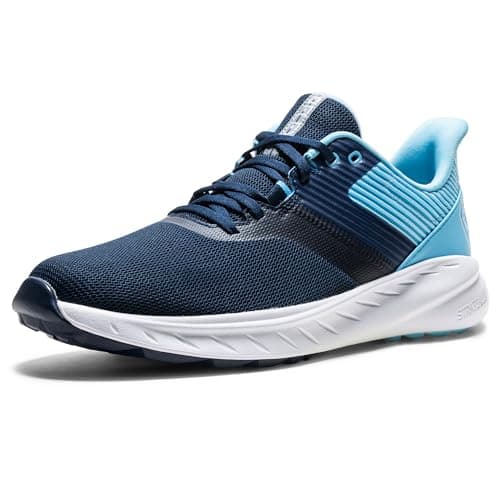
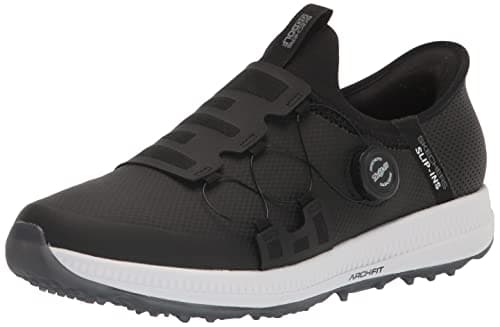
The best orthopedic golf shoe for most seniors is the Skechers Go Golf Elite 5 Arch Fit: its Arch Fit insole is removable, so a custom orthotic drops straight in, and if you do not have one the insole Skechers ships carries what the company calls “podiatrist-certified arch support.” Either way the foot is looked after. Behind it are the ECCO Biom Hybrid 5, whose removable Ortholite insole ECCO says can be taken out “for extra width,” the New Balance Fresh Foam Contend v2 for a wide foot that wants plush cushioning, and the FootJoy FJ Flex, whose removable insole “makes room for custom orthotics” in FootJoy’s own words.
We should be plain about the word. “Orthopedic” is a medical description, not a shoe category, and no golf-shoe maker we could find is licensed to sell one. What a golfer searching for orthopedic golf shoes usually needs is one of two things: a shoe that will accept the orthotic a podiatrist has already prescribed, or a shoe with enough built-in support, cushioning and width to get through four hours on a foot that has been told to behave. The American Podiatric Medical Association is the authority we defer to on the foot itself; we are only reading the spec sheets. If your problem is a specific condition, start at best golf shoes for plantar fasciitis or how to choose golf shoes for bad feet; this page is for the golfer who already has an orthotic, or is about to.
What we ranked on, in order
1. Does the insole come out? A custom orthotic has to replace the factory insole, not sit on top of it; stacked, it raises the heel, crowds the toe box and undoes the fit. Skechers, ECCO and FootJoy all publish that theirs is removable. New Balance publishes a “molded CUSH+” insole without stating whether it lifts out, so on this criterion it ranks below the three that do say.
2. Published widths. An orthotic takes up room, and a foot that needs one is often wider or more swollen than it used to be. New Balance sells the Contend v2 in medium and wide, with extended widths noted on the retail listing; Skechers lists the Elite 5 with a width selector. ECCO takes a different route: remove the insole and the shoe gets wider. FootJoy’s width range for the Flex was not published on the listings we found, so we say so. Our best wide-fit golf shoes for seniors ranks on this alone.
3. Heel hold. An orthotic works by keeping the foot in position. A heel that slips defeats it. Skechers builds what it calls a Heel Pillow into the Elite 5 to hold the foot in place; ECCO describes its Biom Natural Motion build as giving “a snug fit, along with stability” through the swing.
4. Cushioning and drop. New Balance publishes the most detail here — a Fresh Foam midsole with a 10-millimeter drop from heel to toe, which is a running-shoe geometry and the reason the Contend v2 feels the way it does. A higher drop unloads the Achilles and calf; a podiatrist will have a view on whether that helps or hinders your particular foot, and it is worth asking.
5. Spikeless, and how waterproof. Every pick is spikeless, because a foot in an orthotic wants a flat, stable platform, not cleats. Waterproofing varies: Skechers publishes a one-year waterproof warranty and New Balance a two-year one; ECCO publishes an ECCO-TEX membrane; the FJ Flex is reviewed as a dry-conditions shoe. Best waterproof golf shoes for seniors covers wet-course play properly.
The picks
The Skechers Go Golf Elite 5 Arch Fit wins because it answers both versions of the question. With an orthotic: the insole comes out. Without one: the Arch Fit insole is the only stock golf insole we know of with a podiatrist-certified support claim behind it. Add the Heel Pillow, the GripFlex spikeless sole and the waterproof warranty, and it is the default. It is also our top pick for senior golf shoes generally, for much the same reasons.
The ECCO Biom Hybrid 5 is the premium answer and the cleverest one on width. ECCO’s wording is that the removable, washable Ortholite insole gives you “the option of removing it for extra width” — which is exactly what an orthotic wearer does anyway. The anatomical Biom last is why comfort-seekers with difficult feet keep buying ECCO, and the ECCO-TEX membrane keeps it dry. It is by far the most expensive shoe here. We compare it with the Skechers directly in Skechers Arch Fit vs ECCO Biom.
The New Balance Fresh Foam Contend v2 is the wide-foot pick. Medium and wide widths, a Fresh Foam midsole with a published 10-millimeter drop, a two-year waterproof warranty and a published weight of 8.9 ounces. New Balance does not say whether the CUSH+ insole is removable, which is the one thing keeping it off the top of an orthotic list; if you plan to swap the insole, check the pair in hand before you commit.
The FootJoy FJ Flex is here for one published sentence: “the removable insole makes room for custom orthotics.” It is a soft, sneaker-like spikeless shoe on an EVA midsole with the Versa-Trax sole, and it flexes with a stiffening foot. What it gives up is weather protection — reviews treat it as a dry-conditions shoe — and a firm stance.
How to fit a golf shoe over an orthotic
Take the orthotic to the store, or order two sizes. Try the shoe with the factory insole out and your orthotic in, laced as you would play. A shoe that fits without the orthotic tells you nothing. Our how should golf shoes fit guide covers the rest of the checklist.
Go up in width before you go up in length. An orthotic mostly needs room across the midfoot and under the arch. A longer shoe in the same width slides at the heel, which is the one thing an orthotic cannot tolerate.
Ask your podiatrist about drop. The Contend v2’s 10-millimeter drop and the ECCO’s low-to-the-ground Biom geometry are opposite ends of the same spectrum. Which suits a given Achilles, arch or knee is a clinical call, not a spec-sheet one.
Check the shoe’s own support before paying for an insert. If you do not yet have a prescription, the Arch Fit insole may be enough on its own. Our arch support and stability guide explains what built-in support can and cannot do.
Skip this
Skip anything sold as an “orthopedic golf shoe.” No major golf-shoe maker uses the term, and a brand that does is describing a marketing category, not a medical one. Buy on the three published facts — removable insole, width range, heel hold — and let your podiatrist supply the orthopedic part.
Skip stacking an orthotic on top of a fixed insole. It lifts the heel out of the heel cup, crowds the toes and raises the foot above the lateral support the shoe was designed to give. If the insole does not come out, it is the wrong shoe for an orthotic, however comfortable it feels bare.