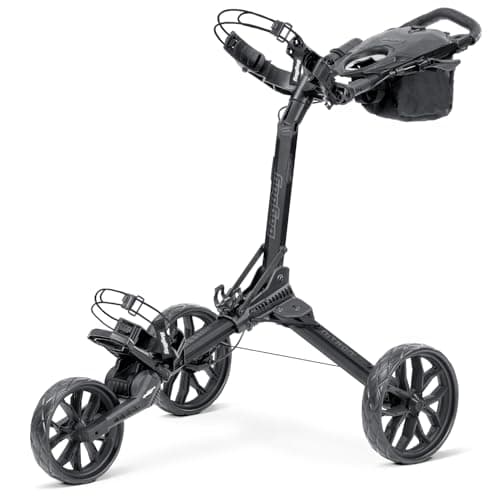
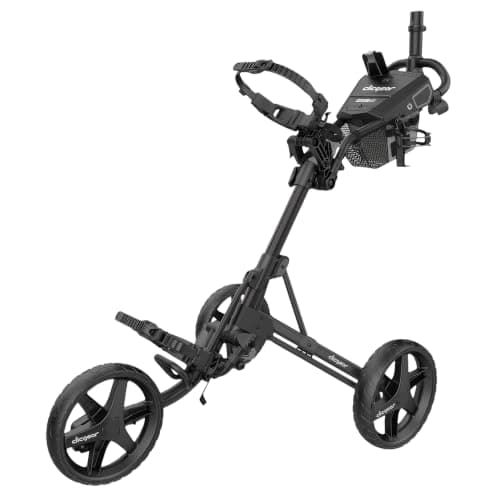
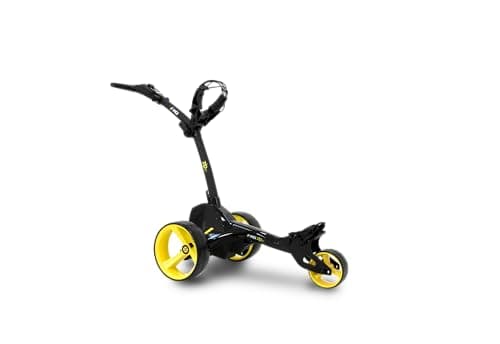
If hills are what ends your round, buy the electric caddy — the MGI Zip X1 is the one we would start with, because at 22 pounds bare and 26.7 with the battery in, it is the lightest thing in the category and the battery lifts out separately so no single piece you put in the trunk is heavy. If the walk is fine and what you want is the bag off your shoulder, a push cart does that for a fraction of the money and never needs charging: the Bag Boy Nitron for the easiest fold, the Clicgear 4.5 if you want one cart for the next decade.
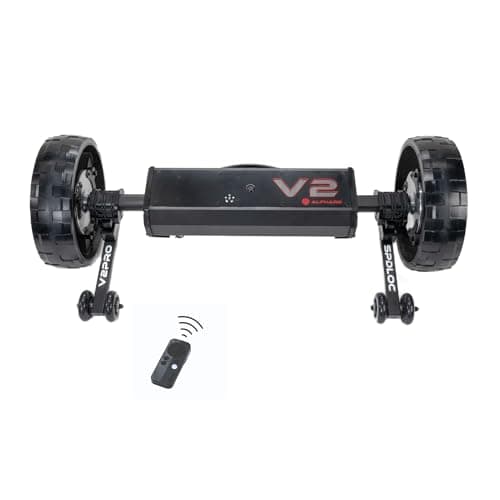
And if you already own a push cart you like, there is a third answer most people do not know about. The Alphard Club Booster V2Pro is a motor base that bolts under the cart you have — Alphard publishes a compatibility list covering Clicgear, Bag Boy, Sun Mountain, CaddyTek, Rovic and Axglo — so you keep the frame and the fold you already know and add the motor to it.
The numbers, side by side
Every figure below is published by the manufacturer for the exact model we link to. We have not pushed, driven or weighed any of them; what we can do is line the specifications up so the trade-offs are visible in one place.
| Model | Type | Weight | Battery | Fold | Hill help |
|---|
| MGI Zip X1 | Electric, walk-beside | 22 lb bare / 26.7 lb with battery | 250 Wh, rated 36 holes | Three-wheel Zip fold | Yes, uphill. No downhill control on this model |
| Alphard Club Booster V2Pro | Conversion kit for your cart | Adds a motor base to an existing cart | Manufacturer-rated, remote controlled | Your cart’s own fold, plus a separate base | Yes, with downhill speed control and parking brake |
| Bag Boy Nitron | Manual push, 3-wheel | No battery to carry | None | Gas-assist one-pull open | No - you push |
| Clicgear 4.5 | Manual push, 3-wheel | No battery to carry | None | Compact flat fold, multi-step | No - you push |
The three questions that actually decide it
1. Is the problem the bag, or the hill? These are different complaints and they have different answers. A push cart solves the bag: the weight comes off your shoulder and your back, which is the single biggest thing you can do for a walking round, and we work through the evidence for that in carrying vs pushing and your back. A push cart does not solve the hill. You are still the engine. If you arrive at the 14th tee with nothing left, a motor is the thing that fixes that, and no amount of cart engineering will.
2. Can you lift it into the car on your own? This is the question people skip and then regret. An electric caddy is a heavier object than a push cart and it arrives in your trunk in one or two pieces depending on the model. The Zip X1 is the friendliest here because the battery comes out: you lift 22 pounds, not 27. The KVV folds smallest at 17.5 by 18.7 by 22 inches, which is the dimension that decides whether it fits a small sedan trunk at all. If you cannot comfortably lift and load the thing, you will not use it, and the money is wasted. Be honest with yourself about this before you buy.
3. Do you want to be free of it, or beside it?There are two kinds of electric caddy and they are not the same product. A walk-beside caddy like the Zip X1 has a speed dial and a go button; your hand rests on the handle and it does the pushing. A remote caddy sends the cart ahead while you walk empty-handed. The remote is the bigger lifestyle change and the bigger thing to learn, and for a lot of older golfers the walk-beside version is the better fit — one less gadget, one less thing to drop in the wet. The full ranking of remote and walk-beside models is in best electric golf push carts for seniors.
Where the push cart still wins
Do not let the technology talk you out of the simpler object. A push cart has nothing to charge, nothing to fail on the 12th, no battery that degrades in its fourth season, and costs a fraction of the price. A Clicgear bought today will very likely still be rolling in ten years, and parts for it are easy to find; that is not a claim anybody can make about a lithium battery. If you walk a flat course and the only thing you wanted was the bag off your back, buy the cart, keep the change, and read best push carts for seniors to pick between them. The three-wheel against four-wheel question is settled in three wheel vs four wheel.
The conversion kit, and when it is the right answer
The Alphard Club Booster is the most interesting product on this page and the most conditional. It is only the right buy if you already own a cart on Alphard’s compatibility list — which covers all Clicgear three- and four-wheel models, the Bag Boy Quad XL, Compact 3, Tri-Swivel and Nitron, Sun Mountain Speed, Micro and Pathfinder, every CaddyTek, Rovic RV1S and RV1C, and every Axglo. If yours is on that list, you get downhill speed control and an automatic parking brake, which are the two features that matter most to an older walker, on a frame you already trust. Alphard says the install takes under half an hour and the cart still works as a plain push cart if you leave the base at home.
If your cart is not on the list, the kit is the wrong purchase: bought together, a new cart plus the kit costs more than a purpose-built electric caddy and does less. And the trade is real either way — you now load two pieces into the car instead of one, which is better for some backs and worse for others.
Our verdict, in one line each
Flat course, bag is the problem: push cart. Hilly course, or the last four holes are a slog: electric. Already own a good push cart: conversion kit. Cannot lift 27 pounds into a trunk on your own: push cart, or an electric with a removable battery, and check the folded dimensions first. Whichever way you go, the related question of how long you can keep walking at all is worth reading: walking 18 holes after 70.