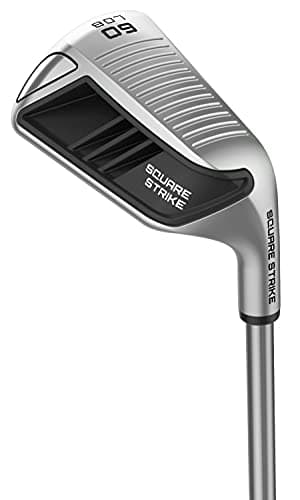
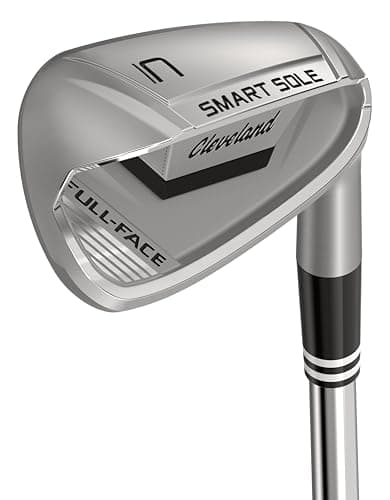
If you have started chunking chips, the club to buy is the Cleveland Smart Sole Full-Face in 42° with the graphite shaft. It is a chipping loft on a three-tiered sole so wide it bounces off the turf instead of digging in, and it is one of the very few short-game clubs sold with a graphite shaft — which is the shaft a slower, lighter swing actually wants. If your short game has gone past bad and into frightening, the Square Strike Wedge is the more drastic fix: a heavy, upright 45° head you can swing with a putting stroke. The steel Smart Sole is the same forgiving head as our top pick for less money, if your hands and wrists are fine with steel.
A chipper is not a wedge, and that difference is the whole point of this page. A wedge is built to launch the ball high and stop it; a chipper is built to get the ball on the green and rolling with the least possible chance of a disaster. For a golfer whose swing has got shallower and whose hands have got less steady, that trade is almost always worth making — and it is a different club from the ones we rank in best wedges for seniors, which is where to go if you also need to get out of sand.
The three clubs, side by side
Every figure here is from the manufacturer listing for the exact build we link to. We have not hit any of them; what we can do is put the published specifications next to each other so the decision is visible.
| Club | Loft | Shaft | Sole | Striking faces | What it is for |
|---|
| Cleveland Smart Sole Full-Face (graphite) | 42° | Graphite | Three-tiered, extra wide | One | Chip-and-run, chunk-proof |
| Square Strike Wedge | 45° | Steel | Extra-wide, high bounce | One | Putting-stroke chipping |
| Cleveland Smart Sole Full-Face (steel) | 42° (C) / 50° (G) | Steel | Three-tiered, extra wide | One | The same head, lower price |
Why a wide sole fixes the chunked chip
The fat chip is a geometry problem, not a nerve problem. A traditional wedge has a narrow sole with a sharp leading edge, and it is designed to be delivered on a descending blow by a player with enough speed to take a divot. As a swing slows and shallows — which is what happens to almost everybody over sixty — the club arrives flatter and slower, the leading edge catches the ground behind the ball, and the shot travels four feet.
A wide, high-bounce sole changes what happens when the club meets turf. Instead of the edge digging, the broad underside skids. Cleveland’s Smart Sole Full-Face uses three tiers across the sole to do that from a range of attack angles, and the grooves run hosel to toe so a strike that lands out toward the end of the face still grabs the ball. The Square Strike takes the same idea further: a heavier head on an upright lie, so you can stand to it like a putt and take the wrists out of the stroke entirely.
Is a chipper legal?
This is the question that stops people buying one, and it has a clear answer: a chipper with a single striking faceconforms, and a two-way chipper — one with a face on both sides so a right-hander and a left-hander can share it — does not. GOLF.com’s Rules Guy puts it plainly: a single-faced chipper can be fine, while a chipper with two striking faces is nonconforming. Every club on this page is a single-faced club. If you play a nonconforming club you are disqualified on the first stroke with it; if it just sits unused in the bag it is two strokes a hole in stroke play, to a maximum of four.
One honest caveat on the Square Strike. It is sold as legal for tournament play and it is a single-faced club, but Plugged In Golf’s reviewer said he could not find it on the USGA conforming list. For a Saturday fourball that does not matter. For a club championship, look the exact model up on the USGA equipment standards list before you put it in the bag. We would rather tell you that than let you find out on the first tee.
What a chipper costs you in shots you can no longer play
Be clear-eyed about the trade. A 42° or 45° club lands the ball and runs it out; it will not stop quickly on a fast, downhill green, and it will not come out of a bunker with a lip. Plugged In Golf found the Square Strike difficult to control past about thirty yards, with no flop, no bump-and-run variation and no flighted shot available. It also gives you almost no feedback on strike quality, so it will not make you better — it will just stop you being worse.
That is a good deal for most senior golfers and a bad one for a few. If you can already chip from a tight lie and your short game is where you score, buy a proper wedge: the Smart Sole versus CBX comparison is the right page for that choice. If you lose two or three shots a round to chips that go nowhere, the chipper is the cheapest stroke-saver in this bag.
Where it fits in the bag
A chipper replaces shots, not clubs — but it still takes up one of your fourteen slots, so something has to come out. In practice it usually replaces a long iron you no longer hit, and we work that trade through in how many clubs does a senior actually need. Pair it with a graphite set and a soft ball and you have a short game built for the swing you have now rather than the one you had at fifty. If your hands are the limiting factor, add an oversize grip: see best oversize golf grips.