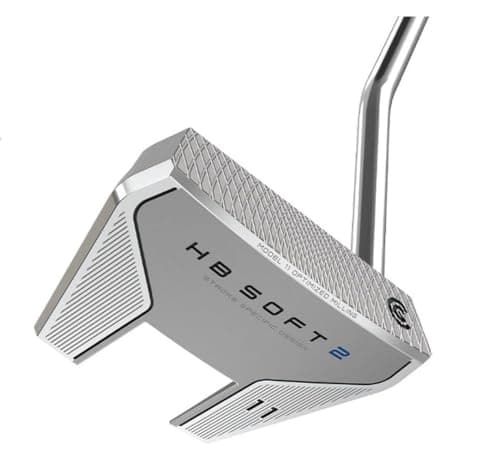
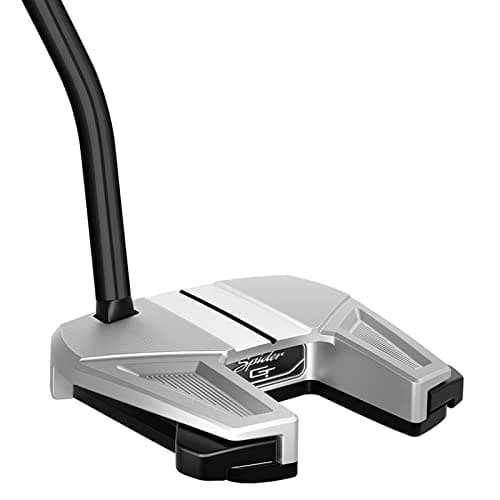
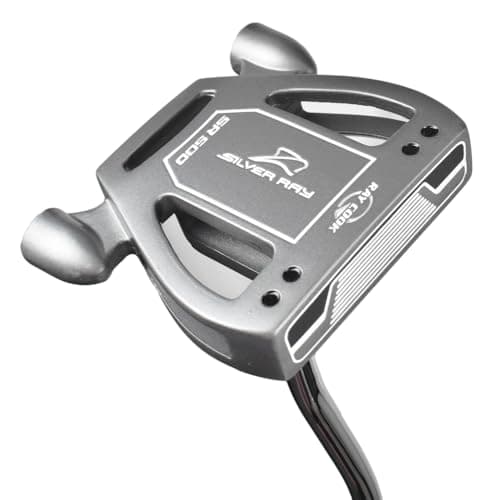
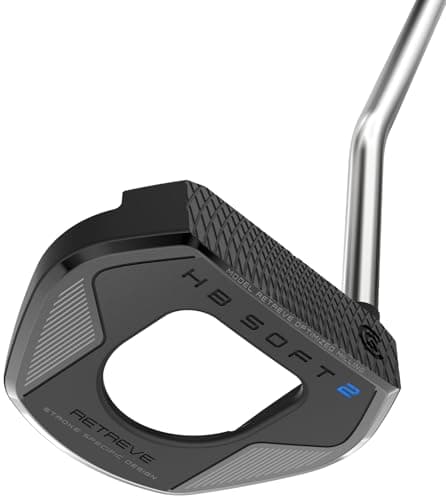
The putter is the one club in the bag where a slower swing is irrelevant — and the one where everything else about getting older matters more. Eyes that struggle to aim, hands that ache after a few holes, a back that grumbles every time you bend to the cup: those are putting problems, and the right putter answers all three. Our pick for most senior golfers is the Cleveland HB Soft 2 Retreve, a genuinely forgiving mallet with an oversize grip fitted as standard that also lifts the ball out of the hole so you never have to stoop for it. If you bend fine and want the same head for less, buy the Cleveland HB Soft 2 Model 11. If your stroke wanders and you want the club to hide it, the TaylorMade Spider GT Max is the most stable head here.
What we ranked on, before any product
Almost every “best putter” list ranks feel and looks, because that is what a good player buys on. That is the wrong list for a golfer past sixty, whose scorecard is being decided by three holes a round where a short putt slid by. Four things decide whether a putter actually helps, and we applied them in this order:
- How much does it forgive? A wide, deep, perimeter-weighted mallet head resists twisting when you catch the ball off the toe or heel, so a slightly missed strike still ends up near the hole rather than four feet short. A blade punishes the same strike. Mishits do not decrease with age.
- Can you aim it?Aim is the quiet killer. Most amateurs aim the face further off line than their stroke ever misses it, and that gets worse as eyesight fades and depth perception goes. A clear alignment aid — a triple line, a half-ball outline, a framed channel — is worth more strokes to an older golfer than any insert.
- What does it ask of your hands? An oversize grip spreads the pressure over more of the palm so you can hold the club without squeezing, and it quiets the small wrist movements that turn a good stroke into a pulled one. The Arthritis Foundation makes the same point about grip size across golf clubs generally, and it applies double on the greens, where you hold the club longest and softest.
- What does it ask of your back? Standard putters are built for a golfer who can hinge comfortably at the hips and bend to the cup 18 times a round. If either of those hurts, the fix is a longer putter, a ball retriever, or in one case on this page both.
One thing we will not pretend: we have not rolled a putt with any of these, and we do not own a launch monitor or a stroke-analysis camera. What we do is read the published manufacturer specifications — length, head weight, loft, lie, hosel type, grip size and core — put them side by side, and reason about what an older golfer’s stroke and body actually need. Every length, hand and grip spec quoted below comes off the live retail listing for the exact putter we link to, and where a named publication has tested one we link them rather than bluff.
Two of the six picks below are the same head. That is deliberate, and it is the most useful thing on this page: the Cleveland Retreve and the Cleveland Model 11 are the same putter apart from one feature, so if that feature is not your problem you can have the identical roll for meaningfully less money. We would rather send you to the cheaper one.
Mallet or blade? For a senior it is not close
A blade putter is a small, mostly-flat head with its weight concentrated near the middle. A mallet is a bigger, deeper head that pushes weight out to the perimeter and back, away from the face. That geometry resists twisting on an off-center strike, which is the entire argument: the same mishit that costs a blade four feet of roll costs a big mallet a foot or two. Five of the six putters on this page are mallets, and that is not a coincidence.
The counter-argument for a blade is feel and shot-making on fast greens, and it is a real preference — but it is a preference for a golfer whose strike is repeatable. If you are reading a page about putters for seniors, the odds are your strike moves around a bit more than it did at forty, and the mallet is simply the club that costs you less when it does. The one honest exception: if you have putted with the same blade for thirty years and you hole your short ones, keep it. Confidence on the greens is worth more than moment of inertia.
Length: the spec that gets seniors wrong most often
Putters are sold in a narrow band — commonly 33, 34 and 35 inches — and most men default to 34 without ever checking. The right length is the one that lets your eyes sit over or just inside the ball with your arms hanging naturally and no strain in your lower back. Too short and you crouch, which is exactly the posture an aging back objects to. Too long and you stand up out of the shot and push your hands away from your body, which makes it harder to swing the putter on a repeatable path.
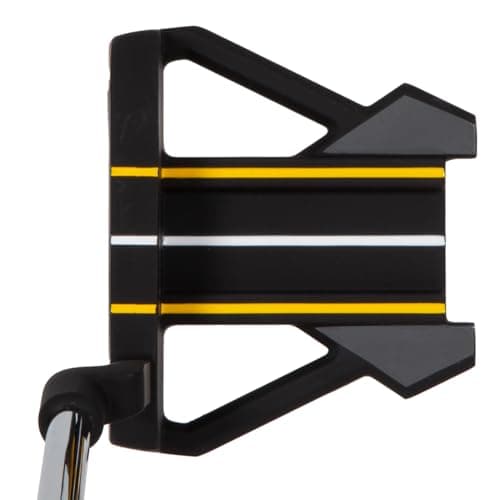
The practical test takes a minute in a shop or your garage: set up over a ball with the putter you own, and have someone check whether the sole sits flat on the ground and whether your eyes are over the ball. If the toe is up in the air, the putter is too long for your posture, or the lie angle is wrong for you. If you are hunched and your hands are jammed into your thighs, it is too short. Two of the picks above are 35-inch builds and one is 38 — buy the length that matches how you stand today, not the length you played in 1995.
Grip size: the cheapest upgrade on this page
If your hands ache, the first thing to change is not the head, it is the grip. A thicker grip spreads the load across more of the hand so you can hold the club securely without squeezing it, and it damps the small wrist flicks that push short putts offline. Both Cleveland picks above come with the brand’s oversize pistol grip — a 0.600 core, 72-gram grip — fitted as standard, which is unusual and is a genuine reason to prefer them.
The other three putters ship with standard or mid-size grips, so budget for a regrip if your hands are the problem. It is inexpensive and it is reversible, which makes it the highest-return change in golf for an arthritic hand. Our do oversize grips help arthritis guide covers the mechanism and the evidence, and best oversize golf grips ranks the ones worth fitting. If you are regripping the putter anyway, the grip size guide has the diameters manufacturers bury.
Long putters, broomsticks and what the anchoring rule really says
A longer putter is a legitimate answer to a back that will not hinge, and the 38-inch Pinemeadow above is the cheap way to try one. But the rule that governs them is widely misunderstood, so here it is plainly. Long putters are legal. Anchoring them is not.
Under Rule 10.1b, you may not make a stroke with the club, or a hand gripping the club, held directly against your body, and you may not hold a forearm against your body to create an “anchor point” that indirectly steadies the club. What you may do is hold one or both forearms against your body as long as that does not create an anchor point, and incidental contact between the club, your hand, your forearm and your clothing is fine — the rule targets deliberate anchoring. The penalty for a breach is two strokes in stroke play or loss of hole in match play. So a broomstick or a 38-inch putter used with your hands free of your chest is entirely within the rules; the same club pinned to your sternum is not.
Worth saying honestly: a long putter is a technique change, not a shortcut. If bending over a standard-length putter is genuinely uncomfortable, it can keep you putting for another decade. If your posture is fine, it is a solution looking for a problem, and most golfers who buy one on a whim go back within a season.
Bending to the hole is a real cost nobody prices in
There are eighteen holes and, for most of us, a couple of dozen bends a round once you add in teeing the ball, picking up the tee, marking a coin and lifting the ball from the cup. That is nothing at fifty and it is a genuine limiter at seventy-five, or after a hip or knee replacement. Cleveland’s Retreve exists precisely for that, and it is the reason it tops this list rather than the more expensive Spider: it is the only putter here that removes a physical barrier instead of just tolerating one.
If a ball retriever built into the putter is not for you, the same job can be done with a suction-cup pickup that screws into the butt of any grip, or by playing with a partner who does not mind. But if the reason you are considering giving up walking is the accumulation of small physical costs like this one, the same logic applies to the rest of the round — see best push carts for seniors for the equivalent fix for your back, and walking 18 holes after 70 for how the whole round adds up.
Face balance, toe hang and which one you want
Balance the shaft of a putter on your finger. If the face points at the sky, it is face balanced; if the toe droops toward the ground, it has toe hang. Face-balanced putters resist rotating open and closed, which suits a straight-back, straight-through pendulum stroke. Toe hang suits a stroke that arcs and rotates naturally. Neither is better; they match different strokes.
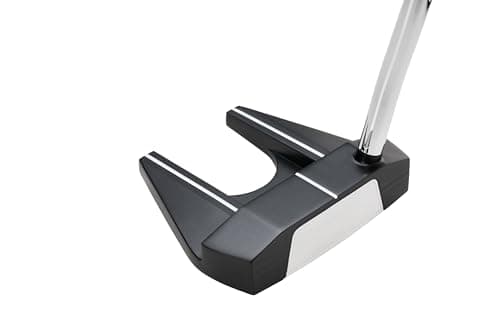
The relevance to an older golfer is that a shorter, slower, more upright stroke — which is what most seniors drift toward — tends to be the straighter of the two, and face-balanced putters suit it. Cleveland builds the HB SOFT 2 in nine shapes precisely so you can match your stroke; Odyssey states that the double bend version of the Ai-Dual is face balanced and “best suited for strokes with minimal arc and face rotation”, while the slant-hosel version is for a stroke with more rotation. The Pinemeadow, despite its length, has toe hang. Know which stroke you make before you buy, because this is the spec people ignore and then blame on the putter.
What a new putter will not fix
Distance control. Nearly every three-putt starts with a first putt left eight feet short or run eight feet past, and no head shape fixes that — it comes from practice on a real green, and from playing a ball whose feel you can read. Nor will a putter fix green reading, which is the other half of lag putting and is a skill rather than a purchase.
What a putter can genuinely buy you is aim, forgiveness on the strike, and comfort in your hands and back. Those are worth real strokes. Just be clear which problem you are paying to solve, and be suspicious of any page that tells you a putter will drop five shots off your handicap.
Who should skip a new putter entirely
If you hole your short putts and like the club in your hands, keep it and regrip it — a fatter grip on the putter you already trust is a fraction of the cost of anything on this page and may be the whole fix. And if the honest problem is that you are arriving on the green in four rather than two, the money is better spent up the bag: the best golf clubs for seniorsroundup ranks the sets that get you there in fewer — start with the swing speed & shaft flex chartso you buy the right flex — and best hybrids for seniors covers the single cheapest club upgrade in the bag. If you are replacing everything at once, the best complete sets for seniors include a putter, and for most returning golfers that boxed putter is fine for a season while you work out what you actually like.