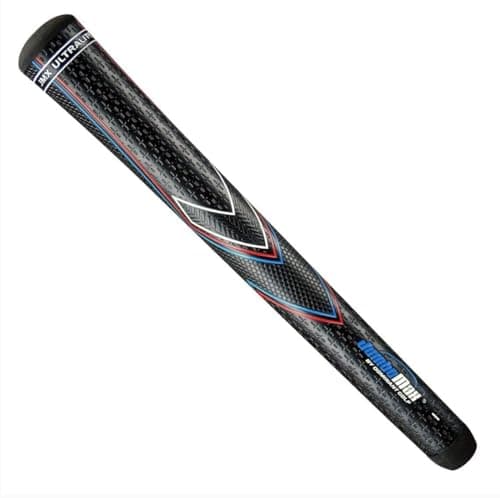
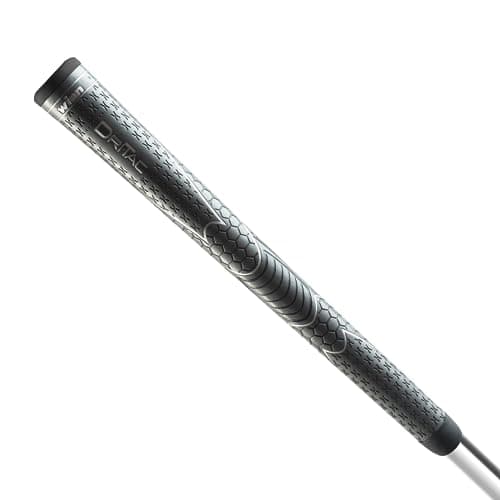
The short version: a midsize (or oversize) grip is a modest step up that eases grip pressure while keeping most of your feel, and a jumbo grip is a big step up that maximizes relief but quiets your hands the most. A mildly sore hand usually wants the smaller step; a genuinely stiff, painful, arthritic hand often wants the bigger one. Below we put a representative oversize grip (the Winn Dri-Tac Oversize) next to a true jumbo (the JumboMax JMX Ultralite) to show the choice.
Both sizes work the same way — a bigger diameter fills the hand so you don’t have to clamp down to keep the club from twisting, and less clamping is what a sore hand wants. The difference is how far each one goes, and what that costs you in feel. If you want the underlying sizing conventions first, the grip size guide lays them out; if you already know you want a soft, bigger grip and just need the ranked picks, the best grips for arthritis roundup has them. A bigger grip also pairs naturally with a lighter set, so the best clubs for seniors roundup is worth reading alongside this one.
What each does well
Midsize / oversize (about a sixteenth of an inch up): a gentler, more familiar step. It reduces grip pressure and hand fatigue while keeping enough wrist and hand action that the club still feels like a golf club. For most senior golfers with mild-to-moderate soreness, this is the right first move — the Winn Oversize is the easy default. It is also cheaper and more widely stocked, so matching a full set is simple.
Jumbo (an eighth of an inch up or more): the maximum-relief option. The very large diameter lets the stiffest, most painful hands hold on with the lightest possible grip, and it noticeably calms a shaky or overactive hand. The cost is feel: a jumbo grip deadens wrist action, which is a deliberate trade that suits some hands and not others. A lightweight build like the JumboMax Ultralite matters here, because a full set of huge grips can otherwise change how your clubs swing.
The line that decides it
Ask how much hand action you still have and want. If you can still release the club and value that feel, start with a midsize or oversize — it relieves pressure without taking your hands out of the swing. If your hands are so stiff or sore that holding the club is the problem and a quiet, stable hand would be a relief rather than a loss, jumbo earns its size. When in doubt, size up one step at a time; you can always go bigger, but an over-large grip you don’t need is harder to love.
The honest way to test it
You don’t have to guess. Regrip one club — a 7-iron is ideal — in the bigger size and play a few holes before you commit the whole bag. Grips are cheap enough and regripping is easy enoughthat a one-club trial costs almost nothing and tells you more than any chart. And remember the size on the package isn’t the whole story: adding extra wraps of tape under any grip builds it up further, so you can fine-tune between the standard steps.
Skip this
Skip jumbo entirely if you still have lively, healthy hands and no real joint pain. The size that rescues an arthritic hand will feel clumsy and disconnected in a good pair of hands, and you will lose the feel that lets you shape and control shots. For you, a soft standard or midsize grip is the ceiling — bigger is not better, it is just bigger.
How we picked this
We haven't hit this gear — and we say so
We compiled the published manufacturer specifications — shaft weight and flex, loft, grip diameter, ball compression, cart weight — did the swing-speed and compression arithmetic, cross-read the owner manuals, and scored each pick against a published rubric. The scores are judgments from documented research — they are notlab measurements we took, because we don't have a lab and we're not going to pretend we do. Where somebody has genuinely measured this, we link them. You can check every number we publish.