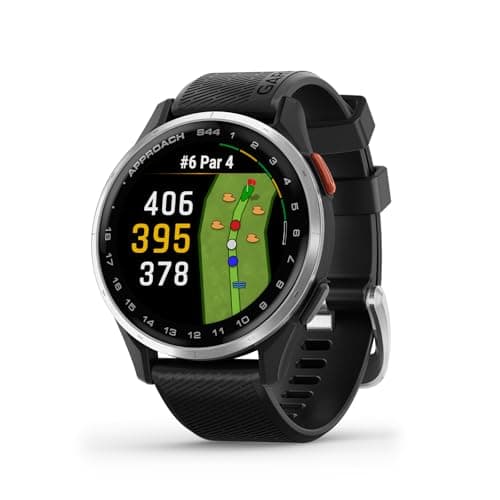
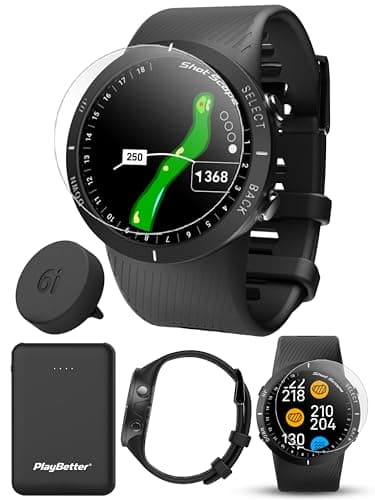
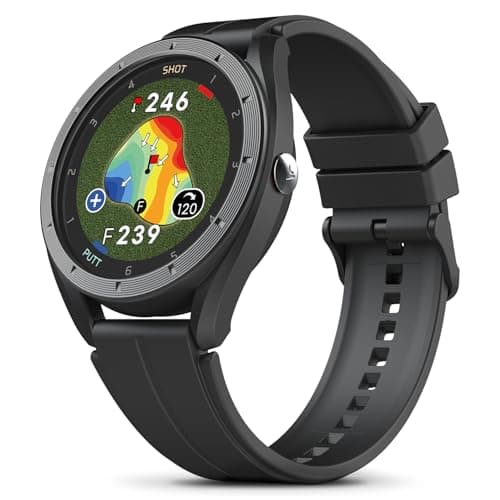
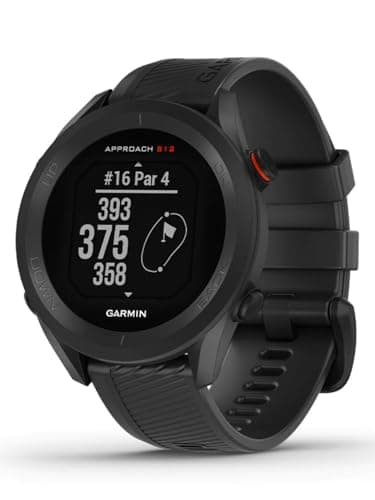
If aiming a laser is the part that frustrates you, a GPS watch is the kinder tool — and the Garmin Approach S12 is the one we’d put on your wrist. It shows big, high-contrast front, middle and back yardages the moment you look down, there’s nothing to point and nothing to hold steady, and Garmin’s course maps are free for the life of the watch with no subscription ever. The Approach S44 is the brighter, do-everything step-up; the Shot Scope V5 adds free shot tracking; and the Voice Caddie T11 LT is built around an unusually readable high-contrast face.
A GPS watch answers a different question than a laser. Instead of the exact distance to the pin, it gives you the distance to the green — front, middle and back — read from satellite positioning and a stored map of the hole. For most senior golfers that’s plenty: you rarely need the pin to the yard, and the middle-of-green number is the smart target anyway. What you gain is enormous: no aiming, no holding a device to your eye, just a glance. If you’re weighing the two honestly, our laser vs GPS guide lays it out.
We rank watches on how easily you can read the face, how simple the round setup is, battery life and value — with real weight on the “no subscription” point, because a watch that keeps charging you a yearly fee is a poor deal for occasional golf. If a small watch face is hard for you to read, don’t force it: a larger handheld GPS may suit you better, and we cover those in the easiest-to-read roundup. A good yardage device pairs naturally with forgiving clubs — knowing the number only helps if the club can deliver it.
How to choose a golf watch for older eyes
Read the face before you buy it. The whole point of a watch is the glance, so the face has to be legible to youreyes at arm’s length in bright sun. Bigger, higher- contrast numbers win. The Garmin S44 and the Voice Caddie T11 lead on readability; the S12’s simpler screen is still large and clear and is the easiest to just pick up and use.
Insist on no subscription.Some golf-GPS platforms charge a recurring fee for full course maps. For someone who plays casually, that’s money down the drain. Every watch we rank here — Garmin, Shot Scope and Voice Caddie — includes its maps free for the life of the device. That’s deliberate, and we’d steer you away from anything that doesn’t.
Buttons or touchscreen? Physical buttons are more reliable with damp hands, cold fingers or in the rain; a touchscreen is slicker but fussier in exactly those conditions. The S12 and Shot Scope use buttons; the S44 is a touchscreen. If dexterity is a concern, favor buttons.
Decide how much watch you want.The S12 is a pure, simple golf-distance watch with the longest, most worry-free battery. The S44 doubles as an everyday smartwatch with activity tracking and richer course detail. The Shot Scope quietly logs your shots for stats at no extra cost. The Voice Caddie leans hardest into a readable golf face and a green-undulation view. Match the watch to how much you’ll actually use.
Who should skip a GPS watch
Skip it if you genuinely need the exact yardage to the flag. GPS reads to the green’s front, middle and back — not to the pin, which can sit fifteen or twenty yards from center. If you have the precision in your game to use that difference and you want it, a laser is the right buy; start with our best rangefinders for seniors. Also skip a wrist watch specifically if a small watch face is simply too hard for you to read — a larger-screened handheld GPS solves that, and there’s no shame in choosing the bigger screen. For everyone else, the glance-and-go of a watch is the easiest yardage you can buy.
One honest note on the step-up: the S44’s screen and smartwatch features are lovely, but they cost battery and money the S12 doesn’t. If you only want simple yardages and the longest run time, the cheaper S12 is the smarter buy, not the fancier one.
How we picked this
We haven't hit this gear — and we say so
We compiled the published manufacturer specifications — shaft weight and flex, loft, grip diameter, ball compression, cart weight — did the swing-speed and compression arithmetic, cross-read the owner manuals, and scored each pick against a published rubric. The scores are judgments from documented research — they are notlab measurements we took, because we don't have a lab and we're not going to pretend we do. Where somebody has genuinely measured this, we link them. You can check every number we publish.