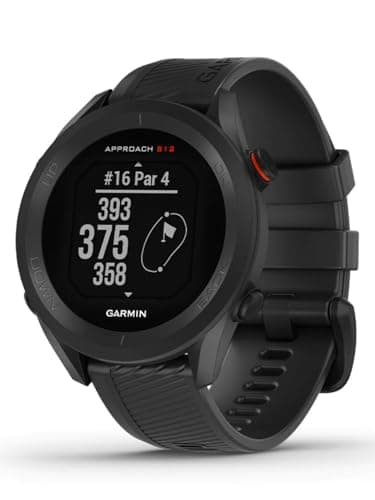
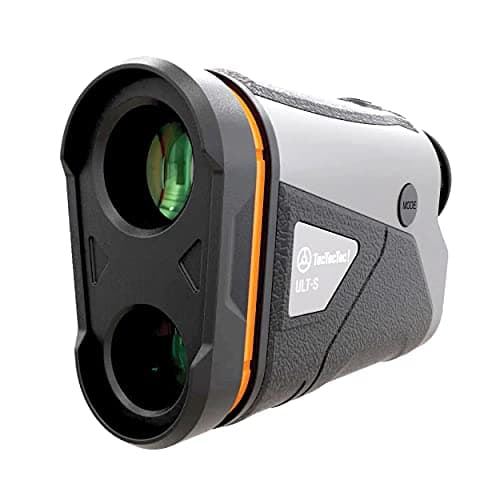
The short version: a laser gives you the exact distance to the pin but you have to aim it, while a GPS watch gives you the distance to the green with nothing to aim at all. For a golfer with sharp eyes and steady hands, the laser’s precision usually wins. For a lot of senior golfers, the watch wins precisely because there’s nothing to hold steady and nothing to point. To make the choice concrete we put a representative laser — the image-stabilized TecTecTec ULT-S — next to a representative GPS watch, the Garmin Approach S12.
A laser works by bouncing a beam off whatever you point it at and timing the return, so it measures the exact thing in your crosshair — the flag, a bunker lip, a tree. That precision is its whole appeal, and the cost is that you must raise the device to your eye, aim a narrow beam at a thin flagstick, and hold it steady enough to lock on. A GPS watch instead reads your position from satellites and looks up a stored map of the hole, then shows the distance to the front, middle and back of the green. No aiming, no holding — just a glance at your wrist. The catch is that it reads to the green, not the exact pin, which can sit fifteen or twenty yards from center.
For our reader, the deciding factor is usually the hands and eyes, not the yardage math. If a small tremor makes aiming a fight, or you simply dislike fussing with a device, the watch removes the hard part entirely. If you have the steadiness and you want the pin to the yard, the laser rewards you — and image stabilization, as on the ULT-S, makes it far more forgiving to hold. Below we lay out what each does well and who each suits, then point you to the full rangefinder and golf watchrankings. Whichever you pick, it only helps if you’ve got clubs that can hit the number.
The short answer
Quick picks
| # | Product | Best for | Score | Price |
|---|
| 01 | TecTecTec ULT-S (Stabilized)The pick for a hand that isn't quite steady anymore. Image stabilization holds the view still so you can actually settle the crosshair on a distant flag — at a value price. | Shaky or unsteady hands | | $119.99·Amazon |
| 02 | Garmin Approach S12 GPS WatchThe no-aiming answer. A big, high-contrast display shows front/middle/back yardages at a glance — no laser to point, no menus, and no subscription fee ever. | Glance-and-go, no aiming | | $199.99·Amazon |
#ad · Live prices from the Amazon Product API, as of Sep 6, 2026. Where we have no verified live price, we show none — we would rather leave a gap than print a number that has rotted.
In detail
The picks, in full
Shaky or unsteady hands
TecTecTec ULT-S (Stabilized)
Image stabilizationSlope on/offFast flag lockValue price
The pick for a hand that isn't quite steady anymore. Image stabilization holds the view still so you can actually settle the crosshair on a distant flag — at a value price.
- Ease of reading
- 9
- Accuracy
- 8
- Ease of use
- 8
- Value
- 9
Pros
- +Stabilization steadies a wobbling view — the single biggest help for a less-than-steady hand
- +Locks onto the flag quickly with a confirming pulse
- +Slope can be switched off to stay tournament-legal
Cons
- −A laser still needs pointing, which some players find fiddlier than a glance at a watch
- −Not the premium optics of a Bushnell
Skip this if…
…you'd rather glance at a wrist than aim a device. If holding and aiming a laser is the struggle, a GPS watch shows the number with no aiming at all.
Glance-and-go, no aiming
Garmin Approach S12 GPS Watch
GPS watchLarge clear numbersNo subscriptionLong battery
The no-aiming answer. A big, high-contrast display shows front/middle/back yardages at a glance — no laser to point, no menus, and no subscription fee ever.
- Ease of reading
- 9
- Accuracy
- 7
- Ease of use
- 10
- Value
- 8
Pros
- +Just look at your wrist for the yardage — no aiming a device at a flag
- +A large, high-contrast readout that's easy on the eyes
- +No subscription: Garmin's course maps are free for the life of the watch
Cons
- −GPS gives you distance to the green, not the exact pin like a laser
- −It's a distance device, not a full smartwatch
Skip this if…
…you want the precise yardage to the flag itself. GPS reads to the green's front/middle/back; only a laser ranges the actual pin — pick a laser if that precision matters to you.
What each does well
Laser (e.g. TecTecTec ULT-S): the exact distance to the pin or any target you choose; precise; no reliance on a stored course map, so it works anywhere including a range. The cost is that you have to aim and hold it, which asks steadier hands and sharper eyes — mitigated, but not erased, by image stabilization.
GPS watch (e.g. Garmin Approach S12): the yardage with zero aiming, read at a glance; a large, high-contrast display; typically simpler to operate; often extra info like layups and hazards. The cost is distance-to-green rather than the exact pin, and it depends on the course being mapped.
The line that decides it
Ask yourself one honest question: is aiming and holding a device a problem for me?If yes — because of an unsteady hand, less-sharp eyes, or simple dislike of the fuss — the GPS watch is the right tool, and the small loss of pin precision is well worth the ease. If no, and you value knowing the pin to the yard, the laser is the more precise instrument. Neither is “better” in the abstract; they’re better for different players. If your hand is the issue specifically, read steadying the read for shaky hands before you decide.
You can also want both
Plenty of golfers carry a watch for the quick glance and reach for a laser only when the pin position really matters. It’s not an either/or purchase for life. But if you’re buying one, buy the one that removes your biggest obstacle — ease of use for most seniors, precision for the steady-handed player who wants it.
Who should skip which
Skip the laserif aiming is itself the struggle; a stabilized laser helps a wobble but can’t help a hand that can’t comfortably raise and hold a device — get a watch instead. Skip the GPS watch if you genuinely need the exact flag distance and have the game to use it, or if a small watch face is hard to read — in which case a laser, or a larger handheld GPS from our easiest-to-read list, serves you better.
How we picked this
We haven't hit this gear — and we say so
We compiled the published manufacturer specifications — shaft weight and flex, loft, grip diameter, ball compression, cart weight — did the swing-speed and compression arithmetic, cross-read the owner manuals, and scored each pick against a published rubric. The scores are judgments from documented research — they are notlab measurements we took, because we don't have a lab and we're not going to pretend we do. Where somebody has genuinely measured this, we link them. You can check every number we publish.
Questions
Frequently asked
Is a laser or GPS rangefinder better for seniors?+
If aiming and holding a device is easy for you and you want the exact pin, a laser. If aiming is a struggle or you dislike the fuss, a GPS watch shows the yardage with no aiming at all — the kinder tool for many older golfers.
Is a GPS watch as accurate as a laser?+
Not to the exact pin. A laser measures the precise target you aim at; a GPS watch reads to the front, middle and back of the green. For most players the middle-of-green number is target enough, but a laser is the more precise instrument.
Can I use both a laser and a GPS watch?+
Yes, and many golfers do — a watch for the quick glance and a laser when the pin position matters. If you’re only buying one, choose the one that removes your biggest obstacle.
Receipts
Sources
We do not run a testing lab, and we do not pretend to. Every spec number here comes from a manufacturer's published sheet or an official standard, cited above. Where we could not verify something, we say so on the page rather than quietly leaving it out. Read our full method.