If your hands aren’t as steady as they were, you already know the moment: you raise the laser, point it at a distant flag, and the view jitters just enough that the crosshair keeps sliding off. You re-aim, it slides again, and three attempts later you finally lock a number. The good news is that this exact problem has two clean solutions — image stabilization on a laser, and a GPS watch that asks you to aim nothing at all. Neither is a gimmick, and one of them will very likely fix your frustration for good.
Why an unsteady hand makes a laser hard
A laser rangefinder magnifies the view so you can see a faraway flag — but magnification enlarges the shake right along with the flag. A tiny tremor in your hand, invisible when you look at your hand directly, becomes a visible bounce once it’s magnified several times through the eyepiece. On top of that, a flagstick is a thin target, and the laser only reads what’s in the crosshair at the instant you fire. So a hand that wanders even slightly makes you miss the pin and catch the trees behind it, or read nothing at all. It isn’t you doing it wrong; it’s physics working against a moving hand.
What image stabilization does
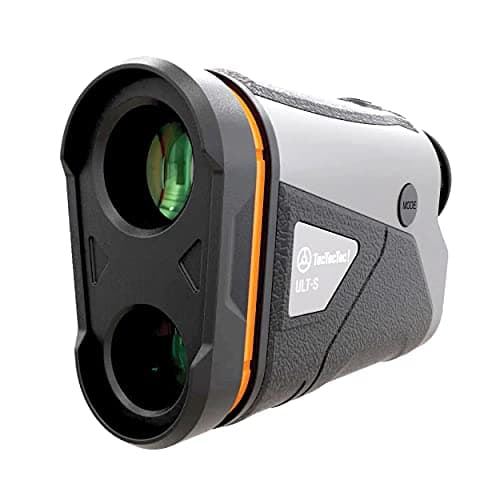
Image stabilization is the same idea used in binoculars and camera lenses: the device senses the small movements of your hand and shifts an internal element to counteract them, so the picture you see holds still even though the body of the unit is moving. Look through a stabilized rangefinder and the flag simply sits there, calm, while your hand does its usual thing. That steadiness does two useful jobs at once — it makes the flag far easier to settle the crosshair on, and it makes the lock more reliable, because the beam stays on target long enough to catch it. Of everything in this category, it is the single most helpful feature for a less-than-steady hand, which is why the image-stabilized TecTecTec ULT-S tops our rangefinder roundup. Stabilization won’t turn a big tremor into a rock-steady hold, but it calms an ordinary wobble enough that aiming stops being a fight.
The other answer: don’t aim at all
There’s a more complete fix for the aiming problem, and it’s to remove the aiming entirely. A GPS watchreads your position from satellites and shows the distance to the front, middle and back of the green the instant you glance at your wrist. There is nothing to point, nothing to hold to your eye, and nothing to lock on — so a shaky hand has no bearing on it whatsoever. You give up the exact pin distance in exchange (GPS reads to the green, not the flag), but if holding a device steady is your core struggle, that trade is usually the right one. For many golfers with an unsteady hand, the watch isn’t a compromise; it’s simply the better tool. Our laser vs GPS guide compares the two head to head.
Small things that steady the read
Whichever device you use, a few practical habits make the yardage easier to get:
- Brace the device. With a laser, rest your elbows on your chest, or steady your hands against a cart post, a bag or even the flag of your own club. A braced hand shakes far less than one held out in the air.
- Use a magnetic mount.Several lasers and handhelds have a built-in magnet that sticks them to the cart frame, so the device is held for you and always within reach — no fishing in a pocket with fingers that don’t want to cooperate.
- Aim at the whole flag, not the pinpoint. Sweep the crosshair up the flagstick rather than trying to freeze it on one spot; the device catches the pin as you pass over it, which is far more forgiving of a moving hand.
- Prefer big buttons. A device you operate with large physical buttons is easier for less-dexterous fingers than a small touchscreen — and it still works with damp or cold hands.
Laser or watch, for a shaky hand?
Here’s the honest split. If your hand has a mild-to-moderate wobble but you can comfortably raise and hold a device to your eye, a stabilized laser like the ULT-S gives you the best of both worlds: the steadiness that fixes the wobble, plus the exact pin distance. If raising and holding a device is itself the hard part — if the tremor is pronounced, or your shoulder or grip won’t cooperate — skip lasers altogether and get a GPS watch, because glancing at your wrist asks nothing of your hands at all. There is no pride to be lost here; the right device is the one that gives you a confident number without a fight.
Finally, if a shaky or aching hand also makes holding the club harder, the device is only half the fix — the right arthritis-friendly grips address the other half, and the two together make a real difference to how the round feels.
This isn’t medical advice. If tremor or hand pain is affecting how you play, talk to your doctor or physical therapist before changing your equipment or your game.