A golf rangefinder is built to lock onto the nearest thing in the crosshair — the flag. A hunting rangefinder is built to ignore the nearest thing and read what is behind it. That single design choice, called target priority, is the whole difference. Everything else — range, magnification, slope — follows from it. You can use a golf laser to range a deer in a pinch. Using a hunting laser on a golf course means fighting the software every time there is a tree behind the pin, which on most courses is every time.
Target priority: the one that matters
A laser rangefinder fires a pulse and gets back several reflections: the flagstick, the trees behind it, the slope beyond that. The unit has to decide which reflection to report. A golf rangefinder uses first-target priority — Scheels’ comparison of the two categories describes it as the “pin-locking feature” — and reports the nearest return, which is the thin flagstick you are aiming at. A hunting rangefinder uses last-target or distant-target priority, which Scheels describes as built to “target game behind vegetation.” It deliberately throws away the branch in front and reports the animal behind it. Point that at a flag with trees behind and it throws away the flag.
For a senior golfer that matters more than for anyone, because the way you compensate for the wrong target priority is by holding the unit rock-steady on a thin stick 150 yards away and reading which of two or three flickering numbers is the pin. An older eye and a less-than-steady hand are precisely the things that make that hard. It is the reason image stabilization exists on golf lasers and the reason our guide to rangefinders for shaky hands exists.
The other differences, in order of how much they matter
Range. Scheels puts golf rangefinders at 400 to 600 yards and hunting units beyond 1,500. A golf laser does not need more; the longest hole you will ever range is under 600 yards, and most of the time you are ranging inside 200. The extra range on a hunting unit costs money and buys nothing on a course.
Magnification. Golf units are typically 6x; hunting units run 6x and up. More magnification sounds better for an older eye until you try to find a flag through it: a narrower field of view and more magnified hand shake make the pin harder to acquire, not easier. This is why our easy-to-read rangefinders ranking weights display brightness and lock confirmation over magnification.
Slope and the rules. Both categories compensate for elevation, and Scheels notes that the golf version is “easily toggled on and off.” That toggle is a rules feature. Rule 4.3a(1) of the Rules of Golf allows a device that gives “information on distance or direction,” but the equipment must not “measure elevation changes” or “interpret distance or directional information” during a round, and the R&A adds that a Committee may adopt a Local Rule prohibiting distance-measuring devices altogether. A golf laser with a slope switch can be turned legal; a hunting laser with permanent angle compensation cannot. Slope explained covers when you actually want it on.
Durability. Scheels rates hunting units as often waterproof and fogproof against golf units that are water-resistant. This is the one category where the hunting unit is genuinely better built, and for a golfer who plays in rain it is worth checking the water rating on whichever golf laser you buy.
Can you use one for both?
Golf for hunting: yes, with limits. Scheels says a golf rangefinder will work when hunting but “won’t be as accurate,” because first-target priority will read the branch in front of the deer. Hunting for golf: Scheels says it is “not recommended,” and we agree, for the target-priority reason above. Some newer units can switch between first- and distant-target modes, which in principle does both jobs; in practice a golfer who has to remember to switch modes on the first tee has bought a complication, not a bargain. If you only ever hunt open ground and only ever play open courses, one unit might serve. Most people do neither.
What to buy for the golf course
A golf laser with first-target priority, a clear lock confirmation, a slope switch you can see, and — if your hand is less steady than it was — image stabilization. The three below are the ones we rank that get those things right at a value price; if you would rather not aim at all, a GPS watch removes the whole question, and laser vs GPS settles which suits you.
The three golf lasers, and who each suits
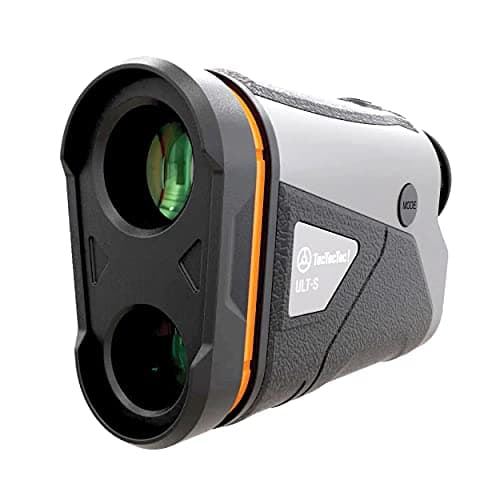
The TecTecTec ULT-S is the pick for a hand that is not quite steady anymore. Image stabilization holds the view still so the crosshair can settle on a distant flag, the unit pulses when it locks, and the slope function switches off to stay legal. It is the top pick on best rangefinders for seniors.
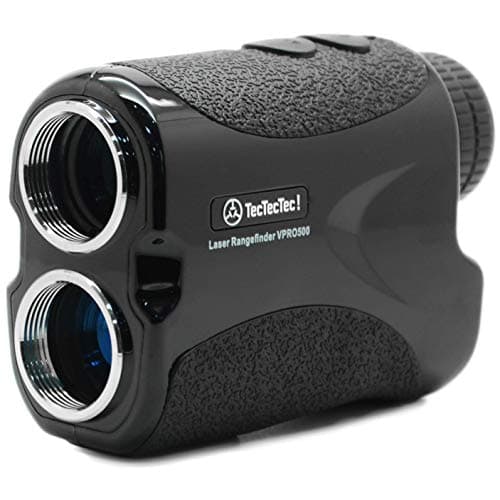
The TecTecTec VPRO500 is the value laser that got a generation of golfers into rangefinders: simple, light, accurate and now cheap enough to be a no-brainer first laser. No stabilization, which is the trade. It leads our best budget golf rangefinders list.
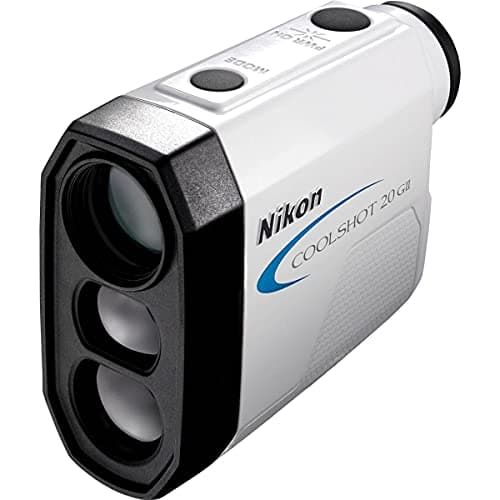
The Nikon Coolshot 20 GII is the one to buy for glass. Nikon’s optics make the flag brighter and clearer through the eyepiece than any budget laser, it is tiny and light, and it has no slope function at all, which keeps it permanently tournament-legal. We put it against the ULT-S in Nikon Coolshot 20 vs TecTecTec ULT-S.
Skip this
Skip “golf and hunting” dual-mode units unless you will genuinely use both. You pay for range and magnification a golfer never uses and get a mode switch to forget. A dedicated golf laser is cheaper and simpler.
Skip any laser whose listing will not say which target priority it uses. “Pin seeker,” “flag lock” and “first target” all mean the golf kind. If the listing talks about ranging through brush, it is the hunting kind, whatever the picture shows.