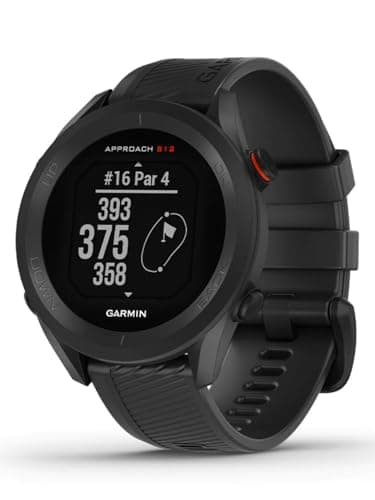
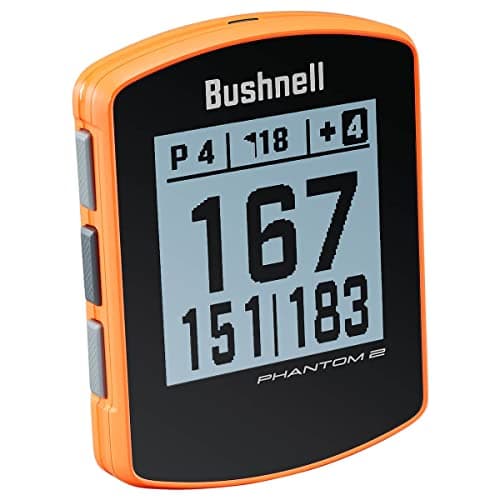
If reading the number is the problem, buy the handheld. The Bushnell Phantom 2has the largest, highest-contrast screen in this category, big physical buttons instead of a small touchscreen, and a magnet that sticks it to the cart frame within reach. If you would rather not carry anything extra, the Garmin Approach S12 puts the same yardage on your wrist and you will never leave it in the cart — which is the most common way a handheld goes missing.
Both device types read the same satellites and give you the same thing: distance to the front, middle and back of the green, not to the pin. The choice between them is not about accuracy. It is about what you can see, what you can press, and what you will still have with you on the closing holes.
The two kinds, side by side
Four devices, two of each type. Every specification is from the manufacturer listing for the model we link to; the judgments about which ones matter to an older golfer are ours, and the rubric behind them is published at how we pick.
| Device | Type | Display | Controls | Where it lives | Subscription |
|---|
| Bushnell Phantom 2 | Handheld | Large color screen, highest contrast here | Big physical buttons | Magnet on the cart, or a pocket | None |
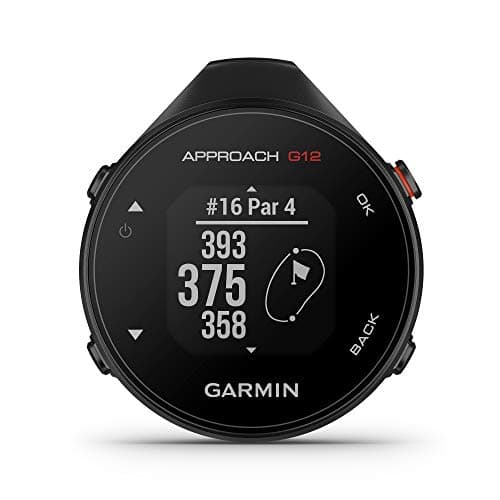
| Garmin Approach G12 | Clip-on handheld | Clear, simple screen | Buttons | Clips to a belt, pocket or bag | None |
| Garmin Approach S12 | Watch | Large, high-contrast readout | Buttons | On your wrist | None |
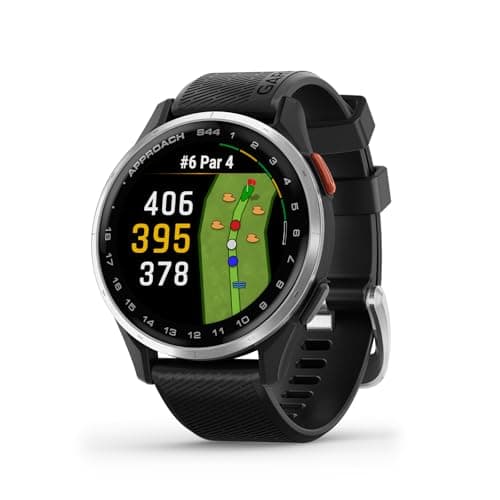
| Garmin Approach S44 | Watch | Bigger, brighter color screen | Touchscreen | On your wrist | None |
The case for the handheld
Screen size is the whole argument, and it is a good one.A watch face has to fit a yardage, a hole number and a battery indicator into an inch and a half. A handheld has several times the area for the same information. If you have found yourself holding your wrist at arm’s length and squinting, that is not a problem a better watch solves — it is a problem a bigger screen solves. The Phantom 2 is the clearest of the lot and we score it 10 out of 10 for readability for exactly that reason.
Buttons beat a touchscreen in the rain and the cold.A wet touchscreen is unreliable; a wet button is a button. This matters more with age than people expect, because drier, less sensitive fingertips register worse on a capacitive screen even on a dry day. It is also the honest knock against the S44 in this group: Garmin’s step-up watch has the better screen of the two watches and the worse controls.
You do not have to wear it. Plenty of golfers simply do not want a watch, particularly if they already wear one they like. The Garmin G12 is the answer to that specifically: a tiny clip-on unit that lives on a belt, a pocket or a bag strap.
The case for the watch
It is on you, so it is with you.The great failure mode of a handheld is that it is in the cart, or the bag, or the pocket of the jacket you took off on the 4th. A watch needs no retrieval and no decision — you look down, you have the number, you play the shot. Over eighteen holes that saves a surprising amount of faff, and it speeds up play for everyone behind you.
No hands required. If arthritis makes gripping and unclipping a device awkward, a glance at a wrist beats retrieving anything from anywhere. The same reasoning sits behind our guide to rangefinder stability with shaky hands, which is the laser version of this problem.
And a watch can do more than yardages.The S44 shows hazards and layup distances rather than only the green, and doubles as an everyday activity watch. That is worth money to some people and nothing at all to others — if it is nothing to you, the S12 does the core job for less and with longer battery life. The wider ranking is in best golf watches.
What neither of them does
Both give you distance to the green, not to the pin. A laser rangefinder is the device that measures the flag itself, and if that precision is what you want, GPS of any shape is the wrong purchase. We set the two technologies against each other in laser vs GPS. The short version: a laser is more precise and needs steadier hands, while GPS gives you a number without aiming at anything. For a lot of senior golfers that second property is worth more than the precision — which is why the GPS units sit so high in best rangefinders for seniors.
Neither carries a subscription. Every device on this page uses free course maps for the life of the unit, which is worth confirming because some competing products do charge.
How to choose in one minute
| If this is you | Buy |
|---|
| You squint at your phone and your wristwatch | Bushnell Phantom 2 |
| You will not wear a watch, but want a pocket device | Garmin Approach G12 |
| You want the number without reaching for anything | Garmin Approach S12 |
| You want hazards and layups, and will wear it off the course | Garmin Approach S44 |
| You want the exact distance to the flag | A laser - see laser vs GPS |
If you are not sure a distance device earns its place at all, start at do you need a rangefinder? That is the honest version of the question, including the case for buying nothing. And if budget is the constraint, the cheapest honest options are in best budget golf rangefinders.