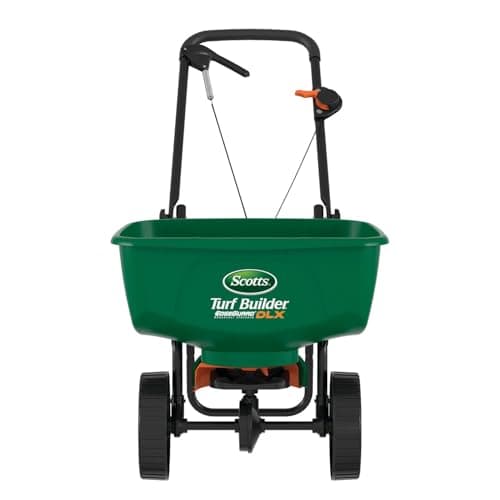
Buy a broadcast spreader. For nearly every homeowner that is the right answer, and the reason is pass count: a broadcast spreader throws product in an arc several feet wide, so it covers a lawn in roughly a third of the walking a drop spreader needs. Our pick is the Scotts Turf Builder EdgeGuard DLX, which adds the one feature that fixes the broadcast pattern's real weakness — a shield that blocks the right-hand side of the arc so you are not throwing fertilizer into beds and onto the driveway.
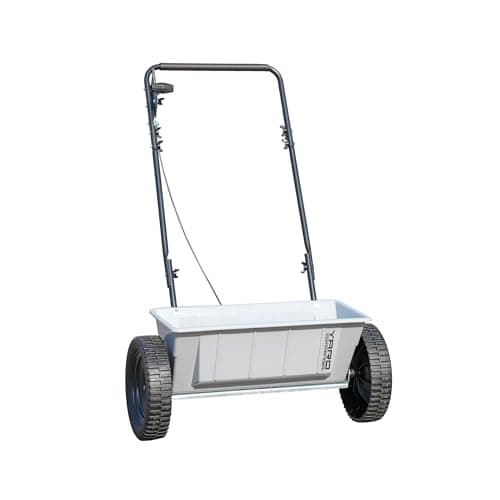
Buy a drop spreaderif your lawn is small and surrounded by things you must not get product on: a gravel path, a vegetable bed, a pond, a neighbor's drive. A drop spreader releases product straight down between its wheels, so it lands exactly where the machine has been and nowhere else. The Yard Commander 60 lb push drop spreader is the sensible homeowner version.
That is the whole decision and it comes down to one trade: accuracy against pass count. Everything below is the detail behind it.
How each pattern works
A broadcast (or rotary) spreader drops product onto a spinning disc that flings it outward in an arc, typically 6 to 10 feet wide depending on the setting and the product. You walk at a steady pace, overlap the arcs, and a lawn is done quickly.
A dropspreader opens a slot in the bottom of the hopper and lets product fall between the wheels. The spread width is the width of the machine — typically 18 to 24 inches on a push model — so the pattern is exactly as wide as the hopper and perfectly defined at both edges.
We have spread with neither on a test lawn. Everything here reads published hopper capacities, stated coverage figures and spread mechanisms — see how we pick. Prices are live from the price layer with an “as of” date beside each spreader.
Broadcast vs drop: head to head
| Broadcast spreader | Drop spreader |
|---|
| Spread width | Roughly 6-10 ft arc | Width of the hopper, 18-24 in |
| Passes for 5,000 sq ft | Few — fastest option | Two to three times as many |
| Placement accuracy | Needs an edge guard | Exact, by design |
| Striping risk | From uneven overlap | From a missed overlap |
| Near beds and paths | Throws product in unless shielded | Nothing lands outside the wheels |
| Seed, lime, ice melt | All three, quickly | All three, slowly and precisely |
| Best lawn | Open, over about 2,000 sq ft | Small, bordered, awkward |
Spread widths, hopper capacities and coverage figures above are what the listings publish. Prices are live with an “as of” date beside each spreader.
The case for a broadcast spreader
Speed, and the fact that speed changes behavior. A spreader that covers a lawn in ten minutes gets used four times a year. One that takes forty minutes gets used twice, and a lawn fed twice a year instead of four times is visibly thinner. The practical argument for broadcast is not just that it is quicker; it is that you will actually do the job.
Forgiveness on overlap. A broadcast arc tapers at its edges, so adjacent passes blend. Get the overlap slightly wrong and you get a gradient rather than a stripe. That is a real advantage for anyone who is not walking a grid.
It handles every product. Granular fertilizer, grass seed, lime and ice melt all broadcast well. Our broadcast spreader roundup ranks the machines themselves, and the aerate-and-seed page explains why broadcast is the right choice for overseeding in particular.
Edge control solves the main objection. The EdgeGuard mechanism on the Scotts spreaders blocks the right half of the pattern, so you can walk a bed or a path with the shield engaged and throw nothing into it. Without that feature, a broadcast spreader near a driveway wastes product and stains concrete.
The case for a drop spreader
Absolute placement. Nothing lands outside the wheel track. If you are spreading weed and feed next to a vegetable garden, or iron next to a concrete path it would stain, or fertilizer beside a pond, that certainty is worth the extra passes.
No waste into beds. On a small lawn with a lot of border, a broadcast spreader can throw a meaningful share of an expensive bag where it does nothing. A drop spreader does not.
Small awkward lawns.A courtyard lawn, a strip between a path and a fence, a lawn in three sections — the pass count penalty is small when the lawn is small, and the accuracy is worth a lot.
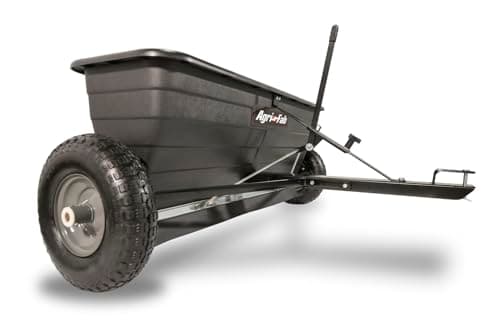
It is the professional choice for exact rates where overlap error cannot be tolerated, which is why tow-behind drop spreaders exist for acreage work.
Striping: both patterns do it, for opposite reasons
Stripes — alternating dark green and pale bands across a lawn a fortnight after feeding — are the classic spreader mistake, and the cause differs.
With a broadcast spreader, stripes come from uneven overlap or a changing walking pace. The fix is to walk a consistent speed, overlap the arcs by about a quarter, and do the perimeter first so you are always turning on treated ground.
With a drop spreader, stripes come from missed overlap, and they are much sharper because the pattern has hard edges. Each pass must just touch the last wheel track. Half an inch of gap on every pass gives you a pale line you will look at all summer. The standard professional answer is to spread at half rate in two passes at right angles, which cancels any gap.
Calibration matters more than which type you bought
Both types are useless uncalibrated, and this is where most lawns actually go wrong. The number on the bag is a rate per 1,000 square feet; the number on the spreader dial is a setting, and the two are only connected if the bag names your spreader.
Measure your lawn, weigh out the amount the bag says that area needs, and spread exactly that much. If you finish early you set the dial too high; if you have product left you set it too low. Adjust and remember the setting. Doing this once is the difference between feeding a lawn and guessing at it — the arithmetic for fertilizer is in the fertilizer roundup, and the timing is in our fertilizer schedule.
The verdict: who should buy which
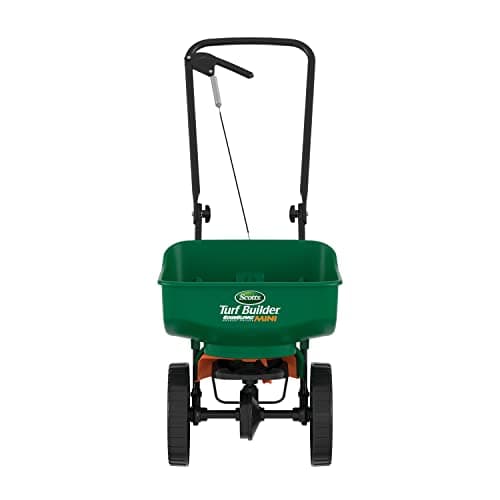
Buy a broadcast spreader with edge control if your lawn is over about 2,000 square feet, or is reasonably open, or you want one spreader for fertilizer, seed, lime and ice melt. That is most homeowners, and the EdgeGuard DLX is the pick. On a small lawn the EdgeGuard Mini does the same job for less.
Buy a drop spreader if your lawn is small and heavily bordered, if you are spreading something that must not touch a path, a pond or a vegetable bed, or if you are applying a weed and feed next to plants you care about. The Yard Commander push model is the homeowner version; the Agri-Fab tow-behind is the one for acreage, where its 42-inch width removes the pass-count penalty entirely.
Buy bothonly if you have a large lawn with precise borders — broadcast for the open middle, drop for the edges. That is a real approach and it is how a groundskeeper would do it, but for one suburban lawn it is a spreader too many.