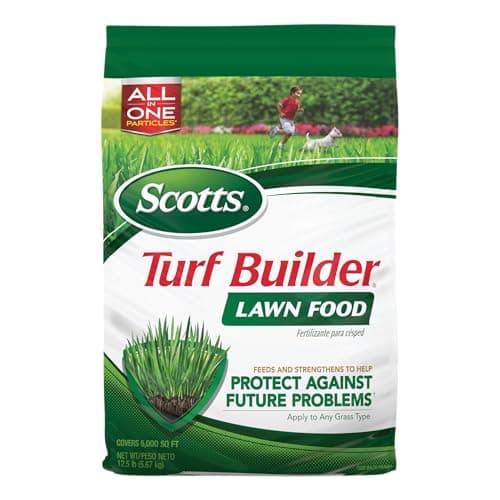
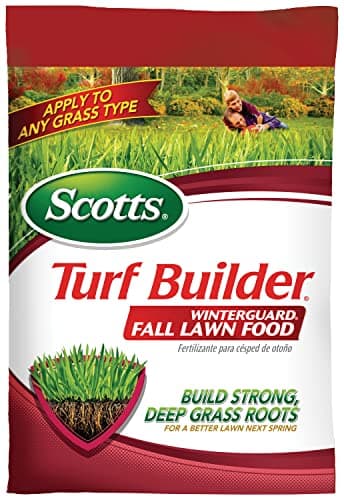
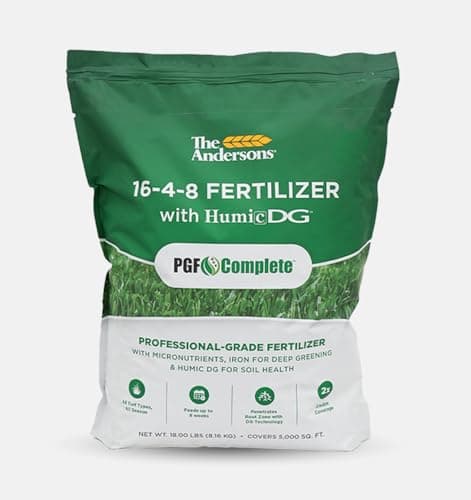
The best lawn fertilizer is The Andersons PGF Complete 16-4-8: the analysis most established cool-season lawns actually want, on a very fine particle that spreads evenly and waters in rather than sitting on the surface. If you feed once a year and do not want to think about it, Scotts Turf Builder Lawn Food is the value pick and perfectly adequate. If you want the most agronomically valuable single application of the year, buy Scotts WinterGuard Fall Lawn Food and spread it in September.
Fertilizer is sold on brand and bought on hope, and the only facts that matter are printed on every bag: the NPK analysis and the square footage it covers. From those two numbers you can work out exactly how much nitrogen you are putting down and what it costs you, which is the whole basis of this ranking. We publish both for every product.
We do not test soil, we do not run plots, and we are not going to imply that we do. What we do is read the published labels, do the pounds-of-nitrogen-per-thousand arithmetic, and rank on what the analysis and the particle size support — see how we pick. For your own lawn, a soil test from your state extension service is worth more than any ranking, including this one, because it tells you what your soil is actually short of.
How to choose a lawn fertilizer
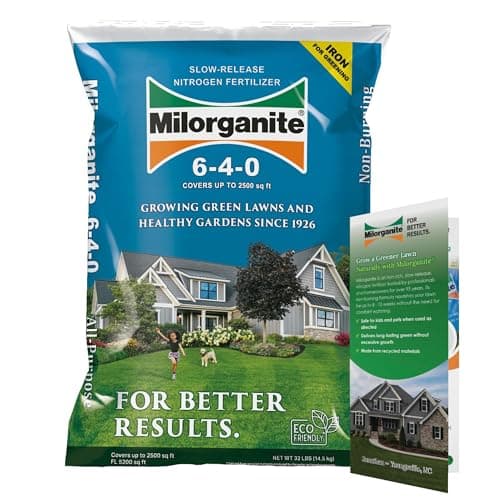
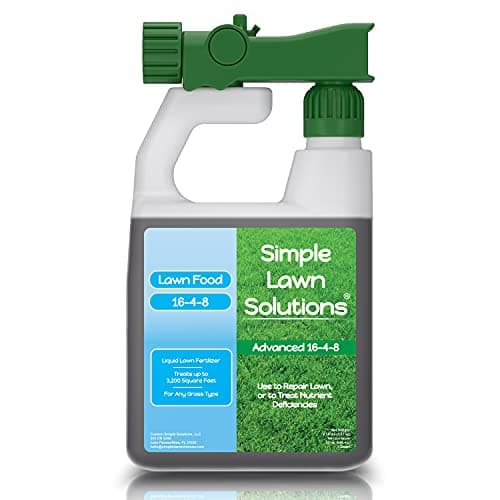
Read the NPK and do one division. The target for a single feed is roughly one pound of actual nitrogen per 1,000 square feet. Divide 100 by the first number to get the pounds of product you need: a 16-4-8 needs about 6.25 lb per 1,000 sq ft, a 6-4-0 like Milorganite needs about 16.7 lb for the same nitrogen. That single calculation is how you compare bags honestly, and it is worked through in how much fertilizer do I need.
Particle size is the underrated spec.Small prills land more densely per square inch, which means a more even distribution and an even green rather than a mottled one. It is the main reason the Andersons product tops this list over nominally similar analyses — and the main reason it needs a properly calibrated spreader to be worth buying.
Slow-release is about forgiveness. A fast-release nitrogen source gives you colour in days and can burn the lawn if you double-pass a strip. Slow-release organic nitrogen like Milorganite releases with soil temperature over weeks and will not scorch even if you overlap heavily. If you spread by eye rather than by calibration, that forgiveness is worth more than analysis precision.
Liquid for speed, granular for duration. A liquid 16-4-8 is taken up through the leaf as well as the root, so colour responds in days rather than weeks. It also fades faster and covers much less ground per dollar. Liquid is a little-and-often method; granular is set-and-forget.
Match phosphorus to the job, and check local rules. New seedlings want phosphorus for root development, which is what a starter fertilizer is for. Established turf rarely needs added phosphorus, and several states and municipalities restrict phosphorus lawn fertilizer precisely because of the runoff problem the EPA documents. Check before you buy a high-phosphorus bag.
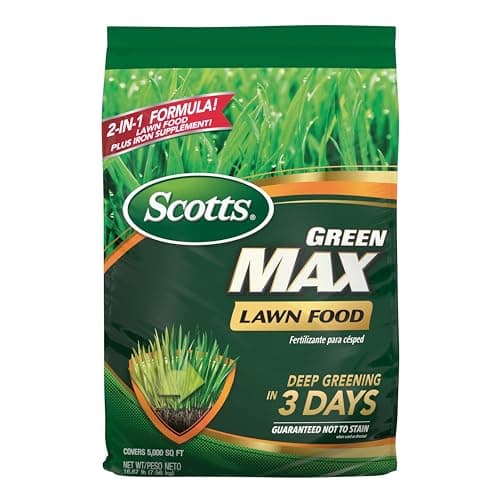
Iron is for colour, nitrogen is for growth. A pale lawn that is growing fine is usually an iron story, not a nitrogen one, and Scotts Green Max addresses that without forcing extra growth you then have to mow. A pale lawn that is also thin and slow is a nitrogen story. Diagnosing which saves you a product.
The calendar matters more than the brand
Autumn is the most valuable feed of the year for a cool-season lawn, because that is when the grass builds roots and stores carbohydrate rather than pushing leaf. If you feed once, feed in September.
Spring is the second feed, and it mostly buys you green and mowing. Useful, not transformative. If you want to tackle weeds in the same pass, read best weed and feed first — the autumn application is the only one where the two jobs genuinely coincide.
High summer is for iron, not nitrogenon a cool-season lawn — pushing nitrogen into heat-stressed grass invites disease.
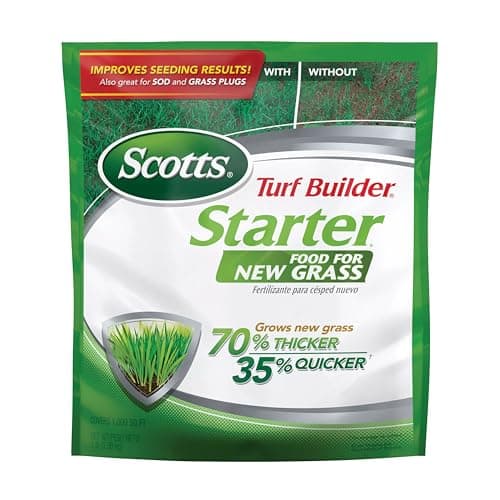
And do not feed newly sown seed with a general fertilizer. Use a starter product, and read best grass seed for the seeding side of the same job.
Who should skip these
Skip all of it if your lawn is hard underfoot or water runs off the surface. That is compaction or thatch, and fertilizer cannot reach roots that have no air — fix it first via aerating vs dethatching. Skip it too if the lawn is thin because it is mown short: raise the deck first, for free.
Skip the Simple Lawn Solutions liquid if you want one application to last two months — it is a little-and-often product and the bottle does not go far. And skip the 3 lb Scotts Starter bag for anything other than a patch; it is the right analysis in the wrong quantity for a whole lawn.