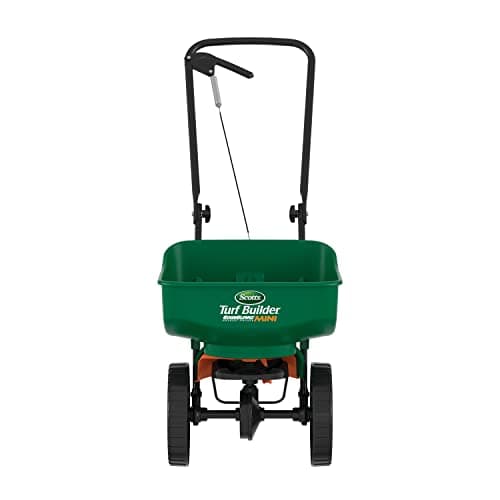
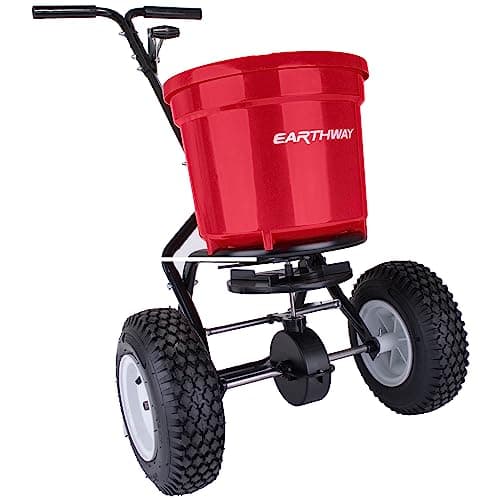
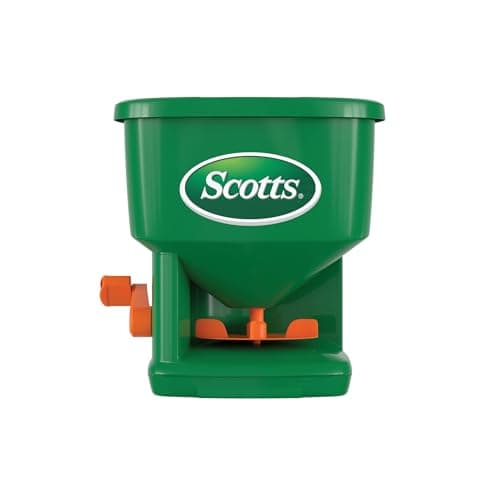
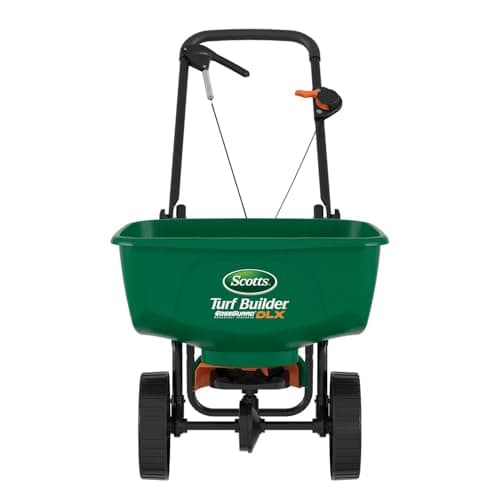
The best broadcast spreader for most lawns is the Scotts Turf Builder EdgeGuard DLX, and the reason is one feature: EdgeGuard shuts off the right-hand side of the spread pattern, so you stop throwing fertilizer into flowerbeds, onto the driveway and down the storm drain. For a lawn under about 8,000 square feet the EdgeGuard Mini has the same shut-off in a cheaper, easier-to-store frame. If you want a spreader you buy once and never replace, the EarthWay 2150 is the commercial-grade answer.
A spreader is not an accessory to lawn feeding — it is half the job. Fertilizer applied unevenly produces dark green stripes beside pale ones for the rest of the season, and once that pattern is in the lawn there is nothing to do but wait it out. A better spreader improves your results more reliably than a better bag of fertilizer does, which is why we would tell anyone to buy one of these before upgrading from Scotts Turf Builder to the Andersons bag.
We have not pushed any of these across a lawn. The ranking reads published capacities, edge-control provision, tire type and calibration method — see how we pick — and weights edge control heavily, because it is both the accuracy feature and the environmental one.
How to choose a spreader
Buy edge control if you can. A rotary spreader throws product in a circle, which means roughly half of it goes to your right whether there is lawn there or not. Next to a bed, a path or a driveway, that is wasted product and a runoff problem of the kind the EPA documents. A side shut-off makes the pattern a half-circle on demand. It is the single most useful feature on any consumer spreader and the main reason the two Scotts models top this list.
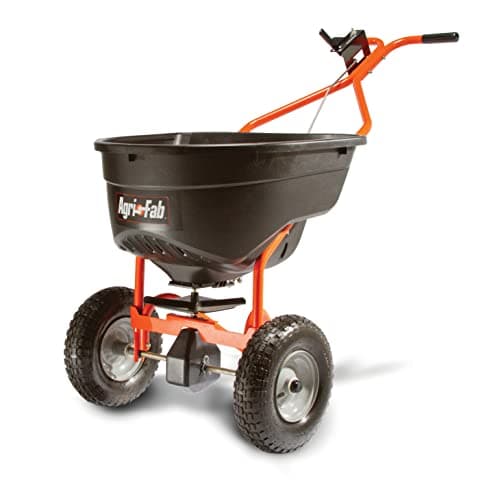
Size the hopper to the lawn, then stop.Capacity beyond what your lawn needs is weight you push for nothing. Under 5,000 sq ft, the Mini. Up to about 15,000 sq ft, the DLX. Half an acre and up, the 130 lb Agri-Fab — and be aware that a full 130 lb hopper is genuinely heavy to push and worse to stop on a slope.
Pneumatic tires matter more than they sound. A rotary spreader's pattern depends on the impeller staying at a constant height above the turf. Hard plastic wheels bounce over bumps and the pattern varies with them; the EarthWay's 13-inch pneumatic tires are the main reason it spreads more consistently over rough ground than anything else here.
Check how it calibrates. Scotts prints matching setting numbers on their own bags, which turns calibration into a dial setting. Other brands give you an adjustable gate and expect you to work it out by weighing a measured area. Both work; the first is far less effort if you buy Scotts products anyway.
Walk the pattern, not the stripe. Whatever you buy, apply half the rate in one direction and the other half at right angles. Two half-rate passes at ninety degrees cancel out most of the unevenness any spreader leaves, and it is the single best technique in this whole hub. It matters just as much when you are sowing grass seed as when you are spreading fertilizer.
Rinse it out, every time. Fertilizer salts are corrosive and they will seize a gate mechanism solid over a winter. Thirty seconds with a hose is the difference between a spreader that lasts a decade and one that lasts three seasons.
Matching spreader to product
Fine particles need a good spreader. The small prills that make the Andersons fertilizer spread so evenly also flow faster through a gate, so a spreader with poor calibration will dump them. Fine products and cheap spreaders are a bad combination.
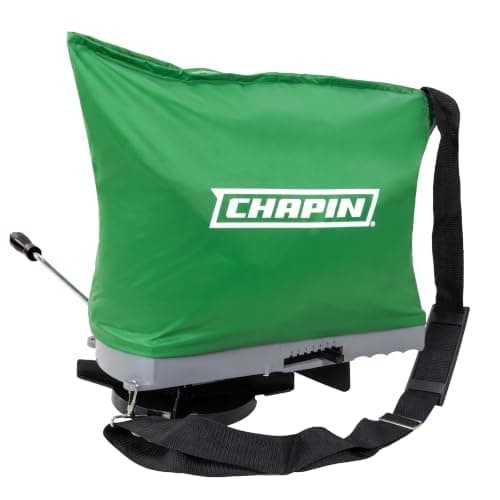
Slopes and strips want the handheld. A wheeled spreader cannot work a bank, a terrace or a narrow strip between fence and path. The Chapin TurfPro holds 25 lb on a shoulder strap and goes where wheels will not.
Ice melt counts. If you buy the Agri-Fab or an EdgeGuard, it is rated for salt and ice melt as well, which earns it shed space in winter.
Who should skip these
Skip the Scotts Whirl hand spreader for feeding a lawn. It is on this list because it is better than throwing handfuls and genuinely useful for scattering seed over a repaired patch, but it cannot apply fertilizer evenly across a real lawn and the striping will show all season. The EdgeGuard Mini costs little more and solves it.
Skip the EarthWay if your main concern is keeping product out of beds and off paving — it is the best-built spreader here and it has no edge shut-off. And skip the 130 lb Agri-Fab on a suburban lawn; a full hopper is more weight than most people want to push around a quarter acre.