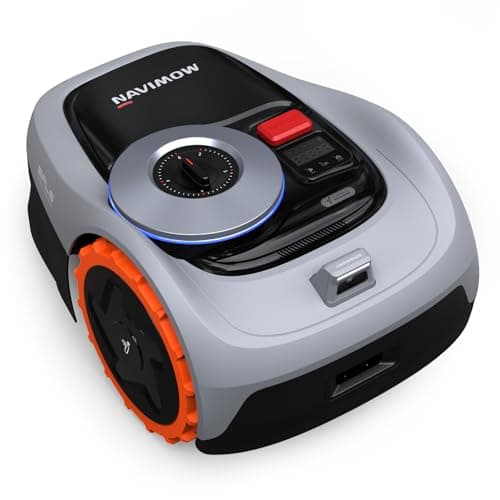
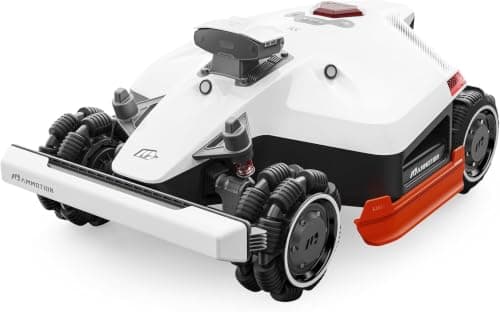
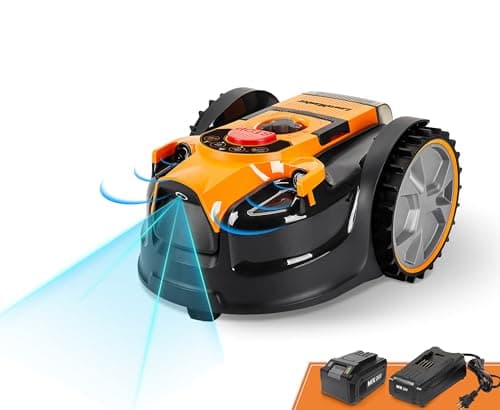
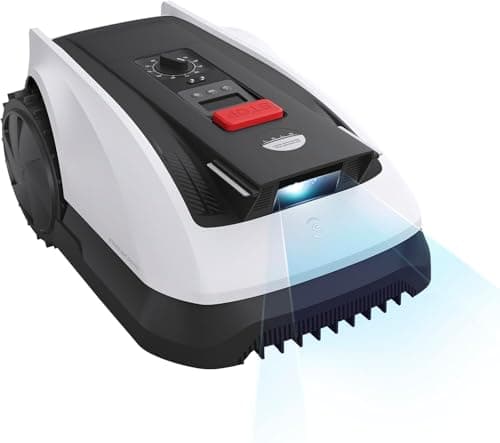
Yes, if your lawn is a reasonably simple shape under about half an acre and you value your Saturdays more than the money. No, if you have a complicated yard, a steep bank with loose footing, or you were hoping to spend what a push mower costs.Robot mowers genuinely work — that part of the sales pitch is true now in a way it was not five years ago. What has not changed is that they cost three to ten times what a walk-behind mower costs and they are fussier about the shape of your lawn than any other kind of mower.
The honest summary is this: a robot mower is not a better mower. It is a different purchase. A walk-behind mower cuts your lawn once a week in half an hour of your time. A robot mower cuts a little of it every day, forever, using none of your time, and in return you accept a higher price, a setup afternoon, and a machine that needs the occasional rescue.
What robot mowers are genuinely good at
They produce a better-looking lawn than you do. This is the part people do not expect. A robot takes a few millimeters off every day or two rather than a third of the leaf once a week, which is closer to how a golf fairway or a bowling green is maintained. The grass thickens, the clippings are small enough to vanish as free fertilizer, and the lawn never has the shaggy-then-shorn cycle a weekly cut gives it.
They are quiet. Published figures sit around 58 dB(A) for the quieter models, which is conversation volume. You can run one in the evening without anybody noticing, which is a real advantage on a small lot with close neighbors.
They remove the job entirely.Not reduce it — remove it. No fuel, no charging you have to think about, no bagging, no Saturday morning that has mowing in it. For anyone whose mobility makes pushing a mower hard, that is a much bigger deal than the lawn quality.
They handle slopes nobody should be walking. Several models publish slope ratings of 45% to 80%, which is steeper than any walk-behind mower should be used on. See the hill mower roundup.
Where robot lawn mowers fall down
Complicated lawns. A robot wants an area it can map and navigate. Narrow passages between beds, a path to a separate back lawn, a lot of tree roots, standing water or stepping stones all cause trouble. A lawn in four disconnected pieces is four problems.
Long grass. A robot mower trims; it does not reclaim. If your lawn is six inches high, cut it with a conventional mower first. Come back from two weeks away in June and you will be getting the walk-behind out.
Edges. No robot mower cuts a clean edge against a wall, a fence or a bed, because the blade sits inboard of the wheels. You will still own a string trimmer and you will still use it. Our string trimmer roundup covers that side of the job.
The price. This is the real objection and it deserves a straight answer below rather than a shrug.
What to look for before you buy one
Rated area, with headroom. Buy a model rated for more lawn than you have. A mower rated exactly to your square footage is working at its ceiling every day, in a climate where June grows twice as fast as August.
Navigation type, which is the biggest technical decision. Older models follow a buried perimeter wireyou lay yourself — cheap, reliable, and an afternoon of work you cannot undo easily. Modern models are wire-free, using RTK satellite positioning (accurate, needs a clear view of the sky, so dense tree cover is a problem), LiDAR (works under trees, costs more) or optical navigation (cheapest, least precise). The full comparison is in wire-free robot mowers.
Slope rating, in percent not degrees. Manufacturers publish percent; people think in degrees, and 45% is about 24 degrees. Check the number against the steepest part of your lawn, not the average.
Drive type. All-wheel drive matters on slopes, on soft ground and anywhere the mower has to climb a lip. Two-wheel-drive models get stuck more often, and a stuck mower is a job you have to do.
Whether you can live with an app. Every modern robot mower is configured through a phone. If that is a dealbreaker, this is not the category for you.
What a robot mower actually costs over five years
Here is the arithmetic the sales material leaves out, and it is worth doing properly because it is the whole question.
A capable battery walk-behind mower is a few hundred dollars and lasts a decade. A robot mower for a quarter-acre lawn is roughly a thousand to two thousand, plus blade sets a few times a year, plus a battery that will want replacing somewhere in years four to six. Call the five-year gap between the two options a four-figure number.
What you buy with that is time. A half-hour cut, thirty weeks a year, five years, is about seventy-five hours. If seventy-five hours of your Saturdays is worth a four-figure sum to you, a robot mower is a rational purchase. If it is not, it is an expensive one. That is the honest test, and it is personal rather than technical.
The one case where the money is not close: a lawn-care service costs that four-figure number every year or two. Against a service rather than against your own labor, a robot mower pays for itself quickly.
Do robot lawn mowers work in practice?
Yes, with two caveats worth stating plainly, because this is the question people really mean.
The first is setup. Expect an afternoon: mapping the lawn, defining no-go zones around beds and the pond, siting the base station where it gets power and — for an RTK model — sky. Done properly it then runs for a season with almost no attention. Done carelessly it will find the one gap you left in the map.
The second is rescues. Over a season, a robot mower will get stuck or lost a handful of times: a dip that fills with water, a pile of leaves, a toy left on the lawn, a patch under a tree where the satellite signal drops. The number is low enough to be an occasional irritation rather than a chore, and it is not zero.
Cut quality, which is the thing skeptics ask about last and should ask about first, is genuinely excellent on an established lawn. It is poor on a lawn being reclaimed. That distinction explains almost every disappointed review you will read.
Which lawns robot mowers suit
A small, simple, fenced lawn. The ideal case. One connected area, clear boundaries, nothing to get stuck on. A model rated for an eighth to a quarter acre is plenty and the setup takes an hour.
A medium suburban lawn with a few beds. Works well with no-go zones drawn properly. Buy wire-free with RTK unless you have heavy tree cover.
A steep bank. The clearest case of all, because the alternative is dangerous rather than merely tedious. Buy on the slope rating and buy all-wheel drive.
A big lawn where mowing has become a chore. Acreage robots rated to three quarters of an acre and beyond now exist and work; they cost accordingly. See robot mowers for large yards.
Which lawns they do not suit
A lawn split into disconnected sections with no mowable route between them. A lawn under dense mature canopy if you are buying RTK rather than LiDAR. A lawn that routinely gets long because you travel. A yard where small children and pets are unsupervised — the blades are small and shielded, but a mower that runs unattended needs a household that understands it. And any lawn where the honest problem is that mowing takes too long rather than that you dislike doing it: a wider deck solves that for a tenth of the price. See the large-yard roundup.
Robot mower or self-propelled mower?
If you are choosing between spending on a robot and spending on a good self-propelled mower, the question is which problem you have. A self-propelled mower fixes effort— slopes, weight, a bad knee — for a few hundred dollars. A robot mower fixes time, for several times that. People often buy the robot when the self-propelled mower was the answer, and regret the price; others buy the mower when they wanted their weekends back, and regret the time.
Our best self-propelled lawn mower roundup is the cheaper branch of that decision, and the robot mower roundup is the full ranking if you have decided.