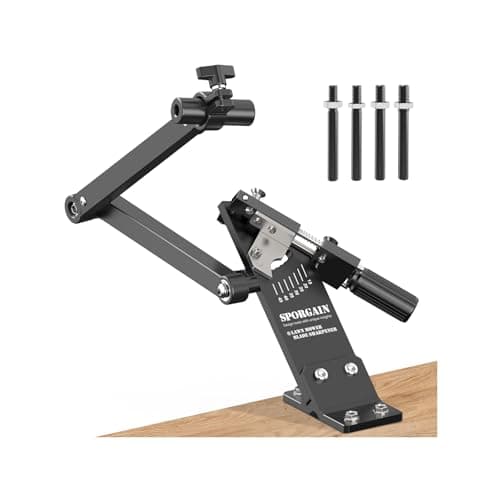
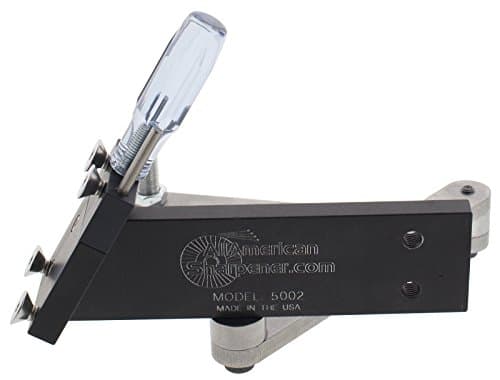
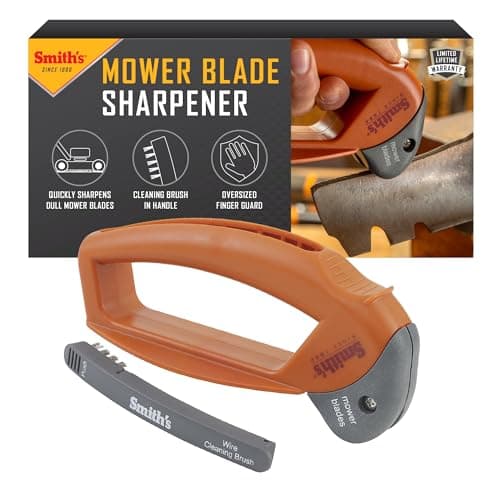
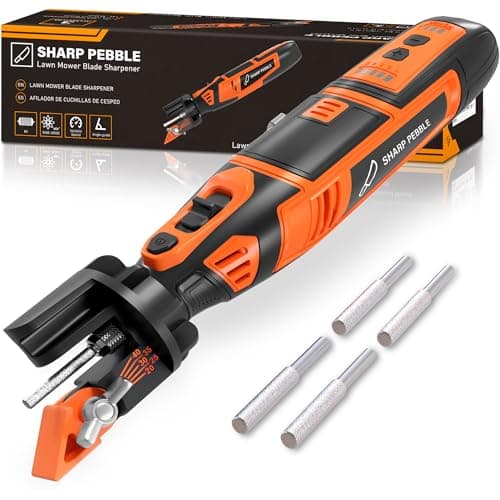
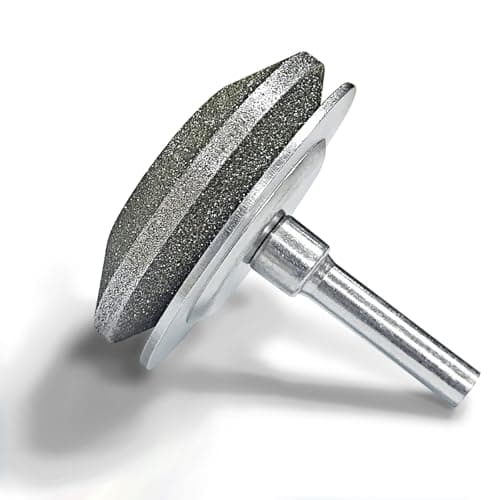
For one mower sharpened twice a year, buy the UF-SHARP drill-mounted diamond sharpener. It is a shaped 120-grit diamond stone that chucks into the drill already in your garage, it costs less than a single shop sharpening, and diamond grit cuts hardened blade steel rather than polishing it. If you want a better edge than a hand-held stone can give, the SporGain adjustable frame clamps the blade at a set angle between 15 and 45 degrees so every pass takes metal off the same bevel, and the All American Sharpener 5002 is the angle-guided tool for anyone doing several blades a season. For a mid-season touch-up with no power at all, the Smith's 50603 is two minutes and a preset carbide edge.
The reason to care: a sharp blade severs a grass blade cleanly, while a dull one tears it and leaves a frayed, split end that browns off and loses water. That is why a lawn can look vaguely unwell a day after mowing for reasons that have nothing to do with feeding or watering. A tired mower with a sharp blade leaves a better lawn than a new one with a dull blade, which makes this the highest-return tool purchase on the whole site relative to its price.
The specification that separates these tools is not grit or power. It is angle control. A mower blade has a bevel, usually somewhere between 30 and 45 degrees depending on the maker, and the job is to take metal off at that same angle along the whole cutting edge. Freehand, people round the edge over into a curve, which is blunt in a different shape. Anything that holds the blade or guides the tool is buying you that consistency, and that is why this list is ordered the way it is. Prices below are live from the price layer with an “as of” date.
The four kinds of sharpener, and who each suits
| Type | How it works | Angle control | Suits |
|---|
| Drill-mounted stone | Shaped diamond stone in a hand drill | Guided by a face resting on the blade | One mower, twice a year |
| Guided frame | Clamps the blade at a set angle | Best — the angle is mechanical | Owners who want a factory bevel |
| Handheld carbide | Pull a preset carbide edge along the bevel | Preset, but pressure is yours | A mid-season touch-up |
| Bench grinder | Dedicated motor and rest | Very good, and fast | Crews and shops |
Sharpening a blade properly, in six steps
One: make it safe. Disconnect the spark plug lead on a gas mower or remove the battery on a cordless one before a hand goes anywhere near the blade. For a rider, use a proper mower lift rather than propping it on blocks.
Two: mark which way up it goes. A paint pen or a scratch on the top face. Blades fitted upside down barely cut, and it happens far more often than anyone admits.
Three: clean it first. Caked grass and grit will eat your stone and hide the real condition of the edge. A wire brush and five minutes.
Four: follow the existing bevel. Do not invent a new angle. Whatever the factory ground is the angle to maintain, and a guided frame or the shaped face on a drill-mounted stone is what keeps you honest. Work from the inner end of the cutting edge outward, with even passes.
Five: stop at butter-knife sharp.A mower blade is not a chisel. The target is an edge that will not cut your thumb when you drag it along the flat — a razor edge on hardened steel spinning into grit chips off in minutes and leaves you worse off.
Six: balance it. This is the step people skip and it is the one that costs money. Hang the blade on a nail through the center hole. If one end drops, take a little more metal off that end and check again until it sits level. An unbalanced blade vibrates the spindle bearings to death and can crack a deck.
How often, and the two-blade trick
Sharpen every 20 to 25 hours of mowing, which for most lawns is twice a season — once in spring and once in mid-summer. Sandy soil, a lawn with gravel edges or a mower that occasionally finds a sprinkler head will all need it more often.
The trick that makes this painless: own two blades. Keep a sharp spare on the shelf, swap it in when the cut starts looking ragged, and sharpen the one you took off at your leisure rather than with the mower in pieces on a Saturday. Blades are cheap and the right ones for your deck are in best lawn mower blades.
When sharpening is the wrong answer
Replace the blade rather than sharpening it if the trailing wing is worn thin, if there is a deep notch in the cutting edge, if the blade is bent, or if the center hole has worn oval. The wing is what moves air for bagging and mulching, and once it has been eroded by grit no amount of sharpening restores lift. Grinding past a deep notch takes so much metal that you end up with a short, unbalanced blade. Both cases are a new blade.
Do you need a powered sharpener?
No, and that is worth saying on a page selling them. A flat file and twenty minutes will sharpen a mower blade perfectly well, and generations of people have done exactly that. A powered tool buys you speed; a guided frame buys you consistency. The guided frame is the upgrade that actually improves the result, which is why the frames outrank the cordless handheld on this list despite costing less.
Who the bench grinder is for
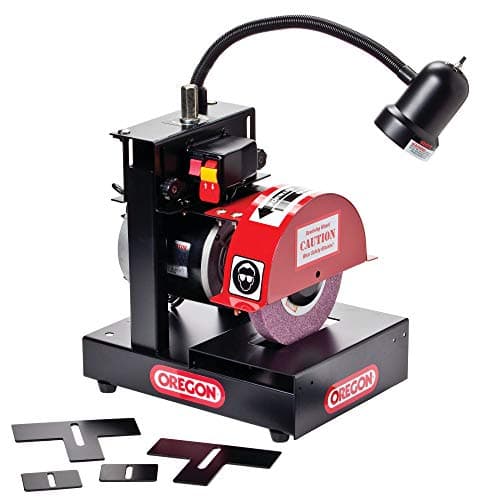
The Oregon 88-023 is shop equipment: a dedicated half-horsepower blade grinder with an adjustable rest, priced accordingly. It belongs on this page because people searching for a blade sharpener include small landscaping outfits, and for a crew sharpening a dozen blades a week it pays for itself in labor. For a homeowner with one mower it is emphatically the wrong purchase, and we would rather say that than let the most expensive item look like the best one.
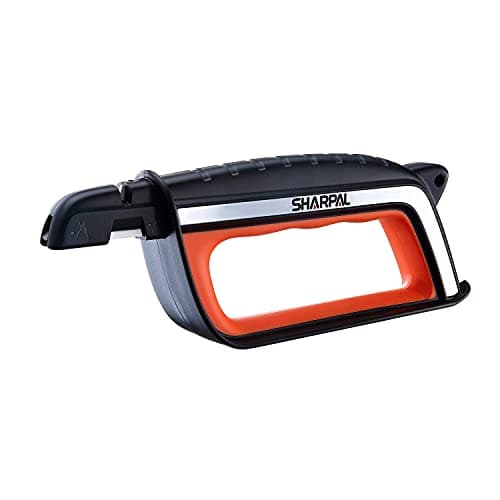
The multi-tool option
If the mower blade is not the only blunt thing in the shed — and it rarely is — the SHARPAL 103N handles the axe, the machete, the pruners and the hedge shears as well. It will not reshape a badly worn mower blade, but as the one sharpening tool in a household it earns its place, and it is a good gift for someone who maintains their own tools.