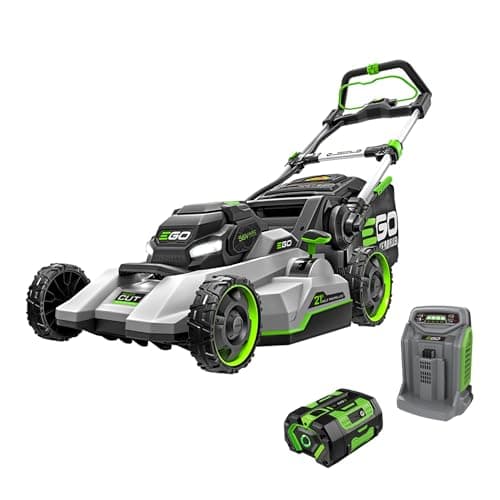
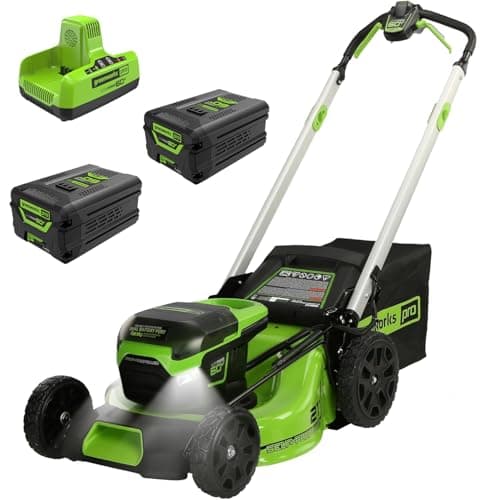
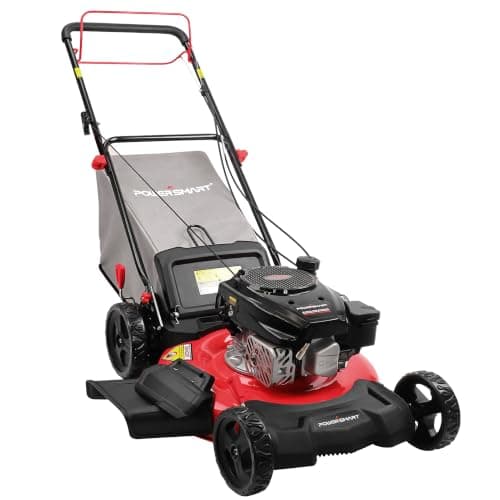
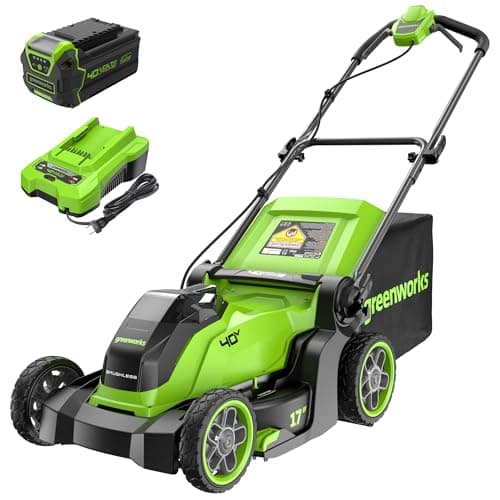
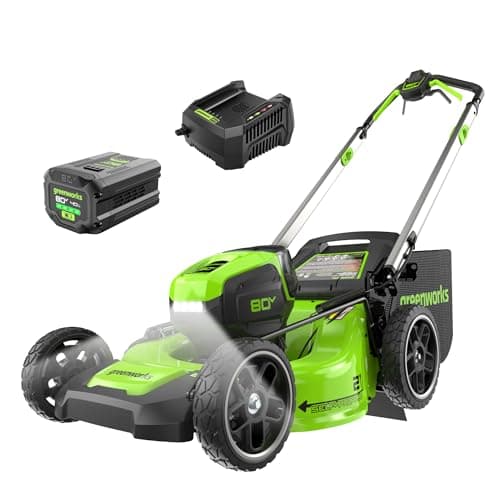
For most lawns in America the best mower is a 21-inch self-propelled battery machine, and the one we would buy is the Greenworks 80V 21" Self-Propelled. It has the deck width that suits a typical suburban lot, the driven wheel that makes any slope manageable, and a battery and charger in the box — and it undercuts the equivalent EGO kit by a wide margin. If budget is no object the EGO LM2135SP is the better-built machine; if your lawn runs to half an acre, the twin-battery Greenworks 60V kit is the one that will actually finish it.
Every mower below is a real, currently-sold model, and the ranking is built on three published numbers: deck width, drive type, and what the maker says about battery capacity or engine displacement. Those three decide almost everything about how a cut feels. Brand reputation, blade metallurgy and marketing names decide very little.
An honesty note, because it matters here: we have not mowed with any of these. We do not have a test lawn and we are not going to pretend otherwise. What we do is read the published specifications, work out how many passes each deck width means on lawns of different sizes, and rank on what those specs support. Our how we pick page lays out exactly how, and every pick carries an honest “don’t buy if”. If you are not sure what size you need, read what size lawn mower do I need first — it is the question that makes this whole list make sense.
How to choose a lawn mower
Start with the lawn, not the mower. Measure it, roughly, in square feet. Under 4,000 square feet you want a narrow deck and you should be reading the small-yard listinstead. Between 4,000 and about 20,000 square feet — which is most suburban lots — a 21-inch deck is the right answer and this list is for you. Over about 30,000 square feet, a walk-behind mower is the wrong category entirely and you want a zero-turn or riding mower.
Then check the gate. This is the step people skip and regret. A 21-inch deck needs roughly 24 inches of clear opening, and plenty of side gates are narrower than that. Measure the narrowest point between where the mower lives and where the lawn is, before you buy anything.
Decide on drive by gradient. If your lawn is flat, a push mower is genuinely fine and saves you money and weight. If it slopes at all, buy self-propelled. A 21-inch deck with a full grass bag is heavier than people expect, and you will be pushing it up that slope every week for years. This is the one upgrade almost nobody regrets.
Choose battery unless acreage says otherwise. Under half an acre, battery wins on every axis that matters to a homeowner: it starts instantly, it needs no servicing, it does not smell, and it is quiet enough to use early. Past half an acre the recharge time becomes the binding constraint and gas starts to make sense again. The full argument, including running costs, is in electric vs gas.
Count the batteries, not the voltage. Voltage tells you about peak power in thick grass. Amp-hours tell you how long you can mow. A 60V mower with two 4.0 Ah packs will finish a bigger lawn than an 80V mower with one, and that is why the Greenworks 60V twin kit sits above the gas mowers here despite the lower nominal voltage. Work out which constraint you are actually hitting.
Buy the platform, not just the mower. The mower is the expensive way into a battery ecosystem. If you intend to own a cordless string trimmer and blower too — and you probably do — then picking a platform with a broad tool range is worth more over ten years than any individual mower's spec advantage.
Who should skip these
If your lawn is under about 2,500 square feet, skip this entire list. You are being sold a 21-inch deck you do not need, and a narrow mower will be cheaper, lighter and easier to store. If your lawn is over three quarters of an acre, skip it for the opposite reason: no walk-behind mower makes that lawn pleasant, and the time you lose every week is worth more than the price difference to a riding machine.
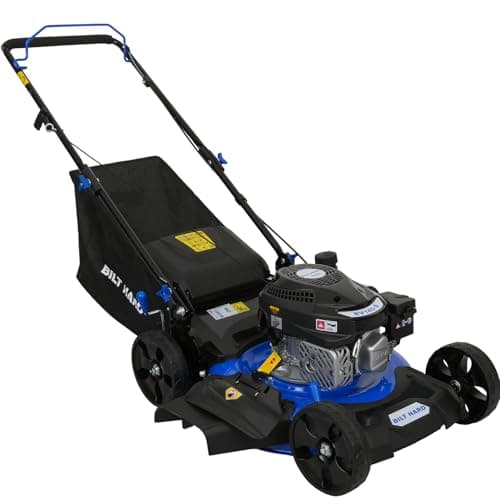
And skip the BILT HARD specifically unless the budget is genuinely immovable. It is a full 21-inch deck for remarkably little money, which is a real thing, but a 144cc engine with no drive system is the one combination on this page that will struggle in the conditions you actually meet — grass that got away from you after a wet week.