Skip to content
Fairway&Fescue

The Feed · Fertilizer, Weed Control & Spreaders

How Much Fertilizer Do I Need?

One division turns the numbers on the bag into pounds on your lawn. Here it is, worked through by lawn size and season.

By Stephen V.Updated How we pick
#ad

We earn a commission when you buy through our Amazon links, at no extra cost to you. It never changes our rankings — and we'll tell you when the cheaper bag or machine is the better buy. How this works.

The short answer: aim for about one pound of actual nitrogen per 1,000 square feet per application, and to find how much product that is, divide 100 by the first number on the bag. A 16-4-8 fertilizer needs roughly 6.25 lb per 1,000 square feet. A 6-4-0 like Milorganite needs about 16.7 lb for the same nitrogen. That is the entire calculation, and it is the only one you need.

Everything else on this page is worked examples and a calendar. But that division is worth internalising, because it is also how you compare bags honestly: a cheap bag with a low analysis is not cheap once you account for how much more of it you have to spread, and a premium bag with a high analysis often costs less per pound of nitrogen delivered. Shelf price per bag tells you very little.

A caveat we would rather state than bury: these are general rates for cool-season lawns, and they are not a substitute for knowing your own soil. A soil test from your state extension service costs very little and tells you what your soil is actually short of, which no generic rate can. We do not test soil and we are not going to pretend our arithmetic replaces one — see how we pick.

The short answer

Quick picks

#ProductBest forScorePrice
01
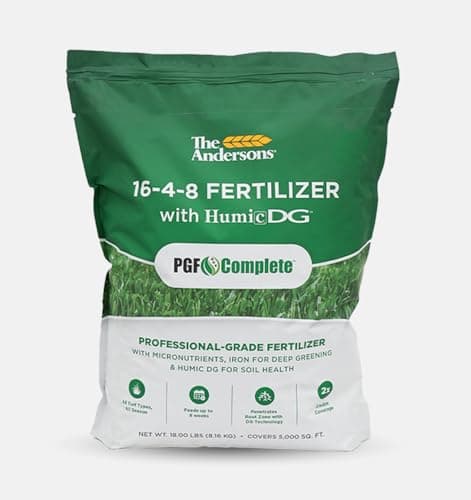
The Andersons The Andersons PGF Complete 16-4-8 with Humic DG (5,000 sq ft)
The Andersons PGF Complete 16-4-8 with Humic DG (5,000 sq ft)

The fertilizer serious lawn people actually use. A balanced 16-4-8 analysis on a very small particle, with 7 percent humic acid — it spreads evenly and waters in without sitting on the surface.

Best all-round lawn fertilizer
8.0
$59.88Amazon
02
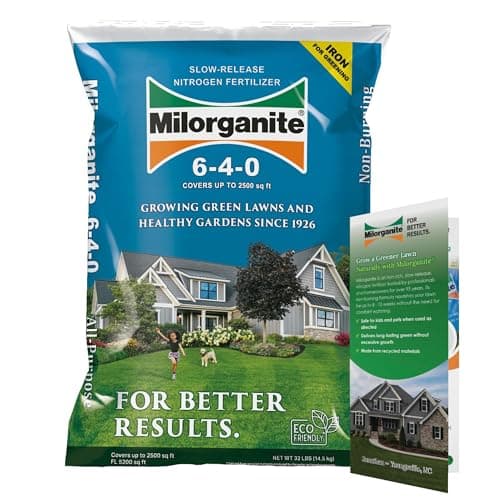
Milorganite Milorganite 6-4-0 Slow-Release Nitrogen (32 lb)
Milorganite 6-4-0 Slow-Release Nitrogen (32 lb)

The one fertilizer you genuinely cannot burn a lawn with. A 6-4-0 organic nitrogen source that releases slowly with soil temperature rather than all at once with the first watering.

The no-burn fertilizer
7.8
$35.01Amazon
03
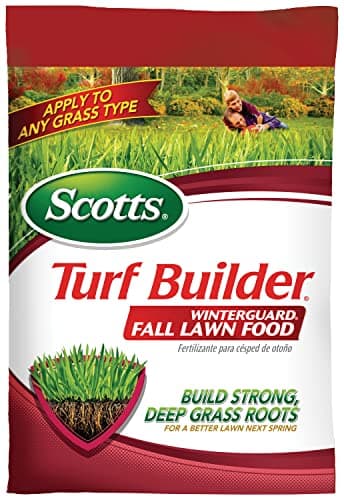
Scotts Scotts Turf Builder WinterGuard Fall Lawn Food (32.3 lb)
Scotts Turf Builder WinterGuard Fall Lawn Food (32.3 lb)

The fall feed, in the bag size a real lawn needs. If you only fertilize once a year, agronomically this is the application to make — autumn feeding builds roots rather than top growth.

The single most valuable feed of the year
8.2
$44.62Amazon
04
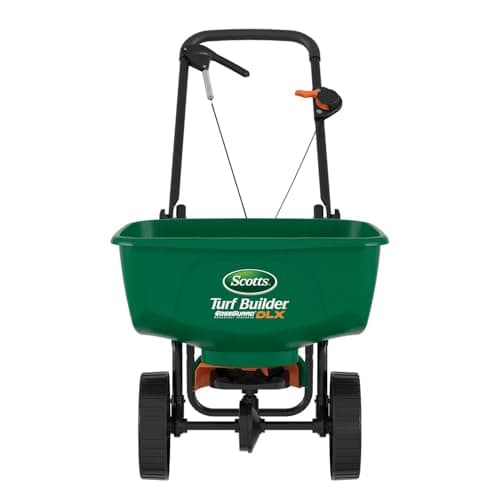
Scotts Scotts Turf Builder EdgeGuard DLX Broadcast Spreader
Scotts Turf Builder EdgeGuard DLX Broadcast Spreader

The spreader to buy. EdgeGuard shuts off the right-hand side of the spread pattern, which is the one feature that stops you throwing fertilizer into beds, onto the driveway and down the storm drain.

Best broadcast spreader for most lawns
8.6
$94.97Amazon

#ad · Live prices from the Amazon Product API, as of October 7, 2026. Where we have no verified live price, we show none — we would rather leave a gap than print a number that has rotted.

In detail

The picks, in full

01
The Andersons The Andersons PGF Complete 16-4-8 with Humic DG (5,000 sq ft)

Best all-round lawn fertilizer

The Andersons PGF Complete 16-4-8 with Humic DG (5,000 sq ft)

16-4-8 NPK7% Humic DGCovers 5,000 sq ftFine particle size
8.0/10

The fertilizer serious lawn people actually use. A balanced 16-4-8 analysis on a very small particle, with 7 percent humic acid — it spreads evenly and waters in without sitting on the surface.

Analysis quality
10
Spread evenness
10
Coverage per bag
7
Ease of use
7
Value
6

Pros

  • 16-4-8 is the ratio most cool-season lawns want: nitrogen for growth, a little phosphorus, and potassium at half the nitrogen rate for stress tolerance
  • The fine particle size is the quiet advantage — small prills land more per square inch, so you get an even green rather than a striped one
  • At 16 percent nitrogen over 5,000 sq ft, a full bag delivers roughly 0.8 lb of nitrogen per 1,000 sq ft — a textbook single application

Cons

  • Costs several times what a Scotts bag of similar coverage does
  • Fine particles need a spreader with decent calibration; a hand-thrown application wastes it

Skip this if…

…you feed your lawn once a year and are not going to measure anything. The value is in precise, repeatable applications; Scotts Turf Builder does the once-a-year job for a fraction of this.

$59.88View on Amazon

Price as of October 7, 2026. Prices change — Amazon's is the one that counts.

#ad · we may earn a commission from this link to The Andersons PGF Complete 16-4-8 with Humic DG (5,000 sq ft)

02
Milorganite Milorganite 6-4-0 Slow-Release Nitrogen (32 lb)

The no-burn fertilizer

Milorganite 6-4-0 Slow-Release Nitrogen (32 lb)

6-4-0 NPKSlow-release organic nitrogen32 lb bagNon-burning
7.8/10

The one fertilizer you genuinely cannot burn a lawn with. A 6-4-0 organic nitrogen source that releases slowly with soil temperature rather than all at once with the first watering.

Analysis quality
6
Spread evenness
8
Coverage per bag
7
Ease of use
10
Value
8

Pros

  • Slow-release organic nitrogen will not scorch a lawn even if you double-pass a strip — the single most forgiving fertilizer sold
  • Also contains iron, which is where the deep green colour response comes from
  • A 32 lb bag at this price is good value per pound of product

Cons

  • Only 6 percent nitrogen, so you spread four to five times the weight for the same nitrogen as a 16-4-8
  • No potassium at all — on a stressed or sandy lawn you will need a second product for that

Skip this if…

…you want a fast green-up before an event. Slow release means slow: the response takes weeks, not days, and a liquid feed is what you actually want.

$35.01View on Amazon

Price as of October 7, 2026. Prices change — Amazon's is the one that counts.

#ad · we may earn a commission from this link to Milorganite 6-4-0 Slow-Release Nitrogen (32 lb)

03
Scotts Scotts Turf Builder WinterGuard Fall Lawn Food (32.3 lb)

The single most valuable feed of the year

Scotts Turf Builder WinterGuard Fall Lawn Food (32.3 lb)

Fall / winterizer analysis32.3 lb bagWinterGuard lineCool-season lawns
8.2/10

The fall feed, in the bag size a real lawn needs. If you only fertilize once a year, agronomically this is the application to make — autumn feeding builds roots rather than top growth.

Analysis quality
8
Spread evenness
6
Coverage per bag
9
Ease of use
9
Value
9

Pros

  • Autumn is when cool-season grasses put down roots and store carbohydrate — a fall feed does more for next summer than a spring one does
  • 32.3 lb covers a proper lawn, unlike the 12.5 lb Turf Builder bag
  • Widely available in September and October when you actually want it

Cons

  • Seasonally specific — the wrong product to spread in May
  • Standard Scotts prill size, so the same evenness compromise as the rest of the line

Skip this if…

…you are feeding in spring or summer. Use the standard Turf Builder or the Andersons 16-4-8 then and save this bag for September.

$44.62View on Amazon

$69.9936% off

Price as of October 7, 2026. Prices change — Amazon's is the one that counts.

#ad · we may earn a commission from this link to Scotts Turf Builder WinterGuard Fall Lawn Food (32.3 lb)

04
Scotts Scotts Turf Builder EdgeGuard DLX Broadcast Spreader

Best broadcast spreader for most lawns

Scotts Turf Builder EdgeGuard DLX Broadcast Spreader

EdgeGuard side shut-offHolds up to 15,000 sq ft of productBroadcast / rotaryCalibrated settings dial
8.6/10

The spreader to buy. EdgeGuard shuts off the right-hand side of the spread pattern, which is the one feature that stops you throwing fertilizer into beds, onto the driveway and down the storm drain.

Spread accuracy
9
Edge control
10
Capacity
9
Build quality
6
Value
9

Pros

  • The edge shut-off is genuinely the most useful feature on any consumer spreader — it saves product and keeps fertilizer out of water
  • A 15,000 sq ft hopper means most lawns are a single fill
  • Scotts prints matching setting numbers on their own bags, so calibration is a dial rather than a maths problem

Cons

  • Plastic construction throughout — this is not a lifetime tool
  • Rinse it after every use or fertilizer salts will seize the gate mechanism

Skip this if…

…your lawn is under about 3,000 square feet. The Mini does the same job in a smaller frame that is far easier to store, for a lot less.

$94.97View on Amazon

$114.9917% off

Price as of October 7, 2026. Prices change — Amazon's is the one that counts.

#ad · we may earn a commission from this link to Scotts Turf Builder EdgeGuard DLX Broadcast Spreader

Step one: measure the lawn

Pace out each area of grass — a pace is close enough to three feet — multiply length by width, and add the areas. Do this properly, because every rate on this page is per 1,000 square feet and an error here scales straight through. People consistently underestimate their lawns, which is also why so many mowers are bought a size too small; the same measurement is useful for choosing a mower.

Step two: do the division

Divide 100 by the first number on the bag. That gives you pounds of product per 1,000 square feet for a one-pound nitrogen application:

16-4-8(The Andersons PGF Complete): 100 ÷ 16 = 6.25 lb per 1,000 sq ft.

6-4-0(Milorganite): 100 ÷ 6 = 16.7 lb per 1,000 sq ft.

32-0-5: 100 ÷ 32 = 3.1 lb per 1,000 sq ft.

Then multiply by your lawn's thousands of square feet. A 5,000 sq ft lawn needs about 31 lb of a 16-4-8 product, or about 84 lb of Milorganite, for the same nitrogen. That comparison is why analysis matters as much as price.

Step three: sanity-check against the bag's own coverage

Every bag states a coverage figure. Compare it with your calculation; if they disagree wildly, the manufacturer is assuming a different nitrogen rate than one pound per thousand — which is common and usually fine. Follow the label. The arithmetic is for comparing products, not for overriding the instructions on the bag you bought.

Worked examples by lawn size

2,500 sq ft (small lawn). About 16 lb of a 16-4-8 per application, so one 5,000 sq ft bag covers two feeds. A 12.5 lb bag of Scotts Turf Builder is roughly one application.

5,000 sq ft (typical suburban back garden). About 31 lb of a 16-4-8 per application. A 32.3 lb bag of Scotts WinterGuard is about one full autumn application for this lawn, which is why that bag size exists.

10,000 sq ft (quarter acre). About 62 lb per application. At this size hopper capacity starts to matter and you want the EdgeGuard DLX rather than the Mini, or you will spend the application walking back to the bag.

21,780 sq ft (half acre).About 136 lb per application — three or four bags. This is where a 130 lb push hopper or a tow-behind spreader stops being a luxury.

The feeding calendar for a cool-season lawn

Early spring. A light feed as growth starts, or skip it and put a crabgrass pre-emergent down instead — but not if you intend to sow grass seed this spring, because a pre-emergent stops your fescue germinating too.

Late spring. A full nitrogen feed. This is the application that buys you visible green and a lot of mowing.

High summer. Go light, or use iron rather than nitrogen. Pushing growth into heat-stressed cool-season grass invites disease, and this is the season to raise your mower deck instead.

Early autumn. The most valuable application of the year. Cool-season grasses build roots and store carbohydrate now, so this feed does more for next summer's lawn than anything else you will do. If you only feed once, feed now.

Late autumn. A winterizer feed, and the one time a weed-and-feed genuinely makes sense — perennial broadleaf weeds are translocating to their roots, so the herbicide goes where it does most damage.

Three ways people waste fertilizer

Spreading it on compacted ground.Nutrients cannot reach roots that have no air. If the lawn is hard underfoot, aerate before you feed — see best lawn aerator.

Spreading it unevenly. Half the rate in one direction, half at right angles. Otherwise you get stripes you then live with all season.

Spreading it onto paving. Fertilizer on a driveway goes into the storm drain, which is the nutrient-pollution pathway the EPA describes. Sweep it back onto the lawn, and use a spreader with edge control.
How we picked this

We haven't hit this gear — and we say so

We compiled the published manufacturer specifications — shaft weight and flex, loft, deck width, blower CFM, fertilizer NPK, seed species — did the deck-width and nitrogen arithmetic, cross-read the owner manuals, and scored each pick against a published rubric. The scores are judgments from documented research — they are notlab measurements we took, because we don't have a lab and we're not going to pretend we do. Where somebody has genuinely measured this, we link them. You can check every number we publish.

Questions

Frequently asked

How much fertilizer do I need per 1,000 square feet?
Aim for about one pound of actual nitrogen per 1,000 sq ft per application. Divide 100 by the first number on the bag to get pounds of product: a 16-4-8 needs about 6.25 lb, a 6-4-0 needs about 16.7 lb.
How much fertilizer for a 5,000 square foot lawn?
About 31 lb of a 16-4-8 product per application, or about 84 lb of a 6-4-0 like Milorganite for the same nitrogen. A 32.3 lb bag of Scotts WinterGuard is roughly one autumn application at that size.
Can I use too much fertilizer?
Yes. Over-application burns a lawn with fast-release products, forces soft growth that invites disease, and sends excess nutrient into storm drains. Slow-release organic nitrogen is far more forgiving if you spread by eye.
When is the best time to fertilize a cool-season lawn?
Early autumn, clearly. That is when cool-season grasses build roots and store carbohydrate rather than pushing leaf, so one September feed does more for next summer than a spring one does.

Keep reading

Receipts

Sources

We do not run a testing lab, and we do not pretend to. Every spec number here comes from a manufacturer's published sheet or an official standard, cited above. Where we could not verify something, we say so on the page rather than quietly leaving it out. Read our full method.