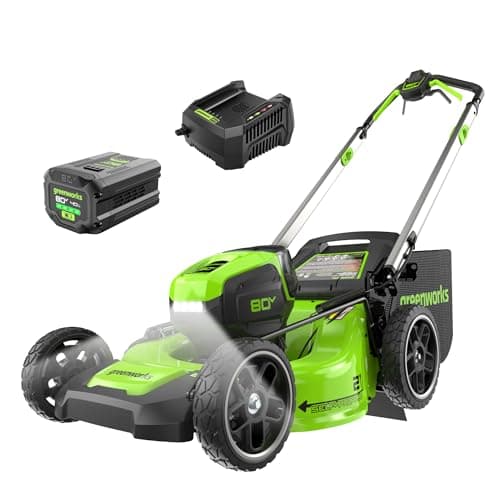
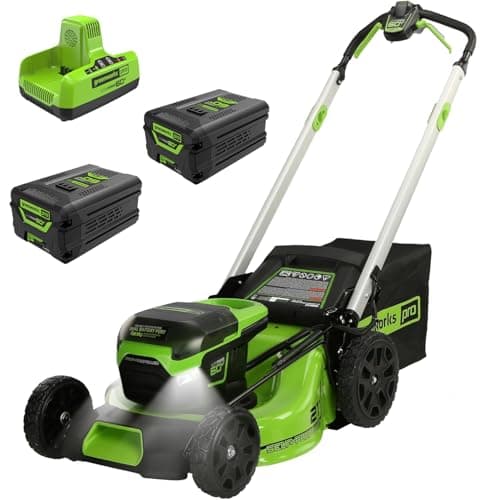
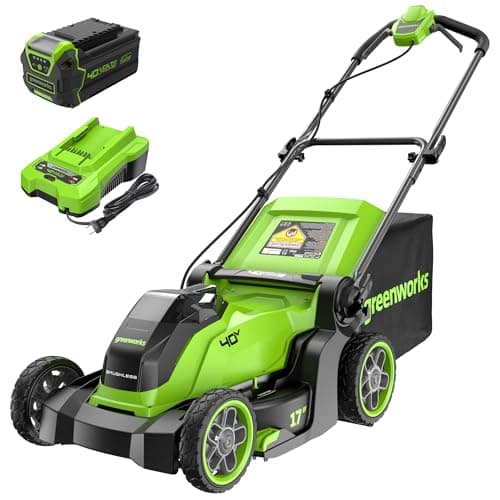
The short answer: under 4,000 square feet buy a 16–17 inch deck; from 4,000 to about 20,000 square feet buy 20–21 inches; from 20,000 square feet to three quarters of an acre buy 21 inches with two batteries or a gas engine; and over three quarters of an acre stop looking at walk-behind mowers entirely. Then override all of that if your narrowest gate is tight, and add self-propelled drive if the lawn slopes.
That is the whole guide in a paragraph, and the rest of this page is the arithmetic behind it — because the reason those thresholds exist is worth understanding. Deck width does not change how fast you walk. What it changes is how many lengths you have to walk, and that relationship is simply your lawn's width divided by the deck's width. Everything else about mower sizing follows from that one division.
A note on measuring: people underestimate their lawns, consistently and by a lot. Pace out the length and the width of each section of grass, multiply, and add the sections together. A pace is close enough to three feet for this purpose. Do it before you shop, because the single most common mower-buying mistake is sizing to a guess.
The arithmetic, in one worked example
Take a rectangular lawn 60 feet wide and 80 feet long — 4,800 square feet, a thoroughly ordinary suburban back garden. With a 17-inch deck and a small overlap, you are cutting a usable 16 inches per pass, so 60 feet of width is 45 lengths. With a 21-inch deck cutting a usable 20 inches, the same lawn is 36 lengths. That is nine fewer lengths of 80 feet, which is 720 feet of walking saved — every cut, thirty times a year, for as long as you own the mower.
Run the same sum on a 2,500 square foot lawn and the saving is trivial, while the extra deck width makes every turn around the apple tree harder. That crossover, somewhere around 4,000 square feet for most lawn shapes, is exactly where our small-yard list stops being the right page and the best lawn mower starts.
Deck width by lawn size
Under 4,000 sq ft — 16 to 17 inches.Turning beats coverage at this size. A narrow deck gets round beds in one pass, weighs less for steps and storage, and costs less. The Greenworks 40V 17" is our pick.
4,000 to 20,000 sq ft — 20 to 21 inches.The large majority of suburban lots. A 21-inch deck is the standard for good reason: it is the widest cut that still fits most gates and turns reasonably. The Greenworks 80V 21" Self-Propelled is the pick.
20,000 sq ft to 0.75 acre — 21 inches, two batteries or gas. Deck width is no longer the constraint; endurance is. Buy a twin-battery kit like the Greenworks 60V, or accept gas. Anything less and you will stop halfway.
Over 0.75 acre — not a walk-behind. At this point the honest advice is to change category. An hour and a half behind a 21-inch deck every week is not a mower problem you can solve with a bigger mower; see best zero-turn mower and zero-turns for two acres.
The two overrides
The gate. Measure the narrowest point between where the mower is stored and where the grass is. A 21-inch mower needs roughly 24 inches of clear opening; a 17-inch mower roughly 20. A deck that will not reach the lawn is worth nothing, and this measurement beats every other consideration on this page.
The slope.Lawn area tells you deck width. Gradient tells you drive type. Any meaningful slope and you want self-propelled, ideally rear-wheel drive, at whatever deck width your area calls for — the reasoning is in our self-propelled roundup. On a severe side slope, a lawn tractor is safer than either a zero-turn or a walk-behind.
What about cutting height?
Not strictly a sizing question, but it is the spec that will do most for your lawn, so check it while you are comparing. More height positions means you can cut low in spring and raise the deck through summer heat, which shades the soil and crowds out weed seedlings. A lawn mown too short in July is the usual reason people go looking for fertilizer and seed in August.