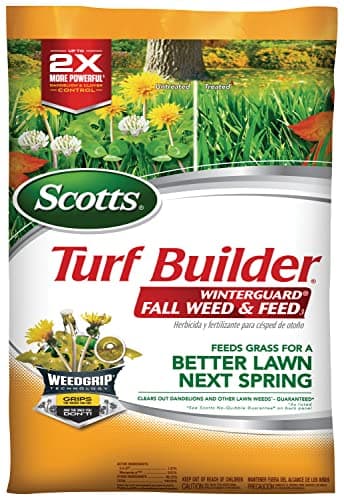
The only weed-and-feed we would genuinely recommend is Scotts Turf Builder WinterGuard Fall Weed & Feed3, and the reason is timing rather than formulation. In autumn, perennial broadleaf weeds are moving resources down into their roots and your cool-season grass is building roots too — so one pass genuinely does both jobs well. In spring, the two jobs want different conditions and you compromise both.
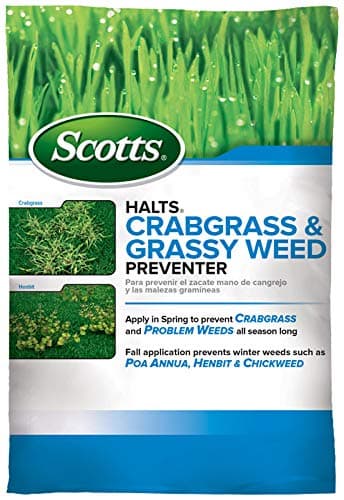
For crabgrass specifically, the answer is not a weed-and-feed at all. Scotts Halts is a pre-emergent: it stops the seed germinating rather than fighting the plant after it has won, and pre-emergent crabgrass control is dramatically more reliable than any post-emergent approach. One correctly-timed spring application beats a whole summer of spot-spraying.
We have not applied any of these to a lawn. The ranking works from the published labels, the herbicide mode of action each one states, and the agronomic timing that mode of action implies — see how we pick. There is a real case, made below, for buying neither of these and spot-spraying instead, and we would rather put that argument in front of you than sell you a bag.
The honest case against weed-and-feed
Start here, because it applies to most lawns. A weed-and-feed applies herbicide to your entirelawn in order to kill weeds that are growing in part of it. If your weeds are in patches — and they usually are — then spot-spraying those patches and feeding the lawn separately uses a small fraction of the herbicide, works better because you can treat each patch properly, and costs less.
There is also a timing conflict built into the product category. Granular herbicide needs to stick to damp weed foliage to be absorbed, so you apply it to a wet lawn and leave it. Fertilizer wants to be watered in off the leaf and down to the roots. You cannot do both ideally in one pass, which is the quiet compromise in every bag on this page except the autumn one.
So: buy a weed-and-feed if your weeds are genuinely spread across the whole lawn and you want one application instead of two. Otherwise buy a good fertilizer and a spot sprayer.
Pre-emergent versus post-emergent
Pre-emergent stops seed germinating. It does nothing to a plant that is already growing, so it has to go down before the weed appears. For crabgrass and other annual grassy weeds this is far and away the more effective approach, and Scotts Halts is the product.
Post-emergent kills a growing plant. This is what the herbicide in a weed-and-feed is: effective on established broadleaf perennials like dandelion, clover and plantain, and marginal at best on crabgrass once it is up.
The conflict to know about. A pre-emergent does not distinguish between crabgrass seed and the grass seed you wanted to sow. If you intend to overseed this season, you cannot also use a pre-emergent — pick one job per spring. This catches people out every year, and it is the single most useful thing on this page.
How to choose and when to apply
Autumn: WinterGuard Fall Weed & Feed3. Roughly September to early November for a cool-season lawn. Perennial weeds are translocating to their roots, so the herbicide travels to where it kills the plant rather than just burning off the top. This is also the most valuable feed of the year, per our feeding calendar. Two real jobs, one pass.
Early spring: Scotts Halts, not a weed-and-feed. Pre-emergent crabgrass control, applied before soil temperatures reach germination range. The window is short and timing is the entire ball game.
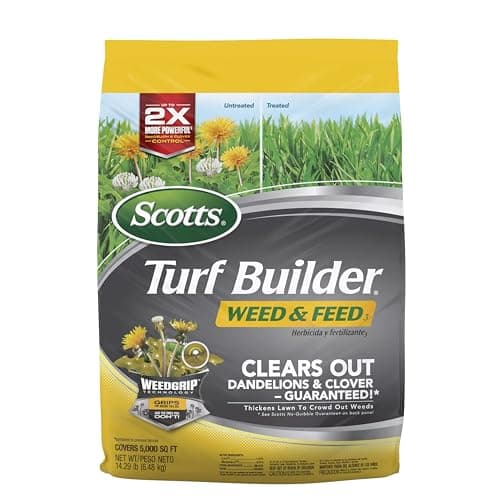
Late spring: Weed & Feed3, if you must.It works on established broadleaf weeds. Apply to a damp lawn and do not water it in for a day or two, which is the opposite of what the fertilizer half wants — the compromise is real.
Never on new grass. Broadleaf herbicides damage grass seedlings. Wait until new grass has been mown three or four times before applying anything on this page.
Spread it with a calibrated spreader. Herbicide applied unevenly means strips with no weed control and strips with too much. A spreader with edge control also keeps herbicide off the driveway, which matters for runoff.
Who should skip these
Skip the whole category if your weeds are in patches. Spot-spraying is cheaper, more effective and puts a tiny fraction of the herbicide on your lawn.
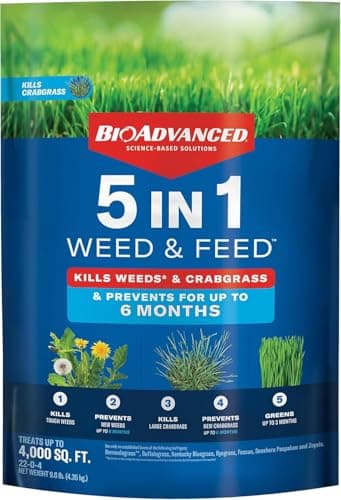
Skip the BioAdvanced 5-in-1 unless price is the deciding factor. It is the cheapest route to a combined application and a small bag, so the real cost per thousand square feet is less of a bargain than the shelf price suggests — and a product making five claims is compromising on all five by definition.
And skip all of it if the lawn is thin. Weeds colonise bare ground, so a thin lawn is a weed factory whatever you spray on it. The durable fix is a thicker lawn: feed it, mow it higher on your mower, and overseed it with decent fescue.