Skip to content
Fairway&Fescue

The Feed · Fertilizer, Weed Control & Spreaders

How to Calibrate a Broadcast Spreader

The setting number on the bag is a starting guess, not a calibration - it assumes a walking speed that is not yours. Two methods to find your real setting, in about twenty minutes.

By Stephen V.Updated How we pick
#ad

We earn a commission when you buy through our Amazon links, at no extra cost to you. It never changes our rankings — and we'll tell you when the cheaper bag or machine is the better buy. How this works.

Calibrating a spreader means finding the gate setting that puts the label rate on your lawn at the speed you actually walk — and the fastest way to do it is the measured-area method: weigh out exactly enough product for 1,000 square feet, mark out 1,000 square feet, and adjust the setting until the hopper runs empty as you finish. Twenty minutes, a tape measure and a kitchen scale. The catch-pan method below is more precise and is what extension services publish for rotary spreaders, but for a homeowner feeding a lawn four times a year, the measured-area method is accurate enough and far quicker.

The reason it matters is that the setting number printed on a fertilizer bag is a guess about a spreader that may not be yours, filled with a granule that may not flow like yours, pushed at a speed that is definitely not yours. UF/IFAS puts it plainly: how much lands on the lawn depends on the material andon the operator’s walking speed, so a spreader has to be calibrated for each product and each person pushing it. Get it wrong high and you burn stripes into the lawn. Get it wrong low and you paid for a feeding that did not happen.

We have calibrated nothing for this page. Capacities, hopper sizes, pattern types and control mechanisms are the figures the manufacturers publish — see how we pick. The calibration procedures are published university extension and turf-association methods, cited at the foot of the page. Prices come from the live price layer with an “as of” date beside each spreader.

The short answer

Quick picks

#ProductBest forScorePrice
01
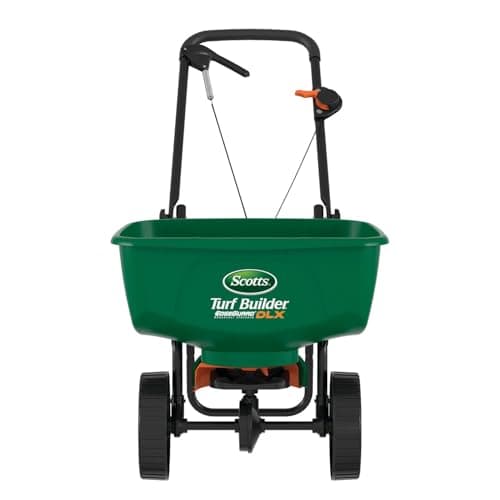
Scotts Scotts Turf Builder EdgeGuard DLX Broadcast Spreader
Scotts Turf Builder EdgeGuard DLX Broadcast Spreader

The spreader to buy. EdgeGuard shuts off the right-hand side of the spread pattern, which is the one feature that stops you throwing fertilizer into beds, onto the driveway and down the storm drain.

Best broadcast spreader for most lawns
8.6
$90.21Amazon
02
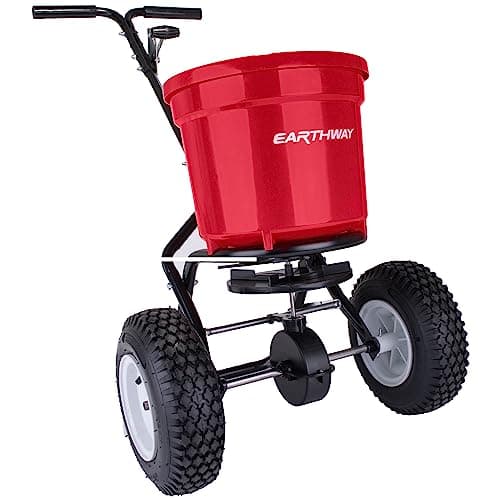
EarthWay EarthWay 2150 Commercial 50 lb Broadcast Spreader
EarthWay 2150 Commercial 50 lb Broadcast Spreader

The one spreader here built to last. A 50 lb commercial hopper, an adjustable drop rate and 13-inch pneumatic tires — the tires are why it tracks straight and spreads evenly over rough ground.

The spreader you buy once
8.2
$279.99Amazon
03
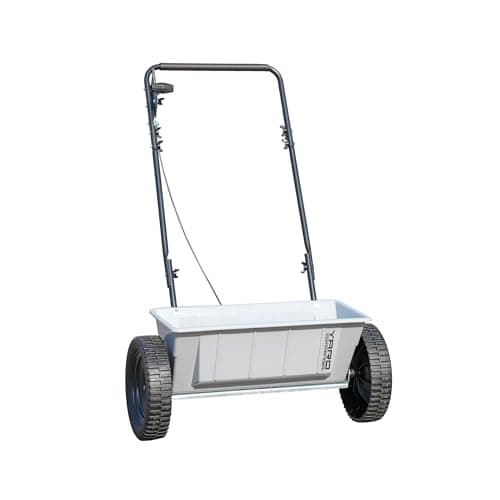
Yard Commander Yard Commander 60 lb Walk-Behind Push Drop Spreader
Yard Commander 60 lb Walk-Behind Push Drop Spreader

The drop spreader a homeowner actually buys. Product falls straight down between the wheels, so nothing is thrown onto a bed, a path or a driveway - which is the entire reason to own one.

Best drop spreader for most lawns
7.4
$89.99Amazon
04
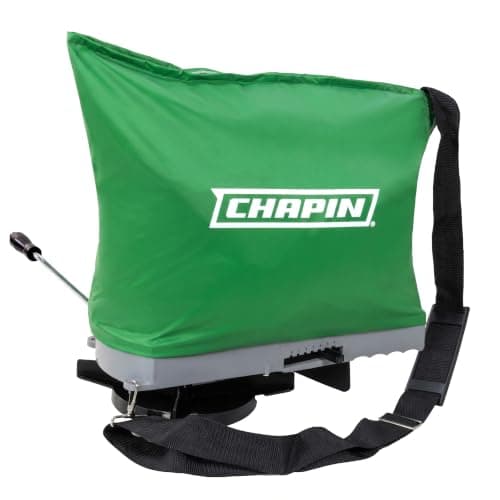
Chapin Chapin 84700A TurfPro 25 lb Handheld Bag Spreader
Chapin 84700A TurfPro 25 lb Handheld Bag Spreader

A shoulder-slung bag spreader holding 25 lb — the tool for the places a wheeled spreader cannot reach: slopes, terraces, narrow side strips and under low branches.

Slopes and awkward strips
7.2
$31.97Amazon

#ad · Live prices from the Amazon Product API, as of November 1, 2026. Where we have no verified live price, we show none — we would rather leave a gap than print a number that has rotted.

In detail

The picks, in full

01
Scotts Scotts Turf Builder EdgeGuard DLX Broadcast Spreader

Best broadcast spreader for most lawns

Scotts Turf Builder EdgeGuard DLX Broadcast Spreader

EdgeGuard side shut-offHolds up to 15,000 sq ft of productBroadcast / rotaryCalibrated settings dial
8.6/10

The spreader to buy. EdgeGuard shuts off the right-hand side of the spread pattern, which is the one feature that stops you throwing fertilizer into beds, onto the driveway and down the storm drain.

Spread accuracy
9
Edge control
10
Capacity
9
Build quality
6
Value
9

Pros

  • The edge shut-off is genuinely the most useful feature on any consumer spreader — it saves product and keeps fertilizer out of water
  • A 15,000 sq ft hopper means most lawns are a single fill
  • Scotts prints matching setting numbers on their own bags, so calibration is a dial rather than a maths problem

Cons

  • Plastic construction throughout — this is not a lifetime tool
  • Rinse it after every use or fertilizer salts will seize the gate mechanism

Skip this if…

…your lawn is under about 3,000 square feet. The Mini does the same job in a smaller frame that is far easier to store, for a lot less.

$90.21View on Amazon

$114.9922% off

Price as of November 1, 2026. Prices change — Amazon's is the one that counts.

#ad · we may earn a commission from this link to Scotts Turf Builder EdgeGuard DLX Broadcast Spreader

02
EarthWay EarthWay 2150 Commercial 50 lb Broadcast Spreader

The spreader you buy once

EarthWay 2150 Commercial 50 lb Broadcast Spreader

50 lb capacityCommercial grade13" pneumatic tiresAdjustable drop rate
8.2/10

The one spreader here built to last. A 50 lb commercial hopper, an adjustable drop rate and 13-inch pneumatic tires — the tires are why it tracks straight and spreads evenly over rough ground.

Spread accuracy
10
Edge control
5
Capacity
10
Build quality
10
Value
6

Pros

  • Pneumatic tires keep the impeller at a constant height over bumps, which is what actually keeps a spread pattern even
  • Built for daily commercial use, so a homeowner will not wear it out
  • Adjustable drop rate gives you real calibration control rather than a numbered dial

Cons

  • Costs several times what the Scotts spreaders do
  • No edge shut-off — you manage the pattern with the drop rate and your line, not with a guard

Skip this if…

…your main concern is keeping fertilizer out of beds and off paving. The EdgeGuard shut-off on the Scotts spreaders does that automatically and this does not.

$279.99View on Amazon

Price as of November 1, 2026. Prices change — Amazon's is the one that counts.

#ad · we may earn a commission from this link to EarthWay 2150 Commercial 50 lb Broadcast Spreader

03
Yard Commander Yard Commander 60 lb Walk-Behind Push Drop Spreader

Best drop spreader for most lawns

Yard Commander 60 lb Walk-Behind Push Drop Spreader

Drop pattern60 lb hopperUp to 15,000 sq ft of productWalk-behind
7.4/10

The drop spreader a homeowner actually buys. Product falls straight down between the wheels, so nothing is thrown onto a bed, a path or a driveway - which is the entire reason to own one.

Placement accuracy
10
Speed per 1,000 sq ft
4
Capacity
8
Ease of use
7
Value
8

Pros

  • A drop pattern puts product only where the hopper passes, so beds, borders and hard surfaces stay clean without a guard
  • 60 lb hopper is more capacity than most homeowner broadcast spreaders carry
  • No sideways throw means no striping from an uneven spread arc

Cons

  • Spread width is roughly the width of the machine, so a lawn takes two to three times the passes of a broadcast spreader
  • Every pass has to overlap the last exactly, or you get a stripe of unfed grass

Skip this if…

…your lawn is over about 8,000 square feet of open ground. The pass count is the whole cost of a drop spreader, and on a big open lawn a broadcast spreader with edge control finishes in a third of the walking.

$89.99View on Amazon

Price as of November 1, 2026. Prices change — Amazon's is the one that counts.

#ad · we may earn a commission from this link to Yard Commander 60 lb Walk-Behind Push Drop Spreader

04
Chapin Chapin 84700A TurfPro 25 lb Handheld Bag Spreader

Slopes and awkward strips

Chapin 84700A TurfPro 25 lb Handheld Bag Spreader

25 lb capacityHandheld / shoulder bagCrank-driven impellerSeed and fertilizer
7.2/10

A shoulder-slung bag spreader holding 25 lb — the tool for the places a wheeled spreader cannot reach: slopes, terraces, narrow side strips and under low branches.

Spread accuracy
6
Edge control
7
Capacity
7
Build quality
8
Value
8

Pros

  • Goes where wheels cannot — a bank, a terrace, a strip between fence and path
  • 25 lb is a lot of capacity for a handheld, so you are not refilling constantly
  • Chapin build quality is a clear step up from the plastic hand-crank spreaders

Cons

  • Hand-cranked, so the spread rate depends on your walking pace and crank speed staying consistent
  • 25 lb on a shoulder strap gets heavy quickly

Skip this if…

…your lawn is open and flat. A wheeled spreader is more accurate and much less work, and accuracy is most of what you are buying a spreader for.

$31.97View on Amazon

$40.0020% off

Price as of November 1, 2026. Prices change — Amazon's is the one that counts.

#ad · we may earn a commission from this link to Chapin 84700A TurfPro 25 lb Handheld Bag Spreader

First: find your real swath width

Everything downstream depends on this number, and almost nobody measures it. A rotary spreader throws granules in a fan, heavy in the middle and thinning to nothing at the edges. The width you can actually use is not the width the granules reach — it is narrower, because the thin outer edge has to be covered twice by the next pass to add up to a full rate.

The method UGA publishes for finding it: set out a row of pans across your path, make a pass, and find the point on each side where a pan has caught half of what the center pan caught. That distance, side to side, is your effective swath width, and it is the spacing you should walk your passes at. On a typical homeowner rotary spreader it lands somewhere around 8 to 12 feet, and it changes with the product — dense, round prills throw further than light, irregular organic granules.

If you do nothing else from this page, do this: throw a pass across a clean driveway and look at where the granules actually land. Pacing your passes to the visible edge of the throw rather than to the half-rate point is the single most common cause of striped lawns, because the overlap zone never gets its second dose.

Method 1: the measured-area method (the fast one)

This is the method to use if you have a lawn to feed this weekend. It calibrates the whole system — spreader, product, gate setting and your own walking speed — in one test, which is exactly what you want.

1. Read the rate off the bag. Every lawn product states coverage: a 14-pound bag covering 5,000 square feet is 2.8 pounds per 1,000 square feet. That number, not the setting number, is the thing you are trying to hit.

2. Weigh out one test portion.Put exactly that weight — 2.8 pounds in the example — into the hopper. A kitchen or luggage scale is fine. Do not eyeball it; the whole test is the weight.

3. Mark out 1,000 square feet. A 20-by-50-foot rectangle, or 25 by 40. Flags, hose, chalk, anything. Pick a flat, representative part of the lawn, not the slope.

4. Set the gate to the bag’s suggested number and spread the test area, walking passes spaced at the swath width you measured, at the speed you would normally walk. Open the gate only while moving and close it at every turn.

5. Read the result.Empty hopper and the area just covered means the setting is right — write it on the bag in marker. Product left over means the gate is too low, so open it a notch and repeat. Ran out early means the gate is too high: close it a notch and repeat. Two or three iterations gets you there.

The number you end up with is specific to that spreader, that product and you. Write it down somewhere permanent. Next spring you will not remember it.

Method 2: the catch-pan method (the precise one)

This is the procedure extension services publish, and it is worth the extra half hour if you are applying something where accuracy really matters — a pre-emergent, a weed-and-feed, or anything whose label has a maximum rate rather than a suggested one.

What you need.Clemson’s version calls for a tape measure of at least 100 feet, a scale that reads small increments, nine shallow trays or cake pans, a bucket and some flags. UF/IFAS uses eleven pans about two inches deep — deep enough that granules do not bounce back out — set one foot apart in a line across your walking path.

Fill the hopper a quarter to half full with the product you are actually going to use. Not a substitute, not sand: granule size, density and shape change the throw.

Make at least three passesdirectly over the center pan, all in the same direction, at a steady pace that matches how you really walk. Keep the spreader running until it has cleared every pan — stopping early undercounts the rate. Arizona’s turf program advises repeating the run until the results agree within about ten percent.

Weigh each pan.The center pans give you the rate; the taper across the row gives you the pattern. A good pattern is a smooth hump that falls away evenly on both sides. If one side is consistently heavier, the pattern is off-center and most rotary spreaders have an adjustment for exactly that — a side-bias lever or an impeller offset.

Do the arithmetic. Total weight caught, divided by the total pan area, divided by the number of passes, scaled to 1,000 square feet. Compare to the label rate and move the gate.

Drop spreaders: a different problem

A drop spreader has no pattern to calibrate. Product falls straight down between the wheels, so the swath is exactly the width of the hopper and the edges are hard lines. That removes the throw variable entirely — which is why drop spreaders are the accurate choice for anything you must not get on a flower bed, a driveway or a neighbor’s hostas.

What it does not remove is the rate variable, so you still calibrate with the measured-area method. And it introduces its own failure mode: because the edges are hard, a drop spreader must be walked wheel-track to wheel-track with no gap. Leave a two-inch gap and you get a two-inch green-free stripe that will be visible for months. The broadcast vs drop spreader comparison lays out which one to own.

The half-rate, two-direction trick

Here is the technique that makes striping almost impossible, and it costs nothing. Once you know your correct setting, halve the rate— close the gate to roughly half the calibrated opening — and make two complete applications at right angles to each other: north-south, then east-west.

Two half-rate passes in crossing directions add up to one full rate, but every error gets averaged instead of accumulated. A slightly thin overlap in one direction is covered by the pass across it. It takes twice as long to walk and it is the single biggest improvement most people can make to how their lawn looks after feeding. Golf course superintendents have been doing it for decades, and it is one of the few things from that world that transfers straight to a home lawn.

The mistakes that waste a calibration

Walking faster than you calibrated. Rate is weight per area, and area is speed times width times time. Walk faster and the same gate setting puts down less. This is why calibrating for yourself matters: a tall person at a brisk pace and a short person strolling apply genuinely different rates through the same hopper.

Opening the gate before moving. Three seconds of a stationary open gate is a pile of fertilizer, and a pile of fertilizer is a dead patch. Start walking, then open. Close, then stop.

Reusing last product’s setting.A dense synthetic prill and a light organic granule flow through the same gate at entirely different rates. Recalibrate when the product changes — which, for most lawns, means once for the feed and once for the weed control.

Spreading a damp or clumped bag. Clumps bridge over the gate and then let go all at once. If the bag has been in a damp shed over winter, break the clumps up before it goes in the hopper or the calibration means nothing.

Not sweeping the hard surfaces. Granules on a driveway or sidewalk are not feeding anything and they wash into the storm drain. Sweep them back onto the lawn. A spreader with an edge shut-off keeps most of them off there in the first place.

Which spreader makes this easy

A rotary spreader with a calibrated settings dial is the right default, because the dial numbers match what is printed on the bags, which gives you a sensible starting point rather than a blind guess. An edge shut-off on one side is the other feature worth paying for: it stops the throw on the hard-surface side, so you can feed right up to a drive without sweeping afterwards.

A commercial-grade rotary spreader earns its price on consistency rather than features. Pneumatic tires roll at a steadier speed over uneven ground than small hard wheels, and steady speed is the thing a calibration depends on. If you feed a lawn four times a year for twenty years, this is the one to buy once.

A drop spreader is the accuracy tool: no throw, hard edges, nothing landing where it should not. Slower, and unforgiving about gaps.

A handheld bag spreader is for slopes, strips and the awkward corner behind the shed. Calibrating one is genuinely hard, because the rate depends on your crank speed as well as your walking speed, so treat it as a tool for small areas and patching rather than for feeding a whole lawn on a measured rate.

The full rankings are on best broadcast spreader. Once the spreader is calibrated, what goes in it is the question — the granular rankings are on best lawn fertilizer, and the timing is on the lawn fertilizer schedule. If it is seed going through the hopper rather than feed, how long grass seed takes to germinate sets the expectations for what happens next.
How we picked this

We haven't run this gear through a lab — and we say so

We compiled the published manufacturer specifications — deck width and gauge, drive type, blower CFM, fertilizer NPK, seed species — did the deck-width and nitrogen arithmetic, cross-read the owner manuals, and scored each pick against a published rubric. The scores are judgments from documented research — they are notlab measurements we took, because we don't have a lab and we're not going to pretend we do. Where somebody has genuinely measured this, we link them. You can check every number we publish.

Questions

Frequently asked

Do I really need to calibrate a spreader if the bag lists a setting?
The bag setting is a starting point, not a calibration. UF/IFAS notes that how much lands on the lawn depends on the material and on the operator's walking speed, so the same setting applies different rates for different people and different products. If you are putting down a plain slow-release feed, the bag number plus a careful pace is usually close enough. If you are putting down a pre-emergent or a weed-and-feed, where the label has a maximum rate, calibrate.
What is the fastest way to calibrate a spreader?
The measured-area method. Weigh out exactly the amount the label says covers 1,000 square feet, mark out a 1,000 square foot area such as 20 by 50 feet, set the gate to the bag's suggested number and spread it at your normal walking pace. Empty hopper at the finish line means the setting is right. Product left over means open the gate a notch; running out early means close it a notch.
How do I find my spreader's swath width?
Set out a row of pans across your walking path, make a pass over them, and find the point on each side where a pan holds about half of what the center pan holds. The distance between those two points is your effective swath width, and it is the spacing to walk your passes at - not the full width the granules reach. On most homeowner rotary spreaders it is somewhere around 8 to 12 feet, and it changes with the product.
Why is my lawn striped after fertilizing?
Almost always because the passes were spaced to the visible edge of the throw rather than to the half-rate point, so the overlap zone never got its second dose. The fix is to measure your real swath width and then, better still, halve the rate and make two applications at right angles to each other. Two crossing half-rate passes average errors out instead of accumulating them.
Do I have to recalibrate for every product?
Yes, whenever the granule changes. A dense synthetic prill and a light organic granule flow through the same gate opening at very different rates. In practice that means one calibration for your fertilizer and another for your weed control or pre-emergent, each written on the bag so you have it next season.
Does a drop spreader need calibrating?
For rate, yes - use the measured-area method. For pattern, no: product falls straight down between the wheels, so there is no throw to adjust and the swath is simply the hopper width. The trade is that the edges are hard lines, so the wheel tracks have to butt up against each other on every pass. A small gap becomes a visible stripe.

Keep reading

Receipts

Sources

We do not run a testing lab, and we do not pretend to. Every spec number here comes from a manufacturer's published sheet or an official standard, cited above. Where we could not verify something, we say so on the page rather than quietly leaving it out. Read our full method.