Skip to content
Fairway&Fescue

The Soil · Aerators, Dethatchers & Lawn Repair

The Best Lawn Sweeper

Leaves, clippings and aeration plugs collected instead of blown - ranked on the two numbers that decide how long the job takes: sweeping width and hopper volume.

By Stephen V.Updated How we pick
#ad

We earn a commission when you buy through our Amazon links, at no extra cost to you. It never changes our rankings — and we'll tell you when the cheaper bag or machine is the better buy. How this works.

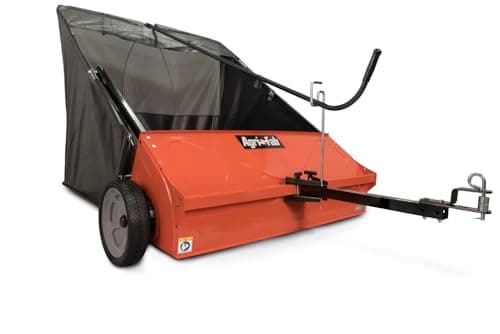
If you own a riding mower, the best lawn sweeper is the Agri-Fab 44" with the 28 cubic foot flow-through hopper. Widest useful sweeping path for the money, the biggest hopper here, and a dump handle you reach from the seat. For a big open lawn the Agri-Fab 50" trades two cubic feet of hopper for six more inches of width, which is the right trade past about half an acre. The Brinly 42"runs six brushes on a 5:1 drive into a 20 cubic foot hamper — the most brush contact per foot traveled of any sweeper here. The Agri-Fab 42" with the 12 cubic foot hopper is the cheapest way into a towed sweeper, and you pay for it in emptying trips. With no tow vehicle, the VEVOR 26" push sweeper is the widest no-engine option, and the Earthwise LSW70021 is the small, cheap, known-brand 21-inch version.

A lawn sweeper is one of the few lawn tools whose mechanism is completely transparent. The wheels turn a geared axle, the axle spins a row of brushes, the brushes flick whatever is lying on the lawn up and backward into a hopper. There is no engine, no battery and nothing to service; the energy comes from the machine moving forward, which is why a towed sweeper costs you nothing but the fuel the mower was already burning. That also explains the one real limitation: a sweeper picks up what its brushes can reach and throw. A dry leaf layer and dry clippings go in beautifully. Wet matted leaf, pressed flat into the turf, does not.

We have swept nothing for this page. Sweeping widths, hopper volumes, brush counts, drive ratios and dump mechanisms are the figures the manufacturers and listings publish, and the rankings read those — see how we pick. Prices come from the live price layer, with an “as of” date beside each tool.

The short answer

Quick picks

#ProductBest forScorePrice
01
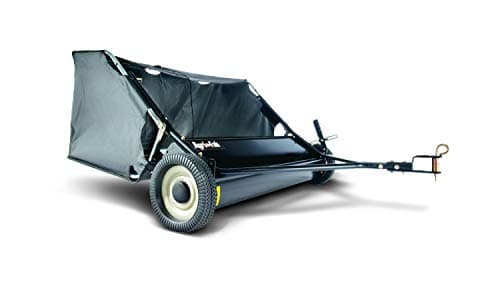
Agri-Fab Agri-Fab 44" Tow-Behind Lawn Sweeper (28 cu ft)
Agri-Fab 44" Tow-Behind Lawn Sweeper (28 cu ft)

The one to buy if you own something to pull it with. A 28 cubic foot flow-through hopper is the biggest here, and the dump handle means you empty it without getting off the seat.

Best lawn sweeper overall
8.8
$429.99Amazon
02
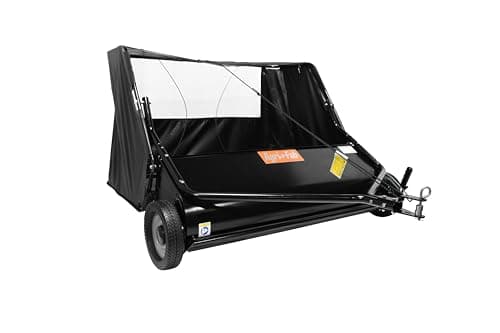
Agri-Fab Agri-Fab 50" Tow-Behind Lawn Sweeper (26 cu ft)
Agri-Fab 50" Tow-Behind Lawn Sweeper (26 cu ft)

A 50-inch brush sweeper with a 26 cubic foot hopper. After dethatching or in leaf season, this is what turns a day of raking into twenty minutes behind the mower.

Clearing debris after dethatching
8.4
$399.99Amazon
03
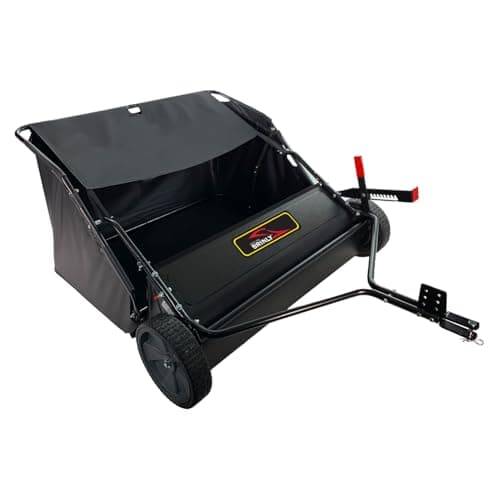
Brinly Brinly 42" Tow-Behind Lawn Sweeper
Brinly 42" Tow-Behind Lawn Sweeper

Six brushes on a 5:1 drive into a 20 cubic foot hamper. The brush count is the interesting part: more brushes means more passes over the same blade of grass per foot traveled.

Best brush system
8.0
$369.00Amazon
04
Agri-Fab Agri-Fab 42" Tow-Behind Lawn Sweeper (12 cu ft)
Agri-Fab 42" Tow-Behind Lawn Sweeper (12 cu ft)

The cheapest way into a towed sweeper. The 12 cubic foot hopper is less than half the 44-inch model's, so you empty it more than twice as often — which is the whole trade.

Cheapest tow-behind sweeper
7.6
$299.00Amazon
05
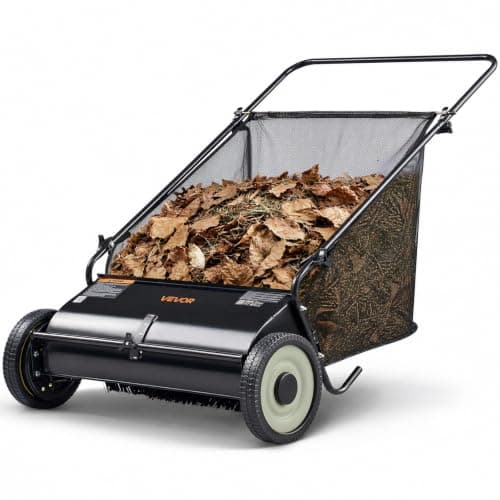
VEVOR VEVOR 26" Push Lawn Sweeper (7 cu ft)
VEVOR 26" Push Lawn Sweeper (7 cu ft)

A 26-inch push sweeper with a 7 cubic foot bag and four brushes — the widest no-tractor option here, and the one that makes sense if the lawn is small but the leaf fall is not.

Best push lawn sweeper
6.4
$115.90Amazon
06
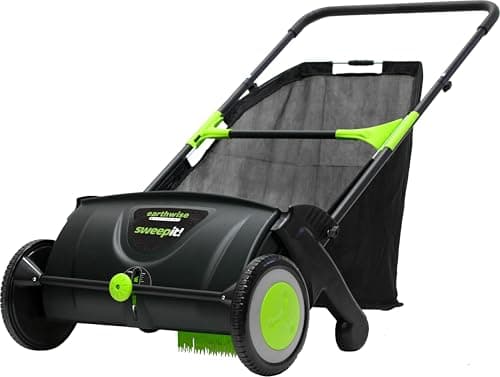
Earthwise Earthwise LSW70021 21" Push Lawn Sweeper
Earthwise LSW70021 21" Push Lawn Sweeper

The small, cheap, known-brand push sweeper. 21 inches wide, no engine, and the right answer for a small lawn with one tree on it.

Small lawns, lowest price
6.2
$112.88Amazon

#ad · Live prices from the Amazon Product API, as of October 21, 2026. Where we have no verified live price, we show none — we would rather leave a gap than print a number that has rotted.

In detail

The picks, in full

01
Agri-Fab Agri-Fab 44" Tow-Behind Lawn Sweeper (28 cu ft)

Best lawn sweeper overall

Agri-Fab 44" Tow-Behind Lawn Sweeper (28 cu ft)

44" sweeping width28 cu ft flow-through hopperDump-from-seat handleAdjustable brush height
8.8/10

The one to buy if you own something to pull it with. A 28 cubic foot flow-through hopper is the biggest here, and the dump handle means you empty it without getting off the seat.

Debris capacity
10
Working width
9
Build quality
9
Ease of use
9
Value
7

Pros

  • 28 cubic feet is the largest hopper in this group, and hopper volume is what decides how many times you walk to the leaf pile
  • A flow-through bag lets air pass out of the hopper instead of ballooning it, which is what keeps a sweeper picking up when it is half full
  • Dumping from the seat turns emptying from a two-minute stop into a ten-second one
  • Brush height adjusts, so it lifts leaves off thin turf without scrubbing the crowns

Cons

  • Needs a riding mower, tractor or zero-turn with a hitch
  • 44 inches wide and tall when assembled — this lives in a shed or a garage bay, not on a hook
  • Costs more than every push sweeper here put together

Skip this if…

…you have no tow vehicle. Nothing about this works without one, and a 26-inch push sweeper will clear a small lawn for a fifth of the price.

$429.99View on Amazon

Price as of October 21, 2026. Prices change — Amazon's is the one that counts.

#ad · we may earn a commission from this link to Agri-Fab 44" Tow-Behind Lawn Sweeper (28 cu ft)

02
Agri-Fab Agri-Fab 50" Tow-Behind Lawn Sweeper (26 cu ft)

Clearing debris after dethatching

Agri-Fab 50" Tow-Behind Lawn Sweeper (26 cu ft)

50" sweeping width26 cu ft hopperAdjustable brush heightTow-behind
8.4/10

A 50-inch brush sweeper with a 26 cubic foot hopper. After dethatching or in leaf season, this is what turns a day of raking into twenty minutes behind the mower.

Debris capacity
10
Working width
10
Build quality
8
Ease of use
7
Value
7

Pros

  • 26 cubic feet is a lot of debris per emptying — dethatching output is the one job that genuinely needs this much capacity
  • Adjustable brush height means it picks up thatch and leaves without scuffing the turf
  • Also earns its keep every autumn on leaves

Cons

  • Needs a riding mower or tractor
  • Takes real shed space — a 50-inch sweeper does not fold away

Skip this if…

…you have no tow vehicle, or no storage. It is a big implement for one or two jobs a year, and a tarp and a rake cost nothing.

$399.99View on Amazon

$429.997% off

Price as of October 21, 2026. Prices change — Amazon's is the one that counts.

#ad · we may earn a commission from this link to Agri-Fab 50" Tow-Behind Lawn Sweeper (26 cu ft)

03
Brinly Brinly 42" Tow-Behind Lawn Sweeper

Best brush system

Brinly 42" Tow-Behind Lawn Sweeper

42" sweeping width20 cu ft hamperSix brushes, 5:1 drive ratioUniversal hitch
8.0/10

Six brushes on a 5:1 drive into a 20 cubic foot hamper. The brush count is the interesting part: more brushes means more passes over the same blade of grass per foot traveled.

Debris capacity
8
Working width
8
Build quality
9
Ease of use
8
Value
7

Pros

  • Six brushes geared 5:1 off the wheels sweep the same ground more times per foot than a four-brush sweeper at the same speed
  • A 20 cubic foot hamper is enough for a suburban lot leaf day without constant stops
  • The universal hitch fits lawn tractors and most zero-turns

Cons

  • Two inches narrower and eight cubic feet smaller than the 44-inch Agri-Fab, for similar money
  • Still a tow-behind implement with a tow-behind implement storage footprint
  • Brinly publishes the hamper volume through its retail listings rather than a downloadable spec sheet

Skip this if…

…the lawn is big and open. Width and hopper volume win on open ground, and the 44-inch Agri-Fab has more of both.

$369.00View on Amazon

Price as of October 21, 2026. Prices change — Amazon's is the one that counts.

#ad · we may earn a commission from this link to Brinly 42" Tow-Behind Lawn Sweeper

04
Agri-Fab Agri-Fab 42" Tow-Behind Lawn Sweeper (12 cu ft)

Cheapest tow-behind sweeper

Agri-Fab 42" Tow-Behind Lawn Sweeper (12 cu ft)

42" sweeping width12 cu ft hopperEasy-dump ropeAdjustable brush height
7.6/10

The cheapest way into a towed sweeper. The 12 cubic foot hopper is less than half the 44-inch model's, so you empty it more than twice as often — which is the whole trade.

Debris capacity
6
Working width
8
Build quality
8
Ease of use
7
Value
9

Pros

  • Clearly the lowest price of any tow-behind sweeper in this group
  • Nearly the full sweeping width of the 44-inch model, so passes per lawn barely change
  • The dump rope works from the seat, the same idea as the bigger machine's handle

Cons

  • 12 cubic feet fills fast in leaf season — expect to empty it two or three times as often as the 28 cubic foot version
  • Smaller hopper also means more frequent stops on grass clippings, which are heavier than leaves
  • Needs a tow vehicle like every towed sweeper

Skip this if…

…you are sweeping half an acre of oak leaves. The emptying trips will cost you more time than the price difference saved.

$299.00View on Amazon

$329.999% off

Price as of October 21, 2026. Prices change — Amazon's is the one that counts.

#ad · we may earn a commission from this link to Agri-Fab 42" Tow-Behind Lawn Sweeper (12 cu ft)

05
VEVOR VEVOR 26" Push Lawn Sweeper (7 cu ft)

Best push lawn sweeper

VEVOR 26" Push Lawn Sweeper (7 cu ft)

26" sweeping width7 cu ft hopper bag4 spinning brushesSteel frame
6.4/10

A 26-inch push sweeper with a 7 cubic foot bag and four brushes — the widest no-tractor option here, and the one that makes sense if the lawn is small but the leaf fall is not.

Debris capacity
5
Working width
5
Build quality
6
Ease of use
7
Value
9

Pros

  • No engine, no battery, no tow vehicle — you walk and the wheels drive the brushes
  • 26 inches is five inches wider than the common 21-inch push sweepers, which is about a quarter fewer passes
  • 7 cubic feet is double the typical 21-inch sweeper bag
  • Quiet, which matters more than people expect when the alternative is a blower at 7 a.m.

Cons

  • Pushing a filling hopper is real work on anything bigger than a few thousand square feet
  • Brushes only pick up what they can reach — matted wet leaves need raking loose first
  • Nothing about the build is heirloom grade

Skip this if…

…you own a riding mower. A towed sweeper costs more but does the same job with your engine instead of your legs, and holds four times as much.

$115.90View on Amazon

Price as of October 21, 2026. Prices change — Amazon's is the one that counts.

#ad · we may earn a commission from this link to VEVOR 26" Push Lawn Sweeper (7 cu ft)

06
Earthwise Earthwise LSW70021 21" Push Lawn Sweeper

Small lawns, lowest price

Earthwise LSW70021 21" Push Lawn Sweeper

21" sweeping widthManual pushLeaf and grass collector bagNo tow vehicle needed
6.2/10

The small, cheap, known-brand push sweeper. 21 inches wide, no engine, and the right answer for a small lawn with one tree on it.

Debris capacity
4
Working width
4
Build quality
6
Ease of use
8
Value
9

Pros

  • The least expensive tool in this roundup by a wide margin
  • Light enough to push and light enough to hang up afterward
  • Earthwise is an established outdoor-tool brand rather than a one-season listing

Cons

  • 21 inches is narrow — about a quarter more passes than the 26-inch VEVOR over the same lawn
  • The bag is small, so emptying is frequent on a real leaf day
  • Like every push sweeper, it needs a reasonably level lawn to keep the brushes in contact

Skip this if…

…the lawn is more than a few thousand square feet, or the leaves fall in a week rather than a month. Width and capacity are what fix both, and this has neither.

$112.88View on Amazon

$139.9919% off

Price as of October 21, 2026. Prices change — Amazon's is the one that counts.

#ad · we may earn a commission from this link to Earthwise LSW70021 21" Push Lawn Sweeper

The criteria, in the order that actually decides it

1. Do you own something to tow it with?This is not a criterion so much as a fork in the road, and it eliminates most of the list either way. Towed sweepers in this group are 42 to 50 inches wide with 12 to 28 cubic feet of hopper. Push sweepers are 21 to 26 inches with 3.5 to 7 cubic feet. That is a four-to-eight-fold difference in capacity, and the towed machines do it using your mower’s engine rather than your legs.

2. Hopper volume, which is the number people underestimate.Sweeping width sets how many lengths you walk or drive. Hopper volume sets how many times you stop, walk to the heap, empty, and come back — and in leaf season that is the larger share of the afternoon. A 12 cubic foot hopper against a 28 cubic foot one is not “a bit smaller”; it is more than twice as many trips over the same lawn.

3. Sweeping width.Same arithmetic as a mower deck: the number of passes is your lawn’s width divided by the tool’s. Going from 42 to 50 inches cuts roughly a sixth off the passes. Going from 21 to 26 inches on a push sweeper cuts about a fifth. Width matters most on open ground and least on a lawn full of beds and trees, where a narrower tool threads more easily.

4. The brush system. Brushes are driven off the wheels through a gear ratio, so brush speed is a multiple of ground speed. Brinly publishes six brushes on a 5:1 ratio, which means more sweeps over each blade of grass per foot traveled than a four-brush sweeper at the same speed. Adjustable brush height is the other half: set too low the brushes scrub the turf and wear out, set too high they skim over the debris.

5. How it empties.A dump handle or rope you can work from the mower seat is worth more than it sounds, because you use it ten or fifteen times in an afternoon. A flow-through hopper bag matters for the same practical reason — air escapes through the mesh instead of ballooning the bag, so the machine keeps taking debris when it is half full.

The six, compared on published figures

SweeperTypeSweeping widthHopperEmptyingBest lawn size
Agri-Fab 44"Tow-behind44 in28 cu ft, flow-throughDump-from-seat handleQuarter acre to an acre
Agri-Fab 50"Tow-behind50 in26 cu ftDump handleHalf an acre and up, open
Brinly 42"Tow-behind42 in20 cu ftHamper dumpQuarter to half acre
Agri-Fab 42"Tow-behind42 in12 cu ftEasy-dump ropeUp to a quarter acre, on a budget
VEVOR 26"Push26 in7 cu ftLift-off bagSmall lawns, no tractor
Earthwise LSW70021Push21 inCollector bagLift-off bagSmall lawns, lowest price

Widths, hopper volumes and dump mechanisms are as published by Agri-Fab, Brinly, VEVOR and Earthwise. Where a figure is not published we have left it described rather than guessed. Live prices with an “as of” date are above.

Sweeper, blower, bagger or rake?

Four tools overlap here and each wins a different job. Choosing the wrong one is the main reason people decide sweepers “do not work”.

A sweeper collects. It is the only one of the four that picks debris up off a whole lawn, in volume, without an engine of its own. It is at its best on dry leaves, dry clippings, aeration plugs that have dried out, pine needles and the debris a dethatcher pulls to the surface — which is a genuinely enormous pile and the reason many people buy one.

A blower moves. Faster than a sweeper on hard surfaces and in beds, around obstacles and against fences, and the only sensible tool for a drive or a patio. It does not collect, so the leaves end up somewhere you then have to handle. The rankings are in best leaf blower, and for a wooded lot the harness machines are in best backpack leaf blower.

A bagging mower collects and shreds.If the leaf fall is light, raising the deck and running the mower over it is the fastest answer of all, because shredded leaf is worth having rather than disposing of — see best mulching lawn mower. The limit is volume: a mower bag is small, and heavy leaf fall clogs a deck.

A rake reaches what nothing else does. Wet matted leaf, leaf in beds, leaf against a wall. No sweeper will take a layer that has been rained on and pressed flat; rake it loose first and the sweeper will then pick it up.

Where a sweeper genuinely beats a blower

Three jobs, and they are the reason this tool still sells in a world full of blowers.

After dethatching or aerating.A scarifier pulls up a startling quantity of dead material, and a core aerator leaves the lawn covered in plugs. Blowing that is nearly impossible — it is heavy and damp. A sweeper takes it in passes. If you have just read aerating vs dethatching and booked a weekend for it, this is the tool that makes the cleanup bearable.

Grass clippings after a long gap. Mowing a lawn that got away from you leaves rows of clippings that will smother the turf underneath. A sweeper lifts them.

Pine needles and small debris in a windy spot. Blowing fine debris in the wind is a game you lose. Brushes do not care about the wind.

Getting it to actually pick up

Most “my sweeper leaves half the leaves behind” complaints are a setup problem, and they come down to three adjustments.

Brush height. Set the brushes so they just touch the grass tips with the hopper empty. Too low and they scrub the turf, wear fast and bog the wheels; too high and they sweep air. Re-check it once the hopper has weight in it, because weight changes the geometry.

Ground speed.Brush speed is a fixed multiple of wheel speed, so faster is not more aggressive — it just gives each brush less time in contact. On a heavy leaf layer, slow down and go over it twice rather than driving fast once.

Dry debris, and the right direction. Sweep when the lawn is dry. Wet leaves stick to the brushes and to each other and the hopper mesh clogs. On a lawn with a prevailing grain from mowing, sweeping at an angle to the mowing direction picks up more than following the same lines.

What we did not rank

Tow-behind sweeper-and-dethatcher combinations. They exist and they look like good value, but stock on them is intermittent and a combination tool does both jobs at a compromise. We would rather point at a sweeper that sweeps.

The 52-inch and larger imports. Several unbranded 52-inch sweepers list at attractive prices. Width is genuine, but with no manufacturer spec sheet behind the hopper figures and no parts channel, we have nothing to verify them against.

Lawn vacuums. Engine-driven vacuums and chipper-vacs collect and shred, which is a different and much more expensive category. For most lawns the mower already does the shredding.

The verdict

Most people with a riding mower:the Agri-Fab 44". 28 cubic feet, flow-through hopper, dump from the seat.

Half an acre and up of open lawn:the Agri-Fab 50". Six more inches of width is worth more than two cubic feet of hopper once the ground is open.

Best brush contact:the Brinly 42", six brushes on a 5:1 drive.

Cheapest towed option:the Agri-Fab 42" with the 12 cubic foot hopper — as long as you accept the extra emptying trips.

No tow vehicle:the VEVOR 26" push sweeper, or the Earthwise 21" if the lawn is small and the budget is the point.

A drive, a patio and some beds: not a sweeper at all. That is a blower job.
How we picked this

We haven't run this gear through a lab — and we say so

We compiled the published manufacturer specifications — deck width and gauge, drive type, blower CFM, fertilizer NPK, seed species — did the deck-width and nitrogen arithmetic, cross-read the owner manuals, and scored each pick against a published rubric. The scores are judgments from documented research — they are notlab measurements we took, because we don't have a lab and we're not going to pretend we do. Where somebody has genuinely measured this, we link them. You can check every number we publish.

Questions

Frequently asked

Are lawn sweepers worth it?
For a lawn with trees on it and a mower to tow with, yes - a tow-behind sweeper collects in passes what a rake collects in hours, using the engine you were already running. For a small lawn with no tow vehicle the case is weaker: a push sweeper is real work once the hopper has weight in it, and a blower plus a tarp may suit you better.
Do lawn sweepers pick up wet leaves?
Poorly. Wet leaves stick to each other, to the turf and to the brushes, and the hopper mesh clogs so air cannot escape. Sweep dry debris. If a layer has been rained on and pressed flat, rake it loose first and then sweep it.
What size lawn sweeper do I need?
Match it to how you will pull it and how much debris you have. Up to a quarter acre, a 42-inch towed sweeper or a 26-inch push sweeper is enough. A quarter acre to an acre with mature trees wants 44 inches and the largest hopper you can get. Past half an acre of open lawn, 50 inches cuts passes noticeably.
Will a lawn sweeper pick up aeration plugs?
Once they have dried for a few days, yes - and it is one of the jobs a sweeper is best at. Fresh, damp plugs smear rather than lift. Worth knowing, though: plugs left to break down on their own return their soil to the lawn, which is usually the better outcome. Sweep them only if you want the surface clean quickly.
Lawn sweeper or leaf blower?
A blower is faster on hard surfaces, in beds and around obstacles, but it only moves debris - you still have to collect it. A sweeper collects over a whole lawn in volume without its own engine. Most people with a big lawn and trees end up using both: the blower for edges and hard surfaces, the sweeper for the open grass.
How do I stop my lawn sweeper leaving debris behind?
Three adjustments. Set the brush height so the brushes just touch the grass tips with an empty hopper, slow your ground speed down on heavy layers (brush speed is geared to wheel speed, so speed only reduces contact time), and sweep at an angle to the direction you mow rather than along the same lines.

Keep reading

Receipts

Sources

We do not run a testing lab, and we do not pretend to. Every spec number here comes from a manufacturer's published sheet or an official standard, cited above. Where we could not verify something, we say so on the page rather than quietly leaving it out. Read our full method.