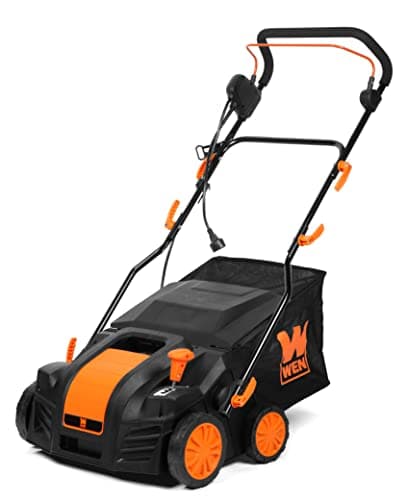
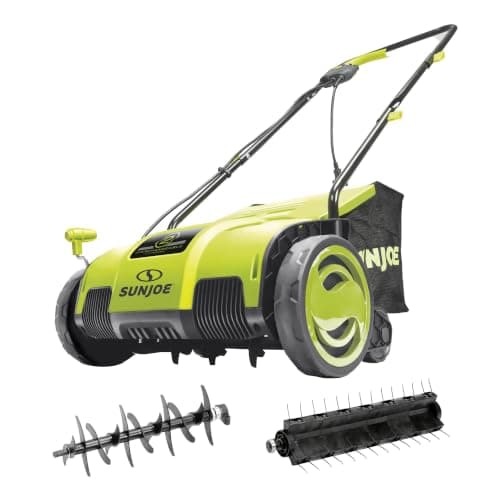
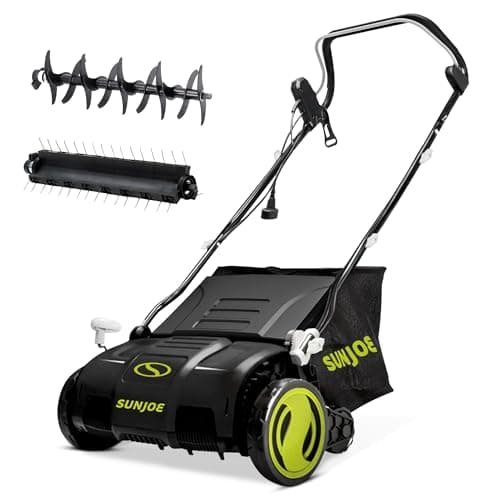
The best dethatcher is the Sun Joe AJ805E, and it wins on one thing: it ships with both reels. A spring-tine reel rakes loose material out of the canopy; a scarifier blade reel cuts down into the thatch mat and slices it out. Most lawns with a real thatch problem need the second one, and most machines sell it separately or not at all. If you want more motor and a collection bag, the WEN DT1516 has the strongest motor and widest cut here at 15 amps and 16 inches.
Before you buy anything, spend a minute on the diagnosis, because dethatching a lawn that does not need it does real damage. Cut a small wedge out of the lawn with a spade and look at the side of it. Between the green grass and the soil you will see a brown, fibrous, slightly spongy layer. Under about half an inch, that layer is doing useful work — insulating and cushioning — and you should leave it alone. Over half an inch, it starts shedding water and harbouring disease, and that is when you dethatch.
We have not scarified a lawn with any of these. The ranking reads published working widths, motor amperages, reel types and depth adjustment — see how we pick. And if what you actually have is hard soil rather than a spongy layer, this is the wrong page: go to best lawn aerator.
How to choose a dethatcher
Check which reel it comes with. This is the spec that decides whether the machine can do the job you bought it for. Spring-tine reels rake; scarifier blade reels cut. A machine with only a spring-tine reel will tidy a lawn with light thatch and will not get through a genuine mat. The Sun Joe AJ805E including both is the main reason it tops this list.
Then look at amperage. Dethatching is the most load-heavy job in this whole hub, because a blade reel full of wet thatch is genuinely hard work for a motor. Fifteen amps, as on the WEN, has real headroom; twelve, as on the cheaper Sun Joe, is adequate for a normal residential layer and will bog in a thick one.
Working width is secondary here. Unlike mowing, dethatching is slow deliberate work and you are not trying to cover ground fast. A wider machine helps on a big lawn but it is a smaller factor than reel type or motor power.
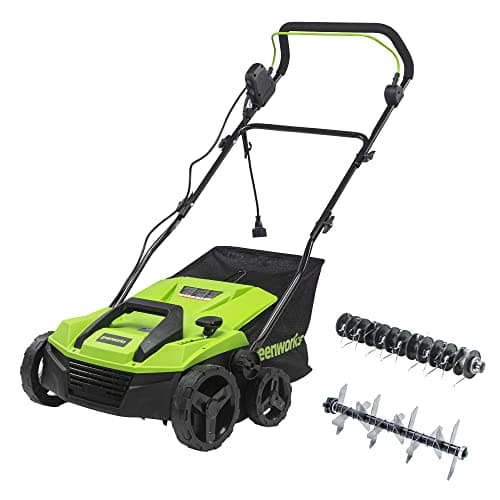
Depth adjustment stops you scalping the lawn. Set it too deep and you tear out living grass along with the thatch. Fixed positions, as on the Greenworks three-position system, are easy to repeat exactly; continuous adjustment gives finer control. Start shallow and go deeper only if the first pass is not pulling material.
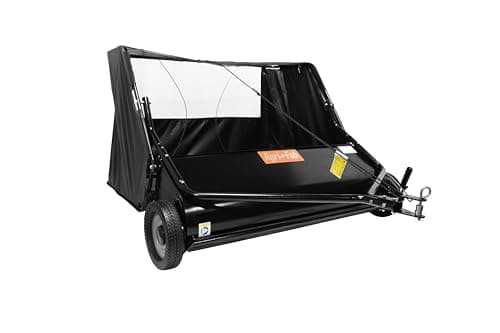
Plan for the debris, properly.This is the thing everyone underestimates. A dethatched lawn produces a startling volume of material — many bags from a small area. A collection bag, as on the WEN, reduces the raking but does not remove it, because the bag fills fast. If you have a ride-on with a hitch, the Agri-Fab 50-inch sweeper and its 26 cubic foot hopper turn a day of raking into twenty minutes, and it earns its keep on autumn leaves as well.
Time it so the lawn can recover. Early autumn for a cool-season lawn. Dethatching is deliberate damage with a purpose, and the grass needs growing conditions afterwards to fill back in. Doing it in summer heat is how a lawn gets killed.
What to do afterwards
A freshly dethatched lawn looks awful and that is normal. It is also the best seedbed you will ever have on an established lawn, because the seed now has direct access to soil rather than sitting on a mat. Overseed it immediately with turf-type fescue, feed it with a starter fertilizer, and keep it damp for two or three weeks. Our fertilizer roundup covers the feeding side.
Then deal with the cause. Thatch builds up where organic matter accumulates faster than soil life breaks it down — which is encouraged by excess nitrogen, by compaction, and by mowing habits. If you were feeding heavily, feed less. If the soil is also hard, core-aerate as well. And note that mulching clippings back into the lawn does not cause thatch; clippings are mostly water and break down quickly. That is a persistent myth and it costs people a lot of bagging.
Who should skip these
Skip all of it if your thatch layer is under half an inch. You would be damaging a lawn to solve a problem it does not have, and the layer you are removing is doing useful work.
Skip the 12-amp Sun Joe AJ798E if your thatch is over about an inch thick — it will stall in it, and the WEN's 15 amps or the AJ805E's blade reel is what that lawn needs. And skip the Agri-Fab sweeper if you have no tow vehicle or no shed space; it is a big implement for two jobs a year, and a tarp and a rake cost nothing.