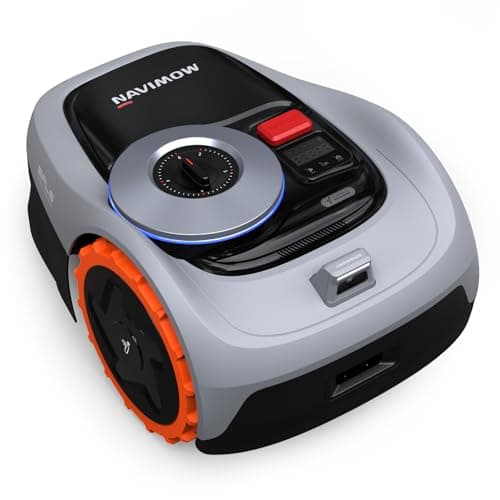
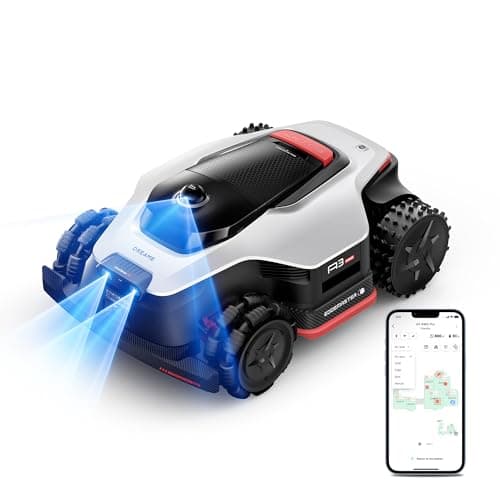
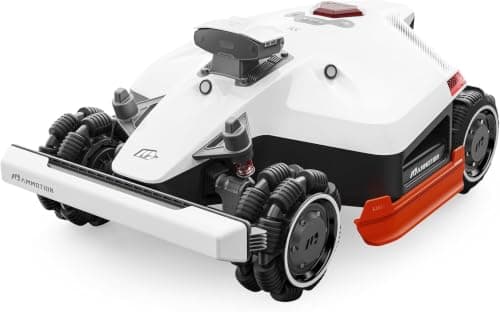
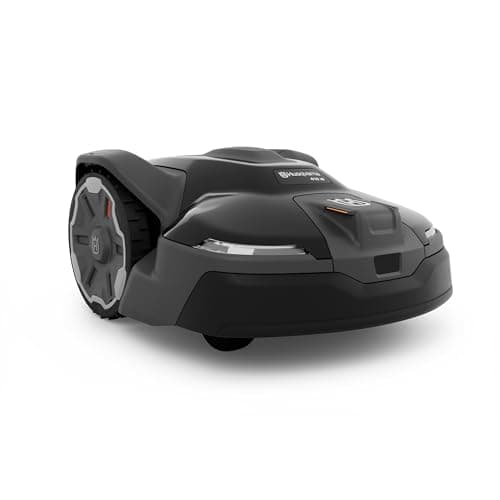
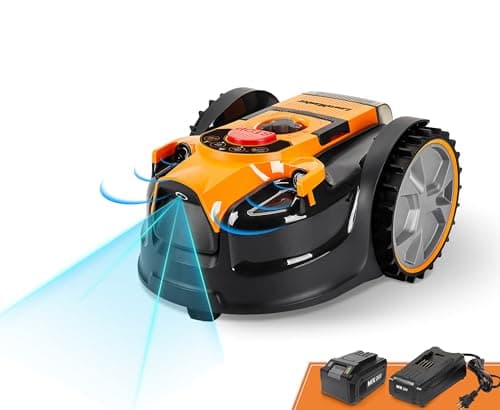
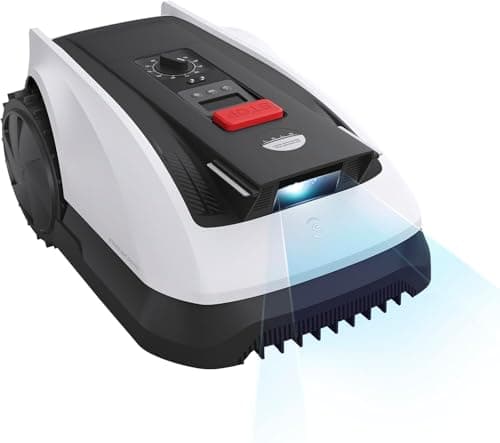
The best robot lawn mower without a perimeter wire for most yards is the ECOVACS Goat O1000: RTK satellite positioning backed up by vision, rated to a quarter acre, mapped from the app with no wire to bury anywhere. If your lawn is small and close to neighbors, the Segway Navimow i105Npublishes 58 dB(A) and is the quietest here. If your lawn sits under mature trees — which is where RTK gets into trouble — buy LiDAR instead: the DREAME A3 AWD. For three quarters of an acre, the Mammotion LUBA 2 AWD 3000HX; for a steep bank, the Husqvarna 410iQ at a 45% slope rating.
The perimeter wire is the thing that put people off robot mowers for a decade, and the objection was reasonable. A boundary wire is an afternoon of pegging or trenching cable around every bed, tree and path on your lawn; it is invisible once grass grows over it and it is a genuine nuisance when an aerator, an edger or a spade cuts it, because then you are hunting for a break in a buried cable.
Wire-free mowers replace that cable with one of four technologies, and which one you buy should be decided by how much sky your lawn can see. That is the single most useful sentence on this page.
RTK satellite positioning
A base station in a fixed spot receives satellite signals and corrects the mower's own position to centimeter accuracy. It is the most precise and the most common approach, it mows in tidy straight lines, and it needs the base station and the mower to have a clear view of the sky. Under a dense canopy, beside a tall building or in a narrow side yard, RTK loses its fix and the mower pauses or wanders.
LiDAR
A spinning or solid-state laser scanner builds a 3D picture of the yard and navigates from the shape of it rather than from satellites. That makes it the right answer under tree cover and in tight enclosed yards, and it costs more. Several models pair LiDAR with cameras for obstacle recognition.
Vision and AI cameras
Cameras identify grass against not-grass, so the mower finds its own boundary. Usually combined with RTK rather than used alone. Vision handles obstacles — hoses, toys, sleeping cats — better than satellite positioning does, and it struggles at dusk and in heavy rain.
Optical and sensor-based navigation
The cheapest wire-free approach: simpler optical sensors steering a mower that works a small area without a precise map. It will not mow in neat lines and it is the right technology for one or two thousand square feet at a price far below the RTK machines.
We have set up none of these. Everything here reads published navigation type, rated area, slope rating, drive type and noise figures — see how we pick. Prices are live from the price layer with an “as of” date beside each mower.
Wire-free robot mowers compared
| Mower | Navigation | Rated area | Slope | Best for |
|---|
| ECOVACS Goat O1000 | RTK + vision | 1/4 acre | Standard | Best all-round wire-free |
| Segway Navimow i105N | RTK + vision | 1/8 acre | Standard | Quietest, 58 dB(A) |
| DREAME A3 AWD | LiDAR | Under tree cover | AWD | Lawns under canopy |
| Mammotion LUBA 2 AWD 3000HX | RTK + AI vision | 0.75 acre | 80% | Three quarters of an acre |
| Husqvarna 410iQ | Wire-free | 1/2 acre | 45% | Steep or banked lawns |
| LawnMaster OcuMow | Optical | 1,000-2,000 sq ft | Standard | Cheapest way in |
Navigation types, rated areas, slope ratings and published noise figures above are the figures the manufacturers state. Prices are live with an “as of” date beside each mower.
How much sky does your lawn see?
Work this out before you compare anything else, because it eliminates whole categories.
Open lawn, few or no mature trees: buy RTK. It is the most precise, the most widely supported and the best value per rated acre. The Goat O1000 and the Navimow models are the picks.
Mature trees over part of the lawn, or a narrow side yard between buildings: buy LiDAR, or buy RTK with strong vision backup and accept that it will slow down under the canopy. The DREAME A3 is the LiDAR answer here.
Heavy continuous canopy: LiDAR only. An RTK mower under dense cover is a frustrating purchase, and no amount of base-station repositioning fixes a lawn the satellites cannot see.
Note also where the base station can go. It needs power, shelter from the worst weather and — for RTK — sky. A base station under the deck or against a north wall is the most common cause of a mower that “does not work”.
Wire-free against wired: the honest trade
A perimeter wire has two real advantages and it is worth naming them. It is cheap, which is why the lowest-priced robot mowers still use one. And it is absolutely reliable— a buried wire does not care about satellites, canopy, dusk or rain. If a wired mower is several hundred dollars less and you are happy to spend an afternoon pegging cable, that is a defensible choice.
What you buy with the extra money is the ability to change your mind. Wire-free boundaries are redrawn in the app in a minute: a new bed, a trampoline for the summer, a no-go zone around a newly seeded patch. With a wire, each of those is a trenching job. Over a decade of a lawn changing shape, that is the real argument.
What slope ratings actually mean
Manufacturers publish slope in percent and almost everybody thinks in degrees, which causes real mistakes. 45% is about 24 degrees. 80% is about 39 degrees. A bank you would describe as steep is often around 30 to 50%.
Check the rating against the steepestpart of your lawn rather than the average, and prefer all-wheel drive if there is any slope at all: AWD models climb better, get stuck less on soft ground and handle a lip at a path edge. Slope capability is also the strongest single case for owning a robot mower at all — see the hill mower roundup.
What no wire-free mower does
Cut edges.The blade sits inboard of the wheels on every model here, so a strip against a wall or fence is always left. You will keep a string trimmer — see the string trimmer roundup.
Reclaim long grass. These are trimmers, not reclaimers. Cut the lawn with a conventional mower first and let the robot maintain it after that.
Cross a path to a separate lawn on its own. Some models manage multiple zones with a mowable route between them; none teleport. A lawn in disconnected pieces is a genuine limitation.
Work without an app. Every wire-free mower is set up and controlled from a phone. There is no manual-only model in this category.
Who should skip these
Skip RTK entirely if your lawn is under heavy canopy. Buy LiDAR or buy a conventional mower; do not buy an RTK machine and hope.
Skip the quarter-acre models if your lawn is bigger — a mower working at its rated ceiling every day through a wet June falls behind. The acreage machines are in robot mowers for large yards.
And skip the whole category if you are not sure the economics work for you. Are robot lawn mowers worth it does that arithmetic honestly before you spend anything.