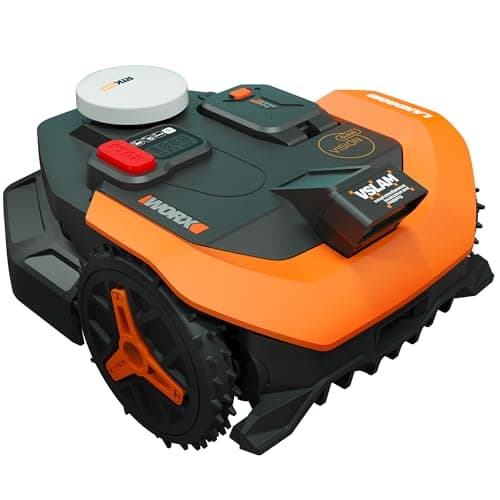
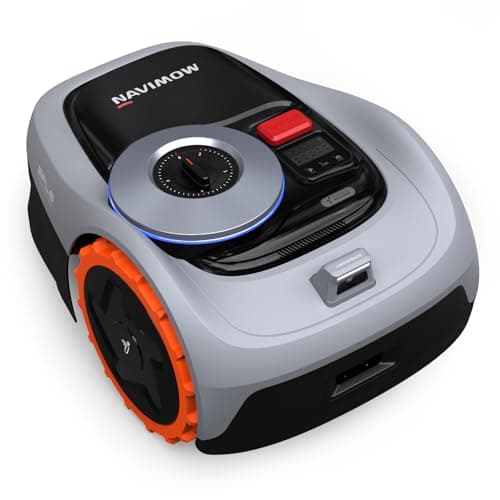
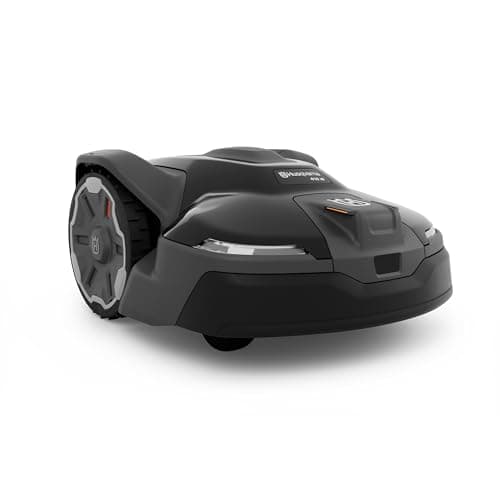
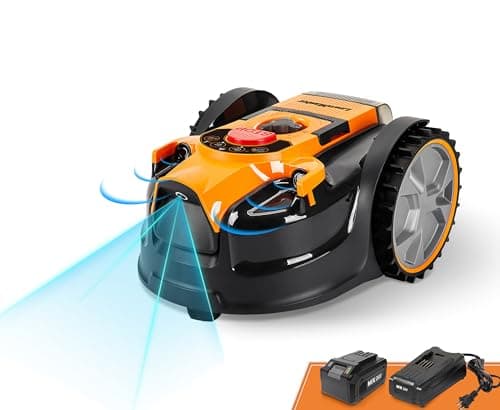
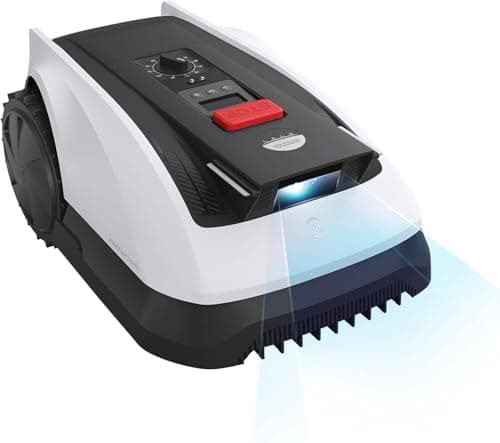
The robot mower that makes the most sense for the most lawns is the ECOVACS Goat O1000 RTK: wire-free RTK plus vision navigation, rated for a quarter acre, for less than many self-propelled walk-behind mowers cost. If your lawn is nearer half an acre, the WORX Landroid WR320 carries the same wire-free proposition at twice the rated area. If your lawn is steep, the Husqvarna 410iQ is rated for 45 percent gradients and nothing else here comes close.
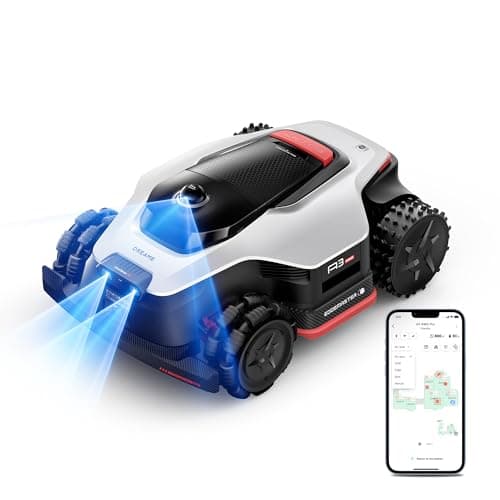
Two specifications decide whether a robot mower will work on your lawn, and everything else is detail. The first is rated area, and it is a ceiling rather than a guideline — a machine rated for an eighth of an acre on a quarter acre lawn will simply never catch up. The second is navigation type, and this is the one people get wrong. RTK uses satellite positioning and needs a clear view of the sky, so a lawn under a dense tree canopy defeats it. LiDAR and optical vision map the lawn without satellites, which is why the DREAME A3 is on this list despite costing more.
We have not run any of these on a lawn. The ranking is read off published rated areas, navigation systems, slope ratings and noise figures where manufacturers state them — see how we pick. If a robot mower turns out to be the wrong answer for your site, the honest alternative is a cordless walk-behind, which costs a fraction as much and has no site conditions at all.
How to choose a robot mower
Measure the lawn and then respect the rating. Rated area assumes the machine can run on a schedule that keeps up with growth. Go over it and the lawn is permanently slightly too long, which is the most common complaint about robot mowers and almost always a sizing mistake rather than a product fault.
Match navigation to your tree cover.This is the decision that separates a working installation from a frustrating one. Open lawn with clear sky: RTK is accurate and cheap, so buy the ECOVACS. Mature trees, tall buildings or a narrow side garden: satellite positioning will drift, and you want LiDAR or vision — the DREAME A3 or the LawnMaster OcuMow at the small end.
Check the slope rating against your worst bank. Robot mowers are light and they lose traction on wet grass going uphill. Most are rated somewhere around 25 to 35 percent; the Husqvarna 410iQ publishes 45 percent and all-wheel-drive machines like the DREAME handle damp gradients better than two-wheel ones. If you have a bank you would not comfortably walk a mower up, check this number first.
Noise is the whole point, so look at the figure.The reason to own a robot mower is that it works while you are not thinking about it — which only holds if you can sit outside while it runs. Segway publishes 58 dB(A) for the i105N, which is roughly conversational. Most manufacturers do not publish a figure at all, and that absence is informative.
Budget for the boundary work you still have to do. Wire-free means no buried cable, not no setup. You still walk the perimeter to teach the map, define no-go zones around beds and ponds, and site a charging base with power. Expect an afternoon.
Know what a robot will not do. It mows, frequently and shortly. It does not edge, it does not collect clippings, and it will not rescue a lawn that has already got away from you. You will still want a string trimmer for the edges and the feeding programme does not change.
Who should skip these
Skip the whole category if your lawn is under about 2,000 square feet — a job that takes fifteen minutes with a small-yard mower does not justify this spend. Skip it too if your lawn is heavily divided by paths or steps the machine cannot cross, because a robot that needs carrying between zones is not saving you anything.
And skip the Husqvarna 410iQ unless you genuinely have slope. It is an excellent machine with the longest track record in the category, and you would be paying roughly double the WORX for a gradient rating a flat lawn will never use.
How we picked this
We haven't hit this gear — and we say so
We compiled the published manufacturer specifications — shaft weight and flex, loft, deck width, blower CFM, fertilizer NPK, seed species — did the deck-width and nitrogen arithmetic, cross-read the owner manuals, and scored each pick against a published rubric. The scores are judgments from documented research — they are notlab measurements we took, because we don't have a lab and we're not going to pretend we do. Where somebody has genuinely measured this, we link them. You can check every number we publish.