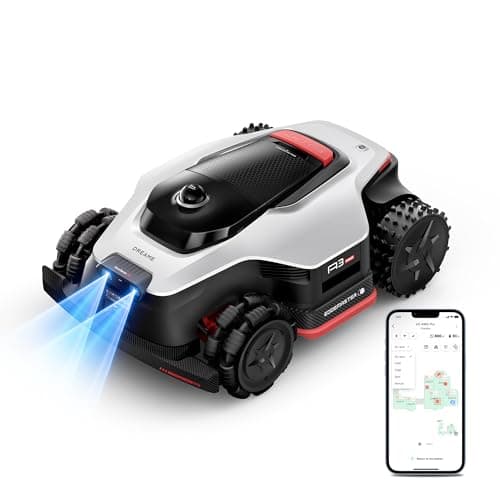
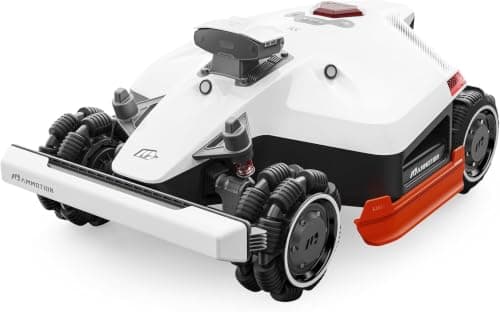
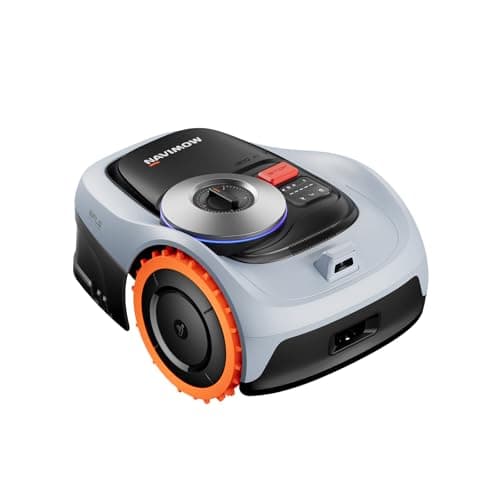
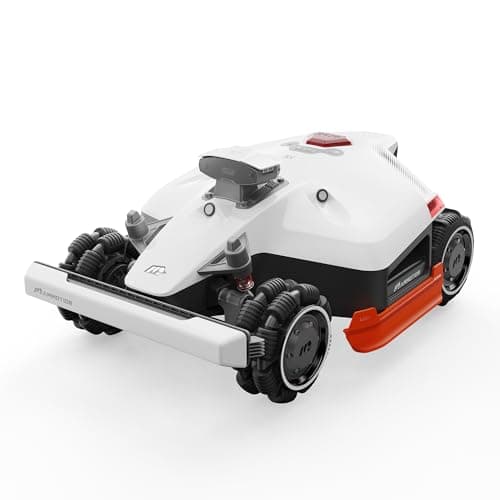
The best robot lawn mower for a large yard is the Mammotion LUBA 2 AWD 5000HX, rated for 1.25 acres with a maximum of 1.48, all-wheel drive and a published 80 percent slope capability. It is the only mainstream robot mower whose rated area genuinely covers an acre-plus property. If your large lawn is under trees, the DREAME A3 AWD Pro 3500 at 0.87 acre uses 3D LiDAR rather than satellite positioning, which keeps working under canopy that breaks an RTK fix. And for three quarters of an acre the LUBA 2 AWD 3000HX is the same platform for meaningfully less money.
Now the answer you need before you spend anything, because a lot of people arriving here are searching for three or five acres: there is no consumer robot mower rated for 5 acres, and nothing credible at 3 acres either. The top of this market is around an acre and a quarter. If your lawn is genuinely three acres or more, the honest recommendation is a zero-turn mower — it will cost less than two robots and cut the whole thing in an afternoon. Running a one-acre robot on a three-acre lawn means it never completes a cut cycle and the lawn always looks half-finished.
Two acres is the genuinely awkward case. It is beyond any single machine's rating but within reach of two robots on separate zones, which some owners do successfully. Whether that is sensible at roughly four thousand dollars of hardware, versus a zero-turn, is a judgment about how much you dislike mowing.
Acreage ratings, slope figures and navigation types below are what each manufacturer publishes. We have not run any of these machines on a lawn, and no robot mower ranking that claims otherwise has run six of them for a season either. See how we pick. Prices come from the live price layer with an “as of” date.
Boundaries and the worth-it question
On a large lawn the navigation choice matters more than anywhere else, because an RTK mower needs sky and an acre of mature trees is exactly where it struggles - see the wire-free robot mower roundup. If you are still weighing the purchase at all, are robot lawn mowers worth it does the arithmetic.
What the acreage rating actually means
| Machine | Rated area | Slope | Navigation |
|---|
| Mammotion LUBA 2 AWD 5000HX | 1.25 acres (1.48 max) | 80% | RTK + AI vision |
| DREAME A3 AWD Pro 3500 | 0.87 acre | 80% | 3D LiDAR + dual vision |
| Mammotion LUBA 2 AWD 3000HX | 0.75 acre | 80% | RTK + AI vision |
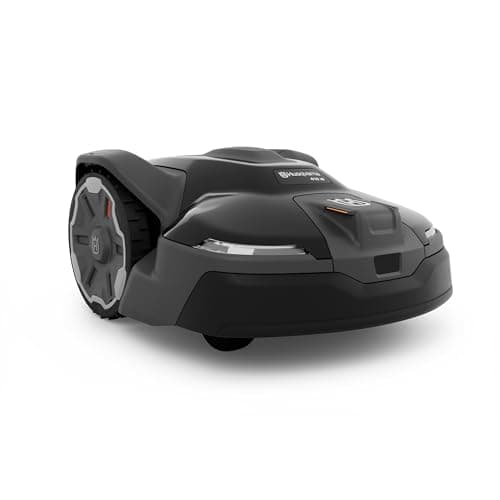
| Husqvarna 410iQ | 0.5 acre | 45% | Wire-free |
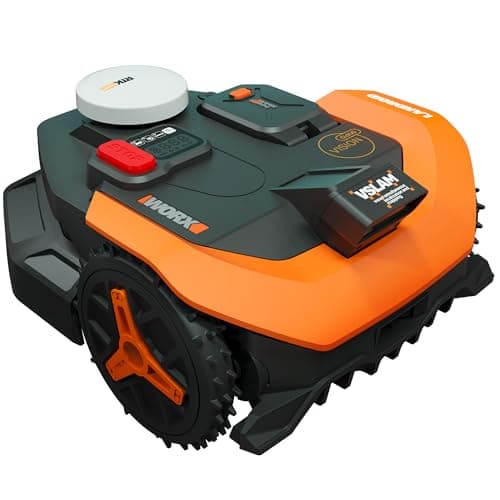
| WORX Landroid WR320 | 0.5 acre | Not published | Wire-free |
| Segway Navimow i210 AWD | 0.25 acre | 45% | RTK, wire-free |
A rated area is the lawn the machine can keep cut on a normal mowing cycle, not the area it can physically reach. Exceed it and the mower does not fail — it just falls behind, cuts each zone less often, and the lawn develops the shaggy-then-scalped look that defeats the purpose. Buy for your actual square footage and then some.
Measure the lawn before you buy, not the property. A two-acre lot with a house, a driveway, beds and a wooded corner is often three quarters of an acre of actual grass. Pace it out, multiply, subtract. This single step moves most people down a model and saves them a thousand dollars.
RTK or LiDAR: the decision tree
RTK uses a satellite base station on your property to position the mower to centimeter accuracy. It is extremely precise on open lawn, and it needs the base antenna to have a clear view of the sky. Heavy tree canopy over the lawn itself degrades the fix, and that is the single most common reason a robot mower disappoints on a wooded lot.
LiDAR builds a 3D map from the mower's own laser scanning and does not depend on satellites at all. On a lawn under mature trees it is the right technology, and it is why the DREAME is the pick for canopy despite its smaller rated area.
Perimeter wire is the old approach and nothing here uses it. It works, and it means burying a cable around every boundary and bed, then repairing it every time you aerate or edge. Wire-free is worth the premium.
Slope is the spec that quietly disqualifies machines
A large lawn is far more likely to have real terrain in it — a bank down to a road, a drainage swale, a slope behind the house. Published slope ratings on this page run from 45 percent to 80 percent, and that is an enormous practical difference.
All-wheel drive is what makes the 80 percent figure possible. A two-wheel-drive robot spins out and beaches itself on wet grass on a bank, and then sends you a notification to come and rescue it, which is the opposite of what you bought. If any part of your lawn is steep enough that you walk it carefully, buy all-wheel drive.
What a large-yard robot does badly
Edges.Every robot mower leaves an uncut margin at walls, fences and beds, because the blade disc sits inboard of the chassis. You will still be trimming, and on a big lawn that is a real job — see best string trimmer and best lawn edger. Anyone telling you a robot eliminates lawn work has not mowed a lawn.
Long grass. Robots are mulching mowers that take a little off very often. Set one loose on grass that has not been cut in three weeks and it bogs down. The first cut of the season needs a real mower; the robot maintains from there.
Clippings in volume. There is no bag. Everything is mulched back into the lawn, which is good agronomy and is covered in best mulching lawn mower, but it is not an option you get to turn off.
Obstacles and things left on the lawn. Hoses, dog toys, fallen branches. Vision and LiDAR systems are much better at this than they were, and they are not perfect.
Robot or zero-turn for an acre?
At one acre the money is genuinely comparable, so it comes down to what you want from your Saturday. A robot costs roughly what a mid-tier zero-turn costs, mows continuously and quietly while you are not there, and needs you for setup, edges, blades and the occasional rescue. A zero-turn cuts an acre in well under an hour, handles long grass and rough ground, tows implements, and asks for that hour every week for the rest of your life.
Our honest split: under an acre, flat to moderate, and you dislike mowing — robot. Over an acre, or rough ground, or you have other uses for a machine — zero-turn, and see best zero-turn for the money.
Who should skip these
Skip every machine here if your lawn is a quarter acre of open grass — you are paying several times over for acreage capability you will never use, and the standard robot mower roundup has the right machines. Skip RTK machines if your lawn is under heavy canopy. Skip all of them if your lawn is three acres or more: that is a zero-turn job, and no robot on the market is rated for it.