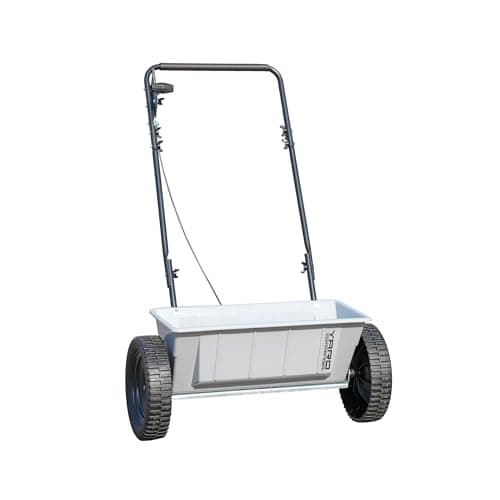
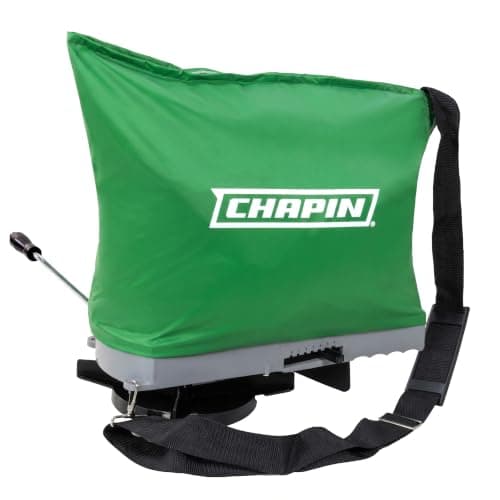
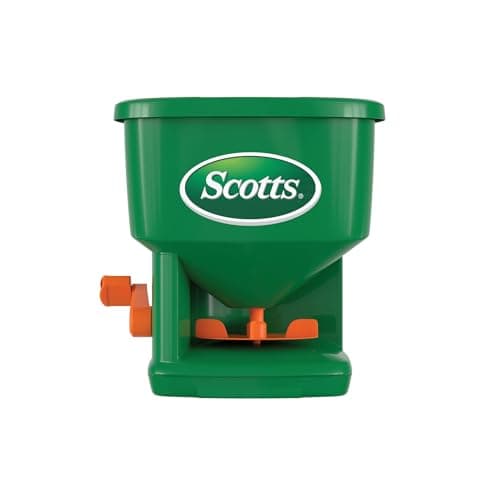
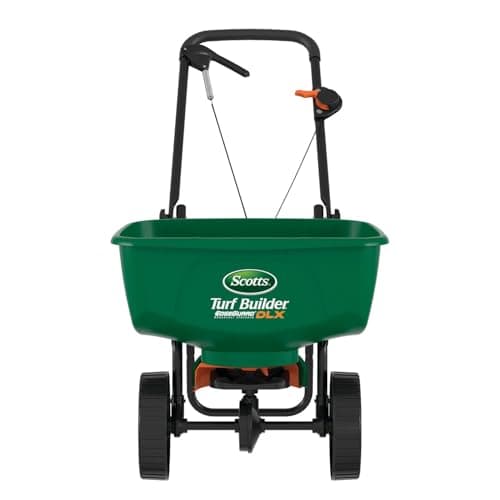
The best broadcast spreader under $200 is the Scotts Turf Builder EdgeGuard DLX, because it is the only unit under the line that combines a large hopper with a blocking plate that stops product being thrown into a flowerbed, a driveway or a storm drain. The budget pick is the Scotts Whirl hand-powered spreader— the cheapest thing here by a wide margin, and the right answer for a small lawn or for touching up a strip you missed. If you need absolute placement accuracy rather than throw, the Yard Commander 60 lb walk-behind drop spreader puts product exactly between its wheels and nowhere else. And if you are walking a large property with a bag on your shoulder, the Chapin TurfPro 25 lb handheld bag spreader is the one built for that job.
Prices are pulled live with an “as of” date. One pick on this page sits closer to the ceiling than the rest and will cross it in a bad week; the live figure on the card is the only number worth acting on, which is the whole reason this site does not type prices into copy. We have not calibrated these units ourselves. Every judgment reasons from published hopper capacity, stated spread width, frame material and the edge-control mechanism each manufacturer describes, and the spreading method we recommend comes from university extension calibration guidance rather than from us. The method is in how we pick.
Under $200, what you are not buying is a commercial frame.That is the honest framing of this whole band. Above the line sit stainless and powder-coated steel frames, 50-pound hoppers, enclosed metal gearboxes and pneumatic tires — machines built to be pushed across several acres a week for a decade. Under it you get a plastic hopper, a plastic-and-steel frame and a gearbox that will last many seasons of homeowner use and not many seasons of professional use. For a quarter-acre lot that is the correct purchase, and spending more buys durability you will never consume.
What you should not give up at this price is even distribution. An uneven spread is far more visible than a cheap frame: it shows up as dark green stripes against pale ones for weeks, and on a thin lawn an overlap can burn. The uncapped ranking, including the commercial units above this ceiling, is the best broadcast spreader.
Broadcast, drop or handheld — decide this first
A broadcast (rotary) spreader flings product in an arc from a spinning plate. It covers ground fast and is the right default for a lawn, but the arc does not stop at the edge of the turf, which is how fertilizer ends up on a driveway and then in a storm drain.
A drop spreader releases product straight down between its wheels. It is slower and demands careful overlapping passes, but it puts product exactly where the hopper is and nowhere else. On a lawn with beds, a pond or a lot of hard surface, that precision is worth the extra passes.
A handheld spreader is for small areas, awkward strips and touch-ups. The crank or battery drive makes it a different tool from the shaker bottles sold alongside it. The full argument between the first two shapes is in broadcast vs drop spreader.
The criteria, in the order they matter under $200
1. Edge control, which is the feature worth paying for. A blocking plate shuts off the half of the spread pattern facing a driveway, a bed or water. It stops waste, stops staining concrete, and stops nutrient running into a storm drain. It is the single most useful mechanism available in this price band.
2. Hopper capacity against your lawn size. Capacity decides how many times you walk back to the bag. On 5,000 square feet almost anything works. On 15,000 a small hopper means four refills and four chances to lose your place.
3. The gate and how precisely it sets. The rate setting is what turns a bag label into an application. A gate with clear detents and a positive stop is far easier to return to a known setting than a vague sliding lever.
4. Frame and wheels. Pneumatic tires roll over a bumpy lawn more evenly than hard plastic wheels, and an even roll is an even spread. Under $200 expect plastic and coated steel; look for a frame that does not flex when the hopper is full.
5. Whether it cleans out. Fertilizer is corrosive and fertilizer left in a hopper over winter is the most common way a cheap spreader dies. A unit that empties and rinses easily will outlive a better-built one that does not.
Which spreader, by the lawn in front of you
| Your lawn | What to buy under $200 | Why |
|---|
| 5,000-15,000 sq ft, the normal case | Scotts EdgeGuard DLX | Large hopper plus the blocking plate that keeps product off the driveway |
| Under 3,000 sq ft, or touch-ups only | Scotts Whirl hand spreader | Cheapest here by a wide margin and quicker to use than it is to fetch a push unit |
| Beds, ponds or a lot of hard surface | Yard Commander drop spreader | Drops between the wheels - nothing is thrown anywhere you did not intend |
| A large property you walk rather than push | Chapin TurfPro handheld | Designed to carry a 25 lb bag on a shoulder strap across open ground |
| Several acres, or you spread for a living | Above this ceiling | Commercial frames, 50 lb hoppers and metal gearboxes start over $200 |
| You already own a lawn tractor | A tow-behind instead | If the tractor is out anyway, towing beats pushing - see our attachments roundup |
Calibration matters more than the spreader
The number on a bag is a recommendation for a rate, not for a spreader setting, and settings do not transfer between products or between machines. Two bags of the same weight with different granule sizes flow at different speeds through the same gate. University extension calibration guidance is unanimous on the method: spread a measured quantity over a measured area at your own walking pace, weigh what is left, and adjust. Repeat until two runs agree to within about ten percent.
That is twenty minutes once a season and it is worth more than the difference between any two spreaders here. Our walkthrough is in how to calibrate a spreader.
Habits that keep a cheap spreader working
Never fill the hopper on the lawn. Fill it on the driveway or a tarp. A spilled double handful of fertilizer will burn a dinner-plate hole that is visible for the rest of the season.
Close the gate before you stop walking, and open it only once you are moving. A spreader standing still with the gate open dumps a pile in one spot.
Rinse and dry it every time, and store it empty. Fertilizer salt eats axles, springs and gate mechanisms. This one habit roughly doubles the life of anything in this price band.
Finally, overlap deliberately. With a broadcast spreader, aim each pass so the edge of the pattern reaches the wheel tracks of the last one; with a drop spreader, overlap the wheel track itself. Striping is nearly always a pattern problem rather than a machine problem. And if the product going in the hopper is a weed-and-feed, read the label twice — those are pesticides, and the label is the law. Our picks there are in the best weed and feed.