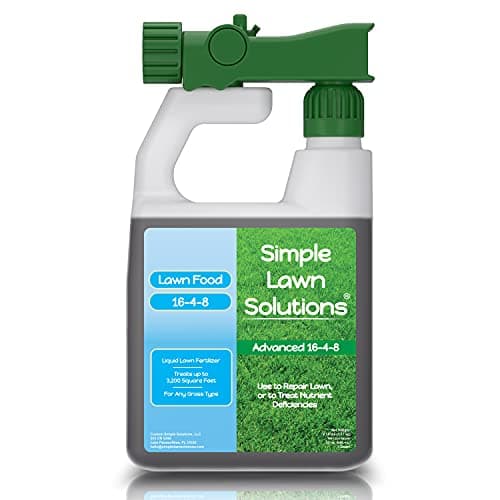
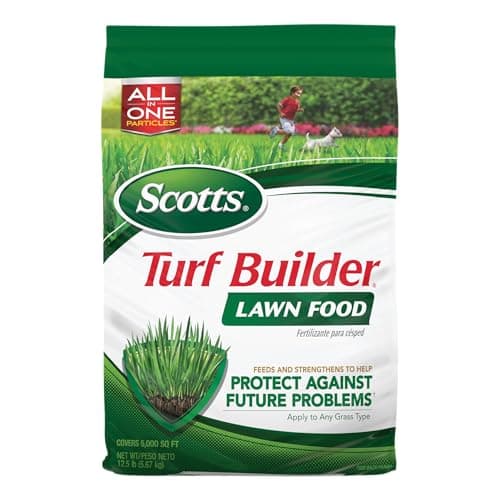
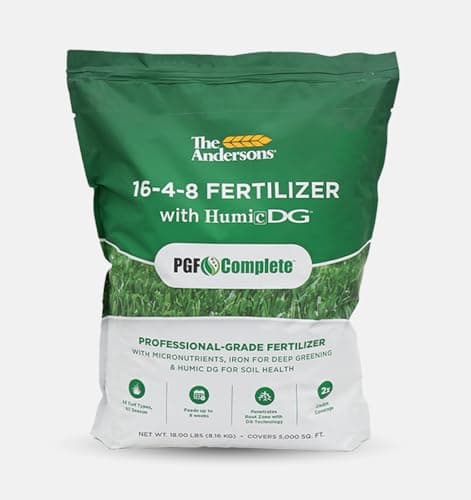
Granular is the backbone of a lawn program and liquid is the finishing tool. If you buy one thing, buy a granular bag — The Andersons PGF Complete 16-4-8 for a homeowner who will measure and calibrate, Scotts Turf Builder Lawn Food for one who will not. Granular carries slow-release nitrogen that feeds for weeks at a few cents per thousand square feet. Liquid, like Simple Lawn Solutions Advanced 16-4-8, is what you reach for when you want visible color in days rather than weeks, and it costs several times as much per application to get it.
The reason the two formats behave so differently is uptake. A granular prill has to dissolve in soil moisture and move down to the root zone before the plant can use any of it, and coated slow-release prills are designed to do that over weeks. A liquid is absorbed through the leaf as well as the root, so some of the nitrogen is inside the plant within a day. Fast in, fast out: foliar feeding also fades faster, because there is no reservoir of undissolved product sitting in the soil waiting for the next rain.
We have measured nothing. The analyses, coverage figures and application rates below are published on the labels, and the cost-per-thousand arithmetic is derived from those published numbers and the live prices on this page — see how we pick. Prices carry an “as of” date.
Head to head on the six things that matter
| | Granular | Liquid |
|---|
| Visible response | One to three weeks | Two to five days |
| How long one application feeds | Four to twelve weeks, depending on release type | Two to four weeks at most |
| Cost per 1,000 sq ft | Low - one bag covers thousands of square feet | High - a 32 oz concentrate is a few applications |
| Equipment needed | A calibrated broadcast or drop spreader | A hose-end sprayer, or nothing if it is ready-to-spray |
| Burn risk | Real if over-applied or double-passed; near zero on organics | Real in heat or at the wrong dilution, but easy to keep low |
| Evenness | As even as your spreader and your walking pace | Very even - the sprayer meters it for you |
Response times are the behavior of foliar versus root uptake, which is established agronomy rather than something we measured. Costs are computed from the live prices above and the coverage each label publishes.
Do the cost arithmetic before you choose
This is where the decision usually resolves itself. A 5,000 sq ft bag of 16-4-8 at 16 percent nitrogen delivers roughly 0.8 lb of nitrogen per 1,000 sq ft across the whole bag — a textbook single application for a cool-season lawn. A 32 oz bottle of liquid concentrate treats a fraction of that area per application, so a season of liquid-only feeding on an average suburban lot runs to many bottles.
That is not an argument against liquid. It is an argument against using liquid as your primary nitrogen source. Spend the money where the format earns it: granular for the bulk nitrogen, liquid for speed and for the jobs granular cannot do.
Four jobs where liquid is the right answer
You need color in a week. A party, a viewing, a photograph. Foliar uptake is the only route to green in days, and no granular product can match it.
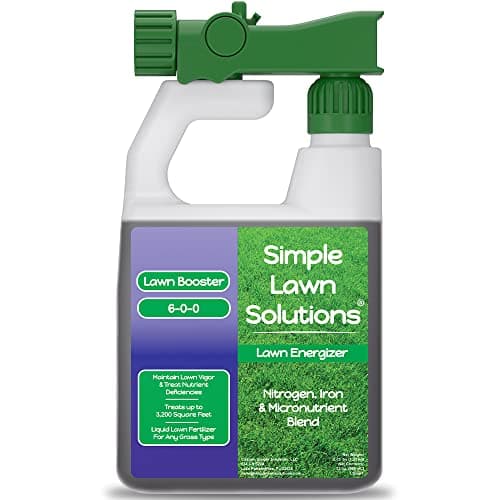
It is high summer and you do not want growth. A nitrogen-and-iron liquid like Simple Lawn Solutions Lawn Energizer darkens the leaf through iron rather than forcing top growth, so you get color without adding a mow to the week. This is why the summer feeding page leans liquid in the hottest weeks.
You have no spreader and a small lawn. Under about 2,000 sq ft, a hose-end sprayer is genuinely simpler than buying and calibrating a spreader for one bag a year.
You want to feed little and often. Light, frequent liquid applications are how the best-kept lawns are actually fed, because the grass never gets a flush-then-starve cycle. It takes more trips, and it produces a more even lawn.
Four jobs where granular wins outright
The whole-season program. Slow-release nitrogen is a reservoir in the soil. Nothing in a bottle replicates it, and it is the cheapest nitrogen you can buy. The fertilizer schedule is built on granular for exactly that reason.
The fall feeding.The single most valuable application of the year wants a long, slow nitrogen release into cooling soil — see fall lawn fertilizer.
Anything combined with a herbicide or a pre-emergent.Weed-and-feed products and crabgrass preventers are granular because the particle has to land on a damp leaf or sit in the soil — see crabgrass preventer.
A large lawn. Past about 10,000 sq ft, the cost gap stops being a preference and starts being the deciding factor.
Burn risk: the honest version
Both formats can scorch a lawn and both do it the same way, by putting more soluble salt around the roots than the plant can handle. The difference is in how the mistake happens. With granular it is a mechanical error: an overlapping pass, a spreader left open at a turn, a pile dropped while you fiddle with the setting. With liquid it is a dilution or timing error: mixed too strong, or sprayed onto a dry lawn in the middle of a hot afternoon.
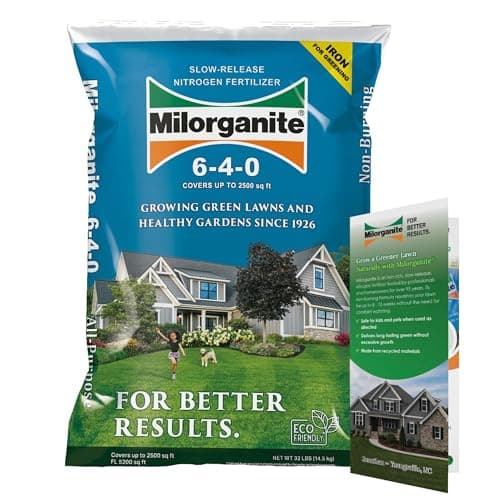
The safest product in either column is a slow-release organic granular — Milorganite is 6-4-0 organic nitrogen that releases with soil temperature, and double-passing a strip of it does not burn the lawn. That forgiveness is the whole reason it is on this page.
The program most lawns actually want
Granular three or four times a year on a schedule, with liquid used on top when a specific job calls for it. In practice: a spring granular feed, a summer iron-and-nitrogen liquid instead of pushing growth in the heat, a granular fall feed, and the one big late-fall application. Liquid in between if the lawn looks tired and you want it green by the weekend.
Whichever you buy, the rate on the label is per thousand square feet, so measure the lawn once and write the number down. Both formats fail the same way — applied by eye.