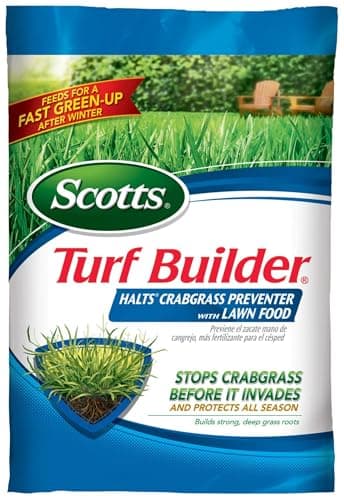
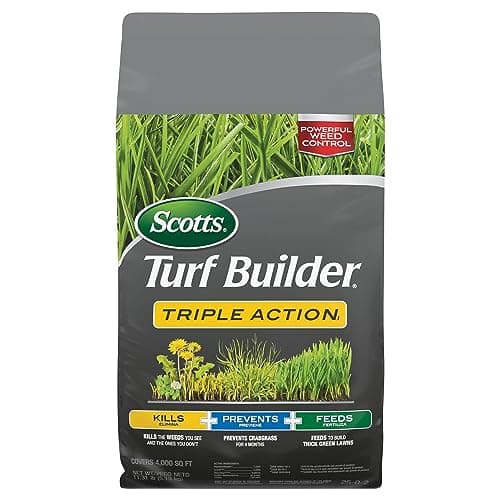
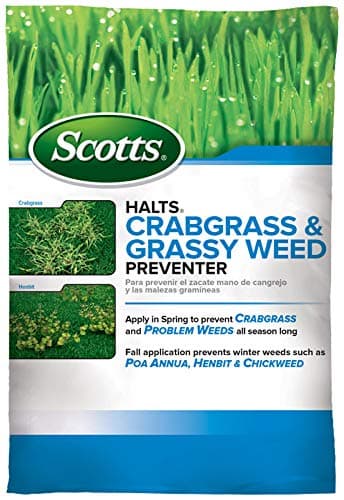
Buy Scotts Halts Crabgrass & Grassy Weed Preventer and put it down before your soil warms up. It is a straight pre-emergent with nothing else in the bag, which is what you want if you already have a feeding program you like. If you would rather make one trip across the lawn in March instead of two, buy Scotts Turf Builder Halts Crabgrass Preventer with Lawn Food instead and let the same pass feed the grass. If the dandelions are already up as well, the three-job bag is Scotts Turf Builder Triple Action1. For a lawn with children and dogs on it, Espoma Organic Weed Preventer is corn gluten meal and nothing else.
The uncomfortable part of this category is that the product matters much less than the date. A pre-emergent does not kill crabgrass; it puts a barrier in the top layer of soil that stops germinating crabgrass seedlings from establishing. Apply it before the seed wakes up and it works. Apply it two weeks after and you have spread an expensive bag of nothing — the plant is already through the barrier and growing. This is why two neighbors can buy the same bag and get completely different lawns.
We have not run plots or trials. Everything below reads the published label — the stated approach, the bag weight, the coverage figure and the application restrictions — plus the agronomy of germination timing, which is public and well established. See how we pick. Prices are live from the price layer with an “as of” date beside each product, and the label is the authority on rates and restrictions, not our copy.
The number that decides everything: soil temperature, not the calendar
Crabgrass is an annual. It dies every winter and comes back entirely from seed, which germinates once the top inch or two of soil holds steady in the mid-fifties Fahrenheit for several consecutive days. That happens on wildly different dates depending on where you live and what kind of spring it is, which is why “apply in April” is useless advice in both directions — too late in Georgia, too early in Minnesota.
The practical version: a pre-emergent needs to be down and watered in before soil temperature reaches the mid-fifties, not when the air feels warm. Air temperature runs ahead of soil temperature by weeks in early spring. A ten-dollar soil thermometer pushed two inches into a sunny part of the lawn removes all the guesswork, and the forsythia-in-bloom rule of thumb is a reasonable backup where it grows.
Which bag for which lawn
| Product | What is in the bag | Buy it when | Published size |
|---|
| Scotts Halts | Pre-emergent only, granular | You already feed on your own schedule | 10.06 lb |
| Scotts Turf Builder Halts + Lawn Food | Pre-emergent plus a spring feed | You want one pass in March | Covers 5,000 sq ft |
| Scotts Turf Builder Triple Action1 | Feed, broadleaf killer and pre-emergent | Dandelions and clover are already up | 11.31 lb |
| Espoma Organic Weed Preventer | 100% corn gluten meal, roughly 10% nitrogen | Children or pets use the lawn constantly | 25 lb |
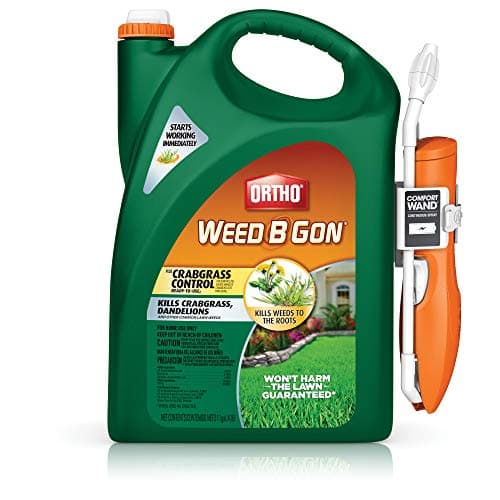
| Ortho Weed B Gon Plus Crabgrass Control | Ready-to-use post-emergent liquid | You missed the window and it is already growing | 1 gal with wand |
Prices for all five are live above with an “as of” date. Sizes and coverage figures are what the labels publish.
The conflict nobody warns you about: you cannot prevent and seed
A pre-emergent barrier does not know the difference between a crabgrass seed and a tall fescue seed. It stops both. This is the most common expensive mistake in lawn care: someone spreads a crabgrass preventer in March, sows seed into the thin patches in April, and nothing comes up. The money is gone twice over.
So pick one job per spring. If the lawn is thin and the real problem is bare ground, skip the pre-emergent entirely this year, overseed, and use a starter fertilizerinstead — a thick lawn is itself the best crabgrass control there is, because crabgrass seed needs light at the soil surface to germinate. If the lawn is already dense and you simply want to keep it that way, lay the barrier down and leave the seed bag in the shed until fall. Our guide to reseeding a lawn covers the fall route, which is the better one for cool-season grass anyway.
The one exception worth knowing: mesotrione-based products are labeled for use at seeding on some grasses, which is a genuinely different chemistry. That is covered on lawn weed control rather than here, because it is a selective herbicide first and a preventer second.
Split the application if your season is long
Pre-emergent barriers break down. The length of control a label states is a range, not a promise, and in a long warm season a single March application can thin out before the last crabgrass seed has finished germinating in June. Where the label allows a second application, two half-rate passes about eight weeks apart hold the barrier longer than one full-rate pass does — the label will say whether and at what interval, and the label is the legal instruction rather than a suggestion.
In the short, cool seasons of the upper Midwest and New England, one well-timed pass is usually the whole job.
Spread it properly or do not bother
A barrier with gaps in it is a lawn with stripes of crabgrass in it, and that is a spreader problem rather than a product problem. Granular pre-emergents want the same careful, overlapping, half-rate-in-two-directions pass that fertilizer wants, from a spreader with real edge control. The broadcast spreader rankings cover which ones hold a rate, and broadcast vs drop explains why a drop spreader is the safer tool next to beds.
Then water it in. A pre-emergent sitting dry on top of the grass is not in the soil, which is the only place it does anything. A quarter to a half inch of water after application is the standard instruction on these labels.
What to do if you are already too late
Post-emergent crabgrass control is genuinely harder than prevention, and this is not pessimism — mature crabgrass is a tough, established grass plant growing inside a lawn of other grass plants, so anything that kills it has to be selective enough to leave the turf alone. Treatments work best on young plants and get progressively less effective as the crabgrass tillers out into those flat rosettes.
If it is already up, the honest plan is: spot-treat the worst of it with a ready-to-use product like Ortho Weed B Gon Plus Crabgrass Control, mow high for the rest of the season so the turf shades the soil surface, feed the lawn properly through fall so it thickens, and put the pre-emergent down on time next spring. Crabgrass dies at the first hard frost regardless of what you do; the seed it dropped is next year's problem, and the barrier is the answer to it.
The verdict
Buy once, feed separately: Scotts Halts. A clean pre-emergent with nothing bundled, so it fits any feeding schedule.
One trip across the lawn: Scotts Turf Builder Halts with Lawn Food. The spring feed and the barrier in a single pass.
Weeds already visible: Triple Action1, which handles the dandelions that are up and the crabgrass that is not.
Children and dogs on the grass: Espoma corn gluten meal. Weaker control, no synthetic herbicide, and it feeds at the same time.
Overseeding this spring: none of them. Seed instead, and come back to this page next March.