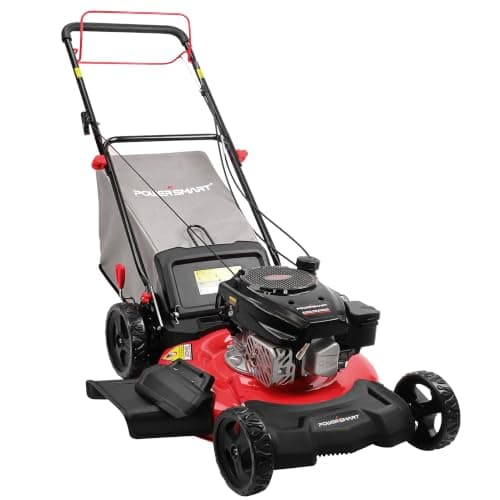
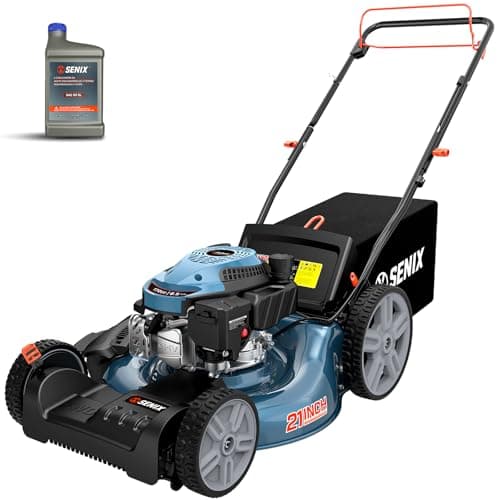
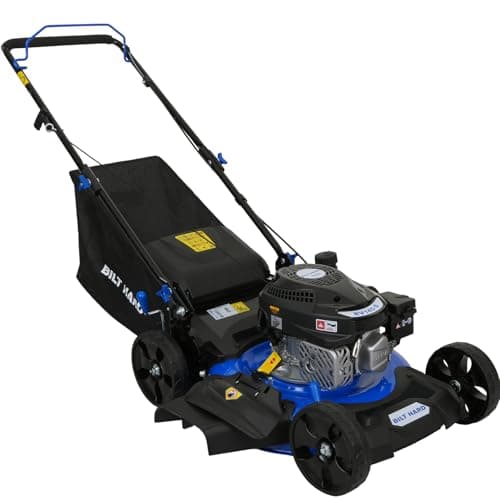
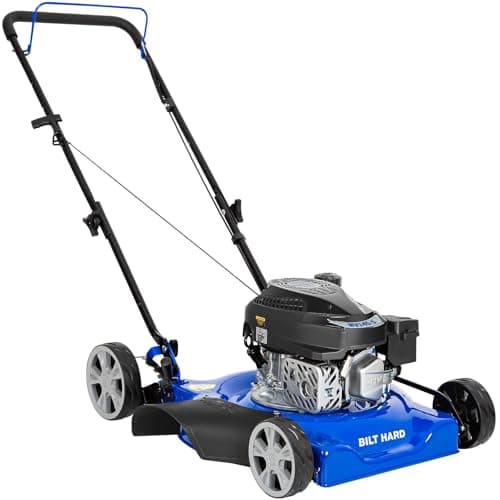
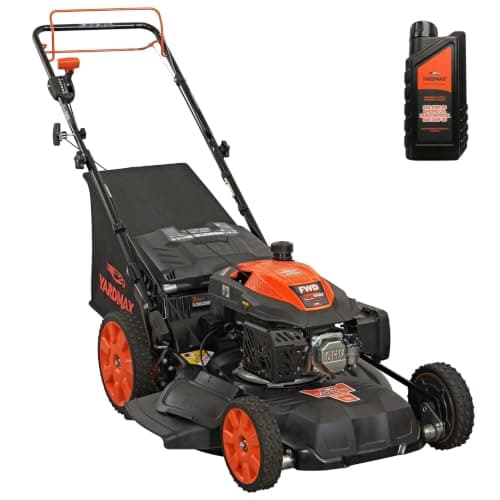
The best gas lawn mower for most lawns that still want one is the YARDMAX 22" 201cc Select PACE: the widest deck here, the only six-speed CVT drive, and high rear wheels for uneven ground. The PowerSmart 21" 170cc self-propelled is the value pick and the one most people should actually buy, and the SENIX 21" 170cc 3-in-1 is the one to take if you want to mulch clippings back into the lawn. If your ground is flat, drop the drive entirely: the BILT HARD 21" 144cc push cuts the same grass for less.
Before the ranking, the honest framing, because this site does not sell gas mowers to people who would be happier with a battery. Up to about half an acre, the battery argument is over. A cordless mower starts on a trigger, needs no oil change, no air filter, no spark plug, no fuel stabilizer and no winterizing, and the good ones cut as well as a comparable gas machine. If that describes your lawn, read best electric lawn mower instead and come back if you disagree.
Gas still wins on three things.First, refueling: a dry tank costs you two minutes and a flat battery costs you an hour, which decides big lawns and long grass. Second, sustained power in heavy growth, where an engine does not taper the way a pack does. Third, purchase price — a 21-inch gas self-propelled mower still undercuts the equivalent battery kit, because you are not buying lithium. Set against that is running cost and upkeep, and the full arithmetic is in electric vs gas lawn mower.
We have mown nothing with these machines. The ranking reasons from published figures — deck width, engine displacement, drive type and layout, deck function — see how we pick. Prices are live from the price layer with an “as of” date.
Gas lawn mowers compared
| Mower | Deck | Engine | Drive | Deck function | Best for |
|---|
| YARDMAX 22" Select PACE | 22 in | 201cc | 6-speed CVT, FWD | 3-in-1 | Widest deck, best drive |
| PowerSmart 21" SP | 21 in | 170cc | Self-propelled | Bag / discharge | Best value self-propelled |
| SENIX 21" 3-in-1 | 21 in | 170cc | Self-propelled | 3-in-1, 6 heights | Mulching back into the lawn |
| BILT HARD 21" push | 21 in | 144cc | Push | 3-in-1 | Flat lawns, full width |
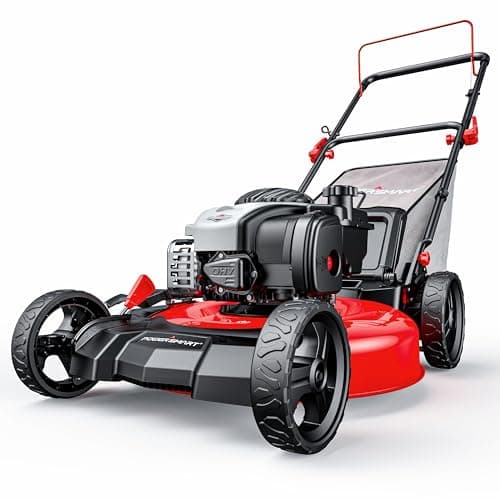
| PowerSmart 21" 3-in-1 push | 21 in | 140cc Briggs | Push | 3-in-1 | Briggs engine, flat lawns |
| BILT HARD 20" push | 20 in | 144cc | Push | 8 heights | Cheapest full-ish deck |
Deck widths, engine displacements, drive types and deck functions above are the figures the listings publish. Prices are live with an “as of” date beside each mower.
Best self propelled lawn mower gas: drive type is the whole decision
On a gas mower the drive matters more than it does on a battery one, because the machine is heavier. Three things to get right:
Whether you need drive at all.On genuinely flat ground, a 21-inch push mower is fine and the money is better spent elsewhere. On any slope worth the name, a driven wheel is the difference between mowing the lawn and putting it off — and a deck full of wet clippings is heavier than anyone expects.
Front-wheel or rear-wheel. Front-wheel drive is easier to pivot at the end of a pass: lift the handle, the drive wheels come off the ground, you turn. Rear-wheel drive keeps traction going uphill and with a full bag, which front-wheel drive loses exactly when you need it. Flat and fiddly lawn: front. Sloping lawn: rear. The YARDMAX here is front-wheel drive with a CVT, which is a good combination on undulating ground and the wrong one on a steep bank.
Single speed or variable.A single-speed drive sets a pace and you walk at it. The YARDMAX’s six-speed CVT lets you match the mower to your stride, which sounds like a minor thing and is the difference between a mower that suits you and one you tolerate.
Deck width, engine size, and which number actually matters
Deck width is the spec that decides your Saturday. Going from 20 inches to 22 removes roughly a tenth of the lengths you walk, on every cut, forever. Measure your narrowest gate first — a wide deck that cannot reach the back lawn is worthless — then take the widest deck that fits. The arithmetic by lawn size is in the best mower for a large yard.
Engine displacement matters less than people assume, within this range. From 140cc to 201cc every mower here will cut a normal lawn at a normal height. Displacement earns its keep in long, wet or thick grass, and on a wider deck — which is why the 201cc engine is on the 22-inch mower and not the 18-inch one. If you mow weekly at a sensible height, 140 to 170cc is plenty.
The specification worth checking that nobody checks is the deck function. A “3-in-1” deck bags, side-discharges and mulches. Mulching returns clippings to the lawn, which genuinely feeds it — roughly a quarter of its nitrogen need over a season — and saves you emptying a bag. If that appeals, the 3-in-1 machines are ranked separately in the best mulching lawn mower.
What owning a gas mower actually costs you
Not money so much as attention, and it is worth being explicit because this is the part people discover in year two. An annual service is oil, an air filter and a spark plug. Fuel goes stale in about a month unless you add a stabilizer, and stale fuel in a carburetor is the single most common reason a mower will not start in April. Winter means either running the tank dry or stabilizing it. None of it is hard; all of it is a habit.
Against that, the running cost of a gas mower on a big lawn is genuinely lower than people think, and the capability ceiling is higher. If you mow three-quarters of an acre, or your grass is routinely long, gas is not nostalgia — it is the correct tool. If you mow a quarter acre on a weekly schedule, you are maintaining an engine for no reason.
Who should skip gas entirely
Skip it if your lawn is under about half an acre and you mow on a schedule. The battery machines in best electric lawn mower will cut it just as well and ask nothing of you between seasons.
Skip it if noise is a live issue — a shared wall, a small lot, an early-morning mowing window.
And skip walk-behinds altogether past about three-quarters of an acre, gas or battery. That is a job for a riding mower, and no deck width fixes ninety minutes of walking a week.