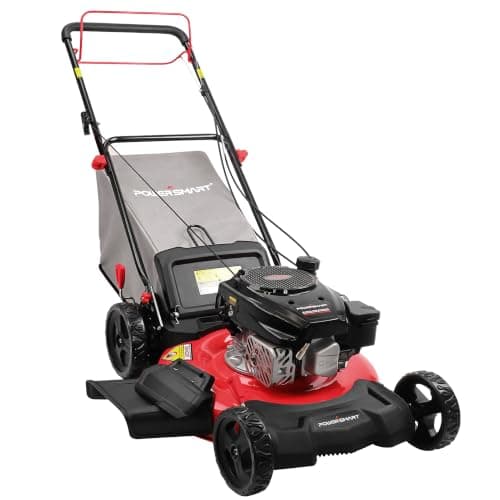
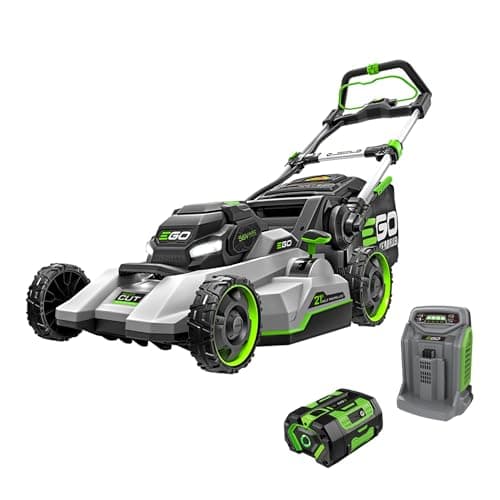
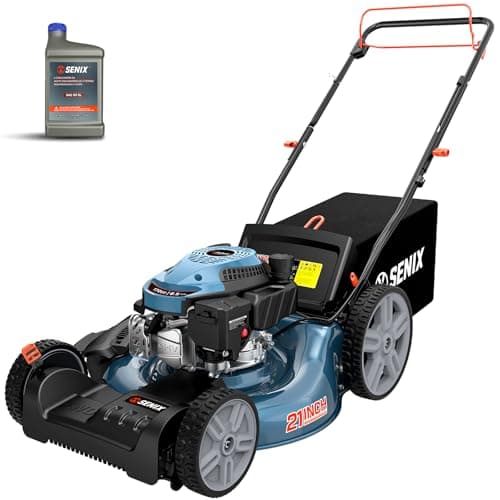
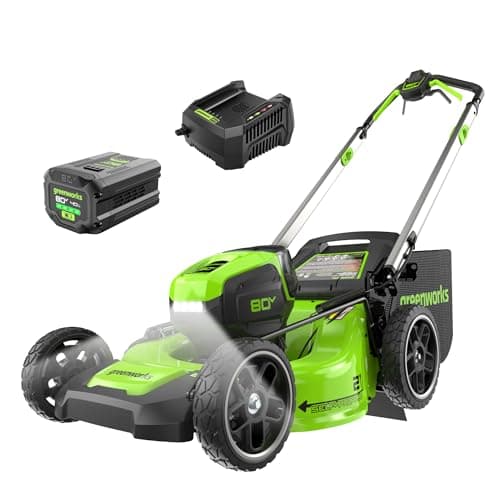
For any lawn up to about half an acre, buy electric — and the Greenworks 80V 21" Self-Propelled is the one we would choose. Battery mowers start on a trigger, need no oil, no filters, no spark plugs, no fuel stabiliser and no winterising, and on a lawn mown regularly at a sensible height they cut as well as a comparable gas machine. Past half an acre, or on a lawn that regularly gets long between cuts, gas still wins, and the PowerSmart 21" 170cc Self-Propelled is the cheapest honest way to get it.
That is the whole answer, and almost everything written about this comparison overcomplicates it. The three things that genuinely differ are refuelling time, maintenance burden, and power headroom in tall or wet grass. Noise and emissions differ too, and they matter, but they rarely change anybody's decision on their own.
We have not run a stopwatch on either. What follows is the arithmetic on published figures — deck widths, voltages, engine displacements, included battery capacity — and a frank account of what each ownership model actually costs you in time. See how we pick.
Where electric clearly wins
Annual upkeep, and it is not close. A gas mower wants an oil change, a new air filter, a spark plug, a sharpened or replaced blade, and either a fuel stabiliser or a drained tank before winter. A battery mower wants a sharp blade. That is the entire difference, every year, for the life of the machine, and it is the single strongest argument on this page.
Starting. A battery mower starts when you pull the trigger, every time, including the first cut after five months in a shed. A pull-start gas engine that has sat over winter with old fuel in it is one of the more reliably annoying objects in a garage.
Noise, and therefore when you can mow. A cordless mower is quiet enough to use at eight on a Sunday morning without a conversation about it. In a terrace or a close, that is a genuine practical freedom rather than an abstract environmental point.
Storage and handling. No fuel means no fumes in the shed, no spill risk, and you can store the machine on its end or hang it on a wall.
Where gas still wins
Refuelling versus recharging. This is gas's real and permanent advantage. A tank takes two minutes; a battery takes an hour or more. On a lawn you can finish inside one charge this is irrelevant. On an acre it decides the question, which is why our zero-turn roundup still has a gas machine as its value pick.
Power headroom in bad conditions. A 170cc four-stroke does not care that the grass is damp and six inches long. A battery deck bogs, draws harder and drains faster in exactly that situation. If your mowing schedule is aspirational rather than actual, gas is more forgiving of the gap.
Up-front price.The PowerSmart gives you a 21-inch deck and a driven wheel for roughly half the price of a comparable cordless kit. If the budget is fixed, a self-propelled gas mower you can afford beats a cordless mower you cannot — our self-propelled roundup ranks both.
No battery to replace. Lithium packs lose capacity over years of cycles and a replacement is a real cost. A maintained gas engine does not have an equivalent wear-out component on that timescale. This is the honest counterweight to the maintenance argument above.
The verdict, by lawn size
Under half an acre: electric.You will finish on one or two packs, you will never service anything, and you will mow more often because starting is frictionless — which does more for the lawn than any mower spec. Start at best electric lawn mower.
Half to three quarters of an acre: electric, with two batteries. A twin-pack kit covers it. One pack will not.
Over three quarters of an acre: neither of these. You are in riding mower territory, and walking a 21-inch deck round that lawn every week is the wrong fight.
Any size, if the grass regularly gets away from you: gas. It is the more forgiving machine, and forgiving is worth more than efficient when life gets busy.