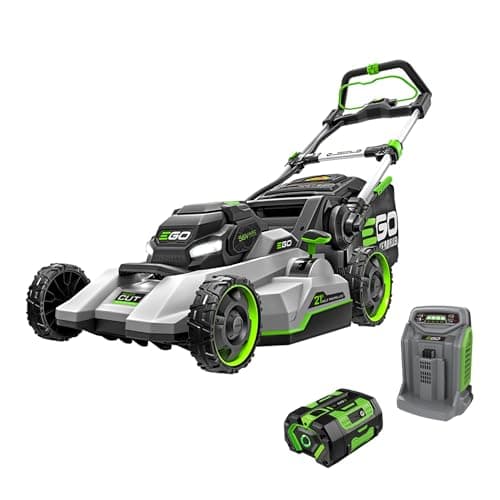
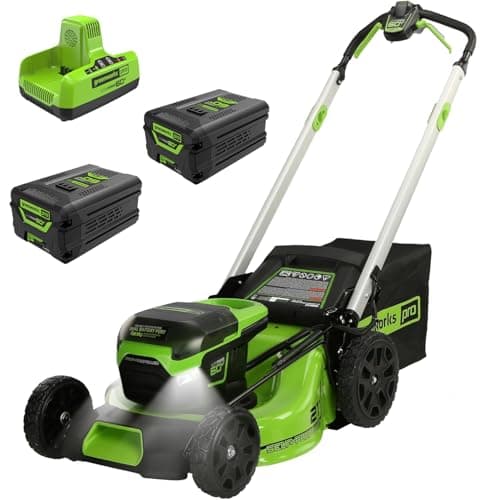
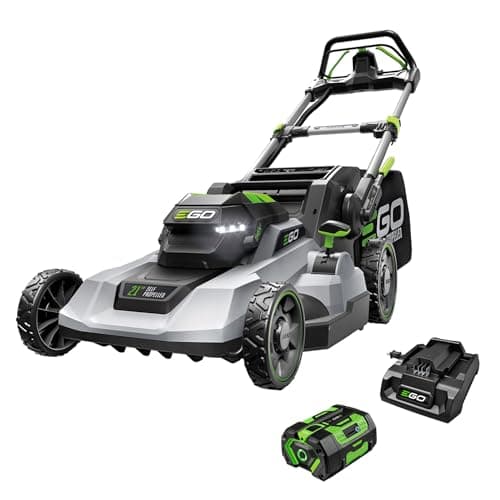
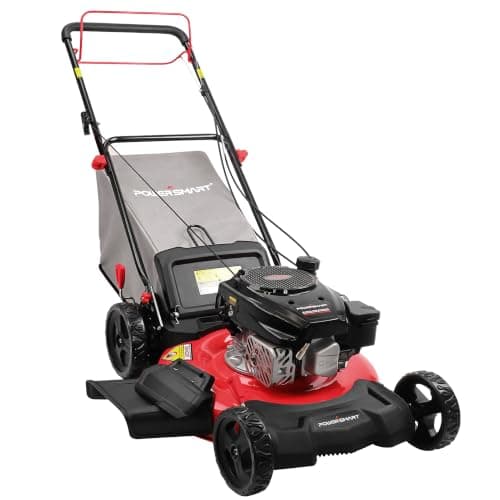
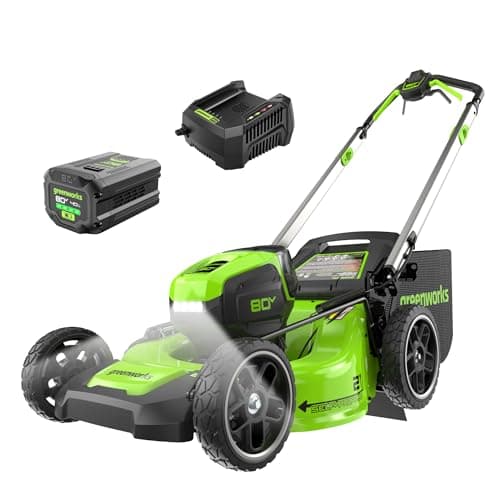
The best self-propelled mower for most lawns is the Greenworks 80V 21" Self-Propelled: a full-size deck, a driven wheel, 80 volts of headroom for damp grass, and a battery and charger included for less than the equivalent EGO. For a lawn running to half an acre, the twin-battery Greenworks 60V kit is the better choice, because two packs beat higher voltage when the problem is finishing. And if you want self-propelled drive for the least money possible, the PowerSmart gas mower does it for roughly half the price of any cordless option here.
The useful way to think about self-propelled drive is not strength but gradient. On genuinely flat ground, a push mower is fine and saves you money, weight and complexity. On a slope, a driven wheel changes the job completely — and a 21-inch deck carrying a full bag of wet clippings is a great deal heavier than it looks in the store. If your lawn has a bank, a terrace, or a long gentle rise up to the house, this is the page for you.
We have not pushed any of these up a hill, and we will not pretend we have. The ranking is built on published deck width, drive type, voltage or engine displacement, and the battery capacity actually included in the box — see how we pick. If you are still deciding whether you need a driven wheel at all, our mower sizing guide covers gradient alongside lawn area.
How to choose a self-propelled mower
Buy it for slope, not for size. A flat half acre is easier to push a mower round than a sloping eighth of an acre. If you have any meaningful gradient, self-propelled is worth the money; if you are completely flat, spend the difference on a bigger battery or a better spreader instead.
Rear-wheel drive handles slopes better than front. On an incline, your weight on the handle transfers load to the rear wheels. Front-wheel drive loses traction exactly when you need it, which is going uphill with a full bag. Front-wheel drive is easier to turn on the flat, because you can lift the nose; rear-wheel drive is the one you want if the lawn is hilly.
Variable speed matters more than top speed. A self-propelled mower that only has one pace forces you to walk at its speed rather than yours. Being able to slow down for a thick patch and speed up on a clear run is the difference between the drive helping you and dragging you.
On battery, count the packs. Self-propelled drive consumes energy that would otherwise go into the blade, so a self-propelled battery mower has shorter runtime than the same mower in push form. That is the honest trade. A two-battery kit like the Greenworks 60V exists precisely because of it.
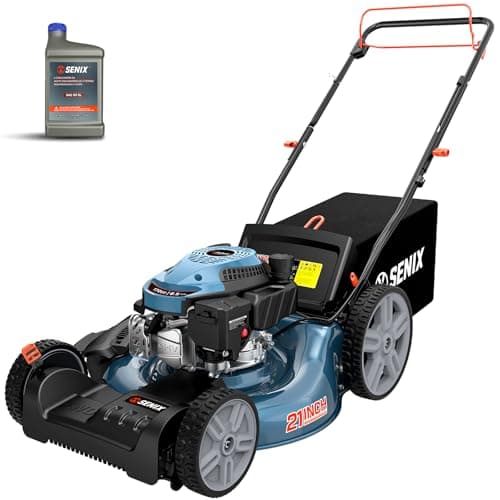
Gas still wins at the bottom of the market.If your budget genuinely does not stretch to a cordless self-propelled kit, the PowerSmart and SENIX gas mowers give you a driven wheel and a 170cc engine for roughly half the money. You pay for it later in oil changes, filters, fuel stabiliser and winterising — the arithmetic is in electric vs gas — but a driven wheel you can afford beats a cordless mower you cannot.
Who should skip these
If your lawn is flat, skip this list entirely. You are paying a premium and carrying extra weight for a drive system that will do nothing for you, and the push mowers in our electric mower roundup are lighter, cheaper and easier to store.
If your slope is severe — the kind where you mow across rather than up and down because up and down feels unsafe — skip walk-behind mowers altogether. That is not a mower problem, it is a machinery problem, and a lawn tractor tracks a side slope far more safely than a zero-turn or a walk-behind.
How we picked this
We haven't hit this gear — and we say so
We compiled the published manufacturer specifications — shaft weight and flex, loft, deck width, blower CFM, fertilizer NPK, seed species — did the deck-width and nitrogen arithmetic, cross-read the owner manuals, and scored each pick against a published rubric. The scores are judgments from documented research — they are notlab measurements we took, because we don't have a lab and we're not going to pretend we do. Where somebody has genuinely measured this, we link them. You can check every number we publish.