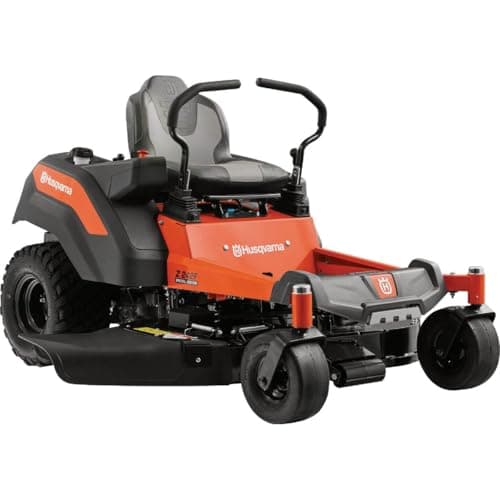
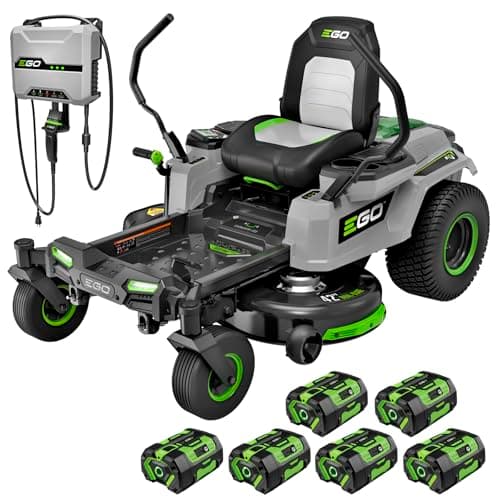
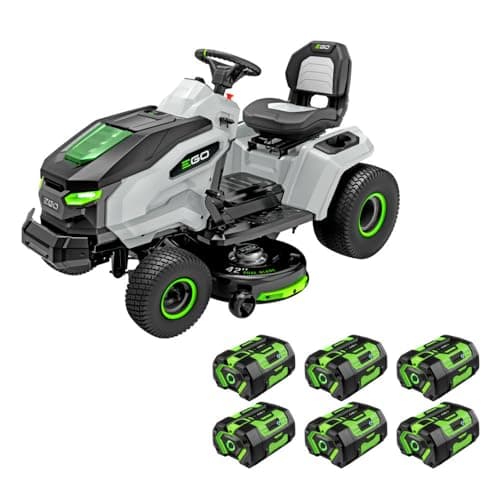
For most people buying their first riding lawn mower, the one to get is the EGO Power+ TR4204 electric lawn tractor. It is the cheapest 42-inch riding deck here, it tracks a slope more predictably than any zero-turn, it will tow an aerator or a sweeper, and being electric it asks nothing of you between seasons — no oil, no filters, no fuel to go stale over winter. If you want the best riding lawn mower for the money, that is the Husqvarna Z242F: a 21.5 HP Kawasaki twin on a 42-inch zero-turn deck for thousands less than any electric machine on this page, refuelled in two minutes. And if your lawn is full of beds, trees and fence lines, pay for the agility and buy the EGO Power+ Z6 42-inch zero-turn instead.
The reason this page ranks two different kinds of machine together is that “best riding mower” is really two questions wearing one coat. A lawn tractor steers with its front wheels and has a real turning circle, like a car. A zero-turn drives each rear wheel independently, so it pivots inside its own footprint. Which one is better is decided by the shapeof your lawn, not its size — and getting that backwards is where most of the money in this category gets wasted. The full case is in zero-turn vs lawn tractor.
We have not driven any of these machines and we are not going to imply otherwise. The ranking reasons from published deck widths, steering layout, engine rating or battery platform, hitch provision and the acreage each maker states — see how we pick. Every pick carries an honest “don’t buy if”, and there is a safety note below about slopes that is worth more of your attention than the rankings are.
Riding mower picks at a glance
| Machine | Layout | Deck | Power | Best for |
|---|
| EGO TR4204 | Lawn tractor | 42 in | Electric 56V | Open lawns, slopes, towing |
| Husqvarna Z242F | Zero-turn | 42 in | 21.5 HP Kawasaki gas | Best for the money, 3 acres and up |
| EGO Z6 ZT4214L | Zero-turn | 42 in | Electric 56V | 1–2 acres with obstacles |
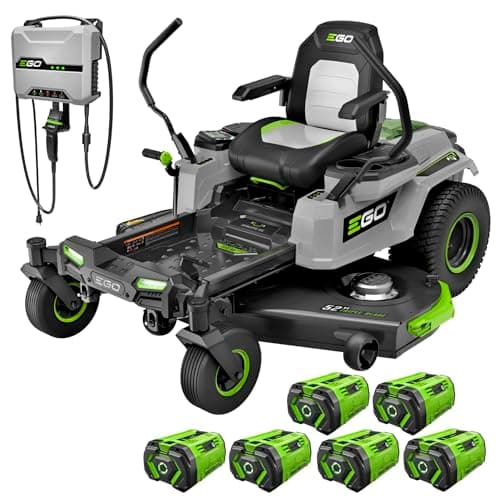
| EGO Z6 ZT5216L | Zero-turn | 52 in | Electric 56V | 2 acres and up, if access allows |
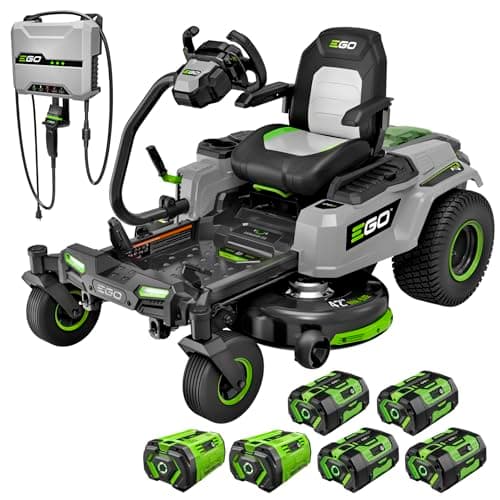
| EGO Z6 e-Steer | Zero-turn, steering wheel | 42 in | Electric 56V | Zero-turn radius without lap bars |
Deck widths, steering layouts and engine ratings in that table are the figures the listings and the manufacturers publish. Prices are live from the price layer and carry their own “as of” date next to each machine above.
How to choose a riding lawn mower
Measure the gate before you choose anything else. A 42-inch deck needs something over four feet of clear opening; a 52-inch deck needs well over four and a half. Plenty of residential side gates are narrower than both. Every other consideration on this page is irrelevant if the machine cannot physically reach the grass, and this is the mistake that costs the most to undo.
Then decide the layout on lawn shape.Count the things you have to mow around: trees, beds, a trampoline, fence posts, a shed. A dozen or more obstacles and a zero-turn will cut both your mowing time and — more importantly — your trimming time, because it leaves a clean edge instead of a crescent of uncut grass. An open lawn with three trees in it does not reward that agility, and a tractor costs less.
Take the slope seriously, because it is a safety specification. A zero-turn steers with its driven rear wheels and carries light, unpowered front castors. On a steep damp side slope that combination gives you less to correct with than a steering wheel and loaded front wheels do. If your land has a bank you would think twice about walking a mower across, weight the tractor layout above everything else here. This is not a performance preference.
Size the deck to the acreage, second.Up to about two acres, 42 inches is the right balance of coverage and access. From two to five acres, 52 inches takes roughly a fifth off your mowing time for a modest price step — the arithmetic is worked through in best zero-turn for 2 acres. Beyond five acres you are outside what any machine on this page is designed for.
Decide electric or gas on acreage, not on principle. Under about two acres, electric wins on ownership: no annual service ritual, instant starting, quiet enough to cut early. From three acres up, charge time becomes the binding constraint and a machine that refuels in two minutes is simply the better tool. That is the whole reason the Husqvarna sits second rather than last, and the same reasoning as electric vs gas for walk-behinds, scaled up.
Factor in what you want to pull. Tractor geometry and a proper drawbar are what let you tow a plug aerator, a spreader or a sweeper. On a big lawn that turns aeration and leaf clearing from a day of work into one pass of an afternoon, and it is a genuine ownership advantage the zero-turns do not match.
What this page does not cover, and why
We only rank products that are live, buyable listings. Most of the big dealer-channel riding brands — John Deere, Cub Cadet, Toro TimeCutter, Craftsman, Troy-Bilt, Ariens — are not sold through the channel we can verify prices on. Searching for them returns their carburetors, blades and drive belts, not their machines. Rather than pad this ranking with parts listings dressed up as mowers, we have kept it to machines you can actually buy at a price we can actually show you. If a dealer brand is on your list, take the layout and deck-width reasoning here and apply it to their spec sheet; the arithmetic travels unchanged.
Who should skip a riding mower entirely
If your lawn is under about three quarters of an acre, skip this category. A good self-propelled walk-behind covers that comfortably for a tenth of the price, stores in a shed rather than a bay, and does not need a gate wide enough to drive through. The sizing thresholds are in the best lawn mower for a large yard.
Skip the e-Steer unless lap bars are a genuine obstacle for you — it is several hundred dollars for a steering interface, not for capability. And skip the 52-inch deck without measuring first: it is the better mower and it is worth nothing on the wrong side of a 40-inch gate.