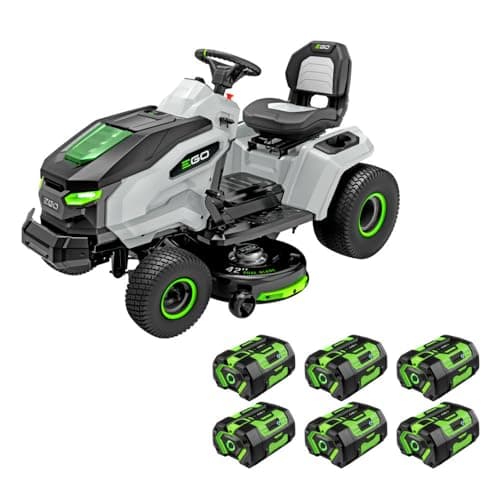
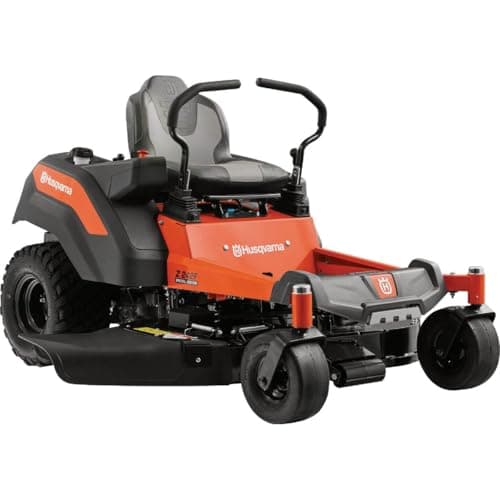
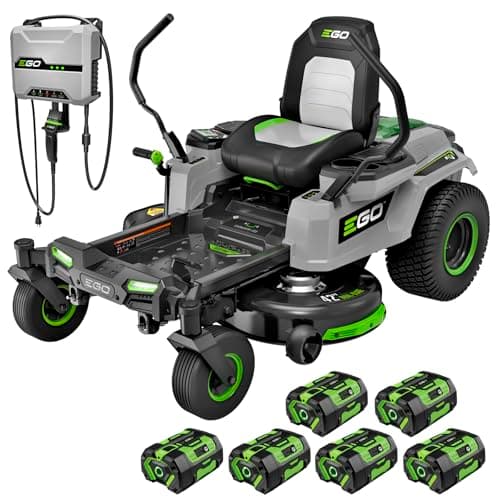
Buy a zero-turn if your lawn has obstacles in it; buy a lawn tractor if it is open, if it slopes, or if you want to tow things. The deciding factor is the shapeof your lawn, not its size — which is the opposite of what most people assume. Our pick on the zero-turn side is the EGO Power+ Z6 42-inch; on the tractor side, the EGO Power+ TR4204, which is cheaper than every zero-turn here and better on a gradient.
The mechanical difference is simple and it explains everything else. A zero-turn drives each rear wheel independently, so it can spin one forward and one back and pivot within its own footprint. A lawn tractor steers conventionally with its front wheels and has a real turning circle, like a car. Every advantage and disadvantage on this page falls out of that one design difference.
We have not driven either machine. What follows is reasoning from published deck widths, steering types, drivetrain layouts and hitch provision — see how we pick — plus a frank account of what each layout does on a slope, which is the part of this comparison that matters most and gets written about least.
Where the zero-turn wins
Obstacles, and it is not close. This is the whole reason the category exists. Around a tree, a flowerbed or a fence post, a zero-turn goes round in one pass and leaves a clean edge. A tractor needs a three-point turn and leaves a crescent of uncut grass you then have to go back for with a string trimmer. On a lawn with a dozen obstacles that difference compounds into a real chunk of every Saturday.
Total time on a complex lawn. Mowing time plus trimming time is the honest measure, and a zero-turn wins on the second half of that sum even where the first half is similar.
Precision at the edges. Pivoting in place lets you place the deck exactly against a border, which means fewer missed strips and less tidying up.
Where the lawn tractor wins
Slope behaviour, and this is a safety point. A zero-turn steers with its driven rear wheels and carries light, unpowered front castors. On a steep, damp side slope that gives you less to correct with if the machine starts to slide. A tractor's steering wheel and loaded front wheels track a gradient more predictably. If your land has a bank you would hesitate to walk a mower across, this consideration should outrank agility.
Towing. Tractor geometry and a proper drawbar are what let you pull a plug aerator, a sweeper or a spreader behind the machine. On a large lawn that turns aeration and leaf clearing from a day of work into a pass of the afternoon, and it is a genuine ownership advantage.
Price. The EGO TR4204 tractor is the cheapest 42-inch riding deck in our registry, below every zero-turn. If the lawn is open, you are paying for agility you will not use.
Straight lines on open ground. A tractor holds a line with less input, which on a big open lawn is both less tiring and tidier-looking.
The verdict
Complex lawn, gentle ground, no towing: zero-turn. Beds, trees and fence lines are exactly what it was invented for. Start at best zero-turn mower.
Open lawn, any real slope, or you want to tow: tractor. It is cheaper, safer on a bank and far more useful with an implement behind it.
Complex lawn and lap bars put you off: the e-Steer. A zero-turn radius with a steering wheel is a genuine third option, and worth the premium if the interface is what has been stopping you.
Under three quarters of an acre: neither. Both categories are overkill and a self-propelled walk-behind will cost you a tenth as much. The sizing thresholds are in what size lawn mower do I need.
How we picked this
We haven't hit this gear — and we say so
We compiled the published manufacturer specifications — shaft weight and flex, loft, deck width, blower CFM, fertilizer NPK, seed species — did the deck-width and nitrogen arithmetic, cross-read the owner manuals, and scored each pick against a published rubric. The scores are judgments from documented research — they are notlab measurements we took, because we don't have a lab and we're not going to pretend we do. Where somebody has genuinely measured this, we link them. You can check every number we publish.