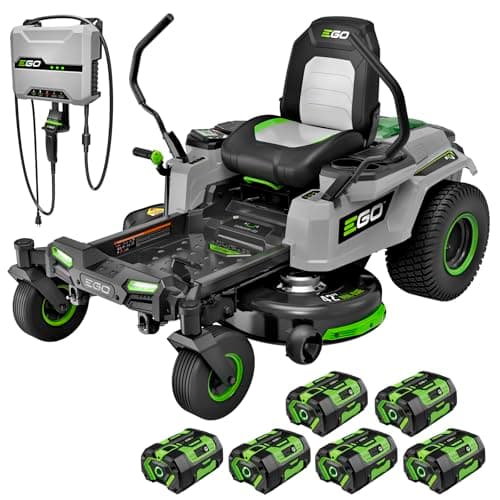
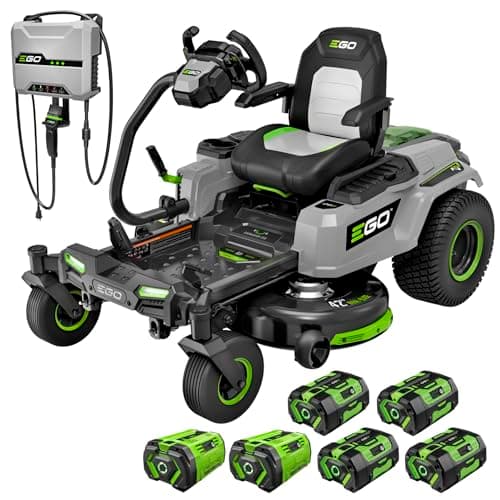
The best zero turn mower with a steering wheel that you can buy today at a visible price is the EGO Power+ Z6 e-Steer (ZT4215S): a 42-inch battery zero-turn with steering-wheel control instead of lap bars, on the deepest cordless platform in lawn care. In gas, the Cub Cadet Ultima ZTS1 42"is the machine the category is built around — its Synchro-Steer system turns all four wheels and is rated for slopes up to 20 degrees, which is a figure almost no lap-bar zero-turn will publish.
Here is the thing the marketing undersells. People assume a zero turn mower with steering wheelis about comfort or familiarity — and it is easier to learn, genuinely. But the real engineering argument is traction on a slope. A conventional zero-turn steers by driving one rear wheel faster than the other, and the front casters just follow. Put that on a side slope and the uphill wheel unloads, spins, and the machine slides downhill with the operator steering into nothing. Four-wheel steering gives the front wheels a job, so the machine tracks the line you asked for.
That is also why this page is short. True steering-wheel zero-turns are a small category: Cub Cadet's Ultima ZTS line and EGO's e-Steer are the two systems that matter in the US market, and everything else sold as "steering wheel" is usually a lawn tractor. We have not driven any of them; the ranking reads published steering systems, slope ratings, deck construction and engine or battery specifications. See how we pick.
What four-wheel steering actually changes
On slopes, everything. Cub Cadet publishes a 20-degree slope rating for Synchro-Steer machines. Lap-bar zero-turns generally do not publish a figure at all, and the reason is that differential-drive steering degrades exactly when you need it: as the uphill wheel unloads it spins, you lose the ability to steer, and the machine goes where gravity says. If your lawn has banks, this is the most important paragraph on the page.
On learning, a lot. Lap bars are not difficult but they are unintuitive, and the first hour involves jerky turns and torn turf at the pivot points. A steering wheel needs no practice lap. If the machine will be shared across a household, that matters.
On turf damage, noticeably. A lap-bar zero-turn executes its tightest turn by counter-rotating one wheel, which scrubs and tears grass. Four-wheel steering arcs instead, which is gentler on the lawn at the cost of a slightly wider turn.
On outright speed, slightly against. A true zero-turn radius is faster around a tree than any arc. If your lawn is flat and full of obstacles and you are confident on lap bars, a conventional zero-turn finishes marginally sooner. That is the honest trade.
How to choose one
Decide whether you actually have a slope. If the lawn is flat, the premium for four-wheel steering buys you an easier first hour and not much else, and the money is better spent on deck width or deck gauge. The main zero-turn roundup is the page for a flat lawn.
Then pick the deck for your lawn. 42 inches for gate access and obstacle-heavy ground, 50 for two acres and up. The small zero-turn page covers the access arithmetic properly.
Then gas or battery.The EGO e-Steer gives you steering-wheel control, no fuel, no oil and no carburetor, with the usual battery runtime ceiling — which on the kind of lawn that needs four-wheel steering is rarely the limiting factor, because sloped lawns tend to be small ones. The Cub Cadet machines are gas, run as long as you keep fueling them, and are dealer-channel purchases with no live price.
Be clear what you are buying, because the term is abused.A lawn tractor has a steering wheel and is not a zero-turn — it has a conventional turning circle and cannot pivot. Steering-wheel zero-turns are the machines where a wheel controls a differential-drive chassis, which is a specific and fairly rare piece of engineering. If what you want is a steering wheel and towing ability rather than a tight turn, a tractor is cheaper and better: see zero-turn vs riding mower.
The other way to solve a slope
Worth saying plainly: past a certain gradient, no riding mower is the right tool. Slope ratings exist and they are not aspirational. If part of your lawn is steeper than the machine's published figure, mow it with a rear-wheel-drive self-propelled walk-behind, which puts your weight behind the drive wheels, or with a wheeled string trimmer on the roughest parts. A robot mower is the third option on steep ground and several of them publish high slope ratings — see the robot mower roundup.