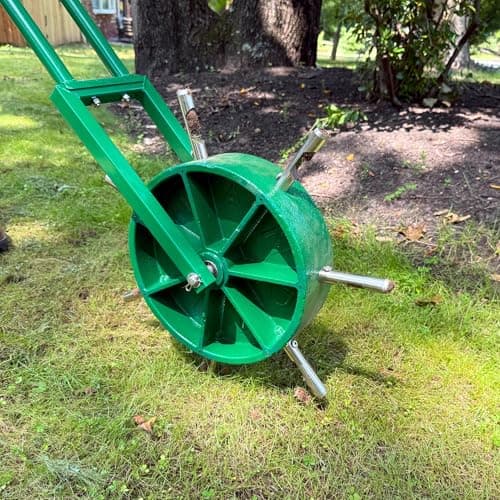
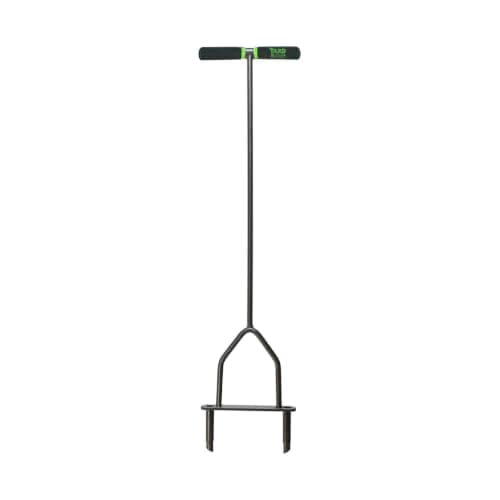
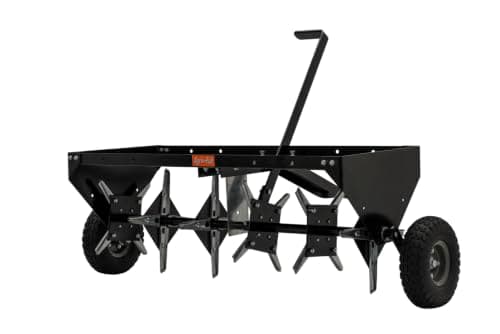
Aerate when your grass is in its strongest growth phase: early fall for cool-season lawns, late spring into early summer for warm-season lawns. For a tall fescue, bluegrass or ryegrass lawn across most of the United States that means roughly late August through September — soil still warm, air cooling, six good weeks of growing weather ahead to heal the holes. For bermuda, zoysia or St. Augustine it means after full green-up, when the grass is running. The tool for most lawns is a hollow-tine core aerator such as the Agri-Fab 40" Plug Aerator; without a tow vehicle, the Landzie Rolling Core Plug Aerator or the step-on Yard Butler ID-6C.
The reason the timing rule is strict is that aeration is a deliberate injury. You are removing thousands of plugs of soil and root, which is good for the lawn in the medium term and a wound in the short term. A plant growing hard closes that wound quickly and thickens up around it. A plant that is dormant, heat-stressed or about to be does not — it sits there with open holes, and the things that colonize open holes in a lawn are weed seeds.
We have not aerated anything for this page. The timing guidance is standard turf-management practice tied to how each grass type grows; the tool specs are the published working widths and tine types — see how we pick. Prices are live with an “as of” date.
The window, by grass type
| Grass type | Best window | Acceptable second window | Never |
|---|
| Tall fescue, fine fescue | Early fall | Early spring, if fall was missed | High summer |
| Kentucky bluegrass | Early fall | Early spring | High summer |
| Perennial ryegrass | Early fall | Early spring | High summer |
| Bermudagrass | Late spring to early summer, after green-up | Midsummer while growing hard | Fall and winter dormancy |
| Zoysia | Late spring to early summer | Midsummer | Fall and winter dormancy |
| St. Augustine | Late spring to early summer | Midsummer | Fall and winter dormancy |
The pattern is the same rule applied to two different calendars: aerate during active growth. Cool-season grass grows in spring and fall and struggles in heat; warm-season grass does the reverse. If you are not sure which you have, fescue vs bermuda is the quickest way to tell.
Why fall beats spring for cool-season lawns
Both windows are in the growth phase, so why prefer fall? Three reasons, and they compound.
Weed pressure. Spring aeration opens thousands of holes in exactly the weeks crabgrass seed is germinating. Fall aeration opens them when very little annual weed seed is looking for a gap.
You cannot aerate and use a pre-emergent.If you aerate in spring you either skip your crabgrass barrier or punch holes straight through one you have just laid. That conflict does not exist in September — see crabgrass preventer.
Overseeding works better.Fall is the right time to sow cool-season seed anyway, and freshly cored holes are the best seedbed you will get without a machine that slices soil. Doing both in one weekend is the single highest-value thing you can do to a thin lawn — see how to reseed a lawn.
How to tell whether you need it at all
Aeration is sold as annual maintenance and it is not always necessary. Three checks, none of which needs a lab.
The screwdriver test. Push a long screwdriver into moist lawn soil by hand. If it goes in six inches with light pressure, compaction is not your problem. If you are leaning on it to get two inches, it is.
Water behavior. If water puddles or runs off a lawn that is not on a slope, the surface is sealed. Compaction and thatch both do that, which is why the next check matters.
Cut a wedge and look.Lift a small triangle of turf with a spade. A spongy brown layer thicker than about half an inch between green growth and soil is thatch, and thatch is a dethatcher's job, not an aerator's. Hard, pale, tightly packed soil with shallow roots is compaction. You can have both, and aerating vs dethatching sets out which order to do them in.
How often
Clay soil, children, dogs or regular foot traffic: once a year, in the window for your grass type. Clay repacks quickly; see aerators for clay soil.
Loam with light use: every two or three years is plenty.
Sandy soil: rarely. Sand drains and resists compaction by nature, and aerating it is mostly wasted effort unless there is a measured problem.
A new lawn: not for the first full season. Let it root first.
The day itself, in order
Water a day or two before. Moist soil cores; dry soil will not let a tine fill, and saturated soil smears. This single step decides whether you pull plugs or scrape lines.
Mark the sprinklers and the shallow cable. Irrigation heads, low-voltage lighting runs and dog-fence wire all live in the top few inches, which is precisely where the tines go.
Mow a little shorter than usual. Not scalped - just low enough that the plugs land on the surface rather than in long grass, and that seed can reach soil if you are overseeding.
Two passes at right angles. Hole density is the goal, and crossing passes is how you get it without forcing the machine.
Seed and feed the same day if you are going to. The holes are the opportunity and they close.
Leave the plugs. They break down in a week or two and return their soil to the lawn.
Keep it damp for two to three weeks. Especially if you seeded. This is the period where the result is decided.
When not to aerate, however good your intentions
In drought or heat stress. You are wounding a plant that is already struggling and drying the root zone out further.
In dormancy. No growth means no recovery, and open holes all winter.
On saturated ground. Tines smear wet clay into a sealed glaze, which is the opposite of the point, and the machine makes ruts.
On a brand-new lawn. Wait a full season.
Right after a pre-emergent. You will punch through the barrier you just paid for.