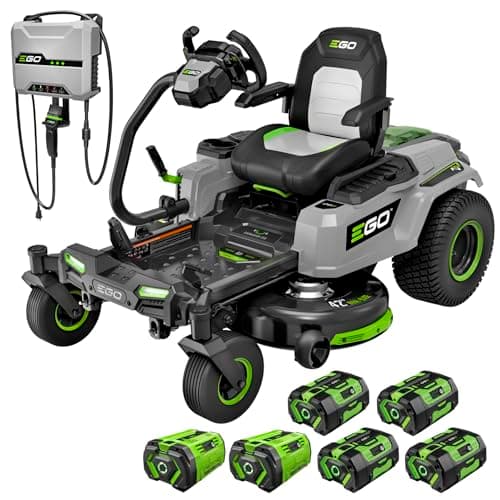
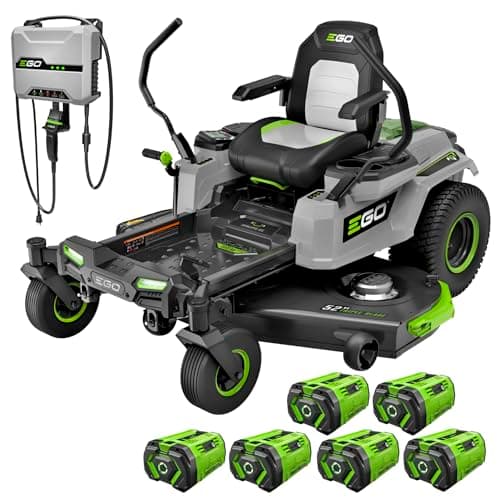
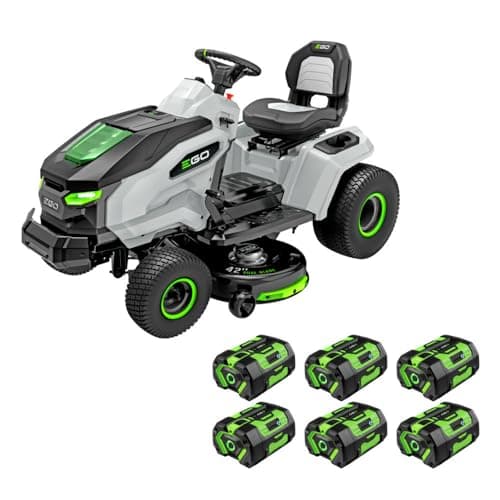
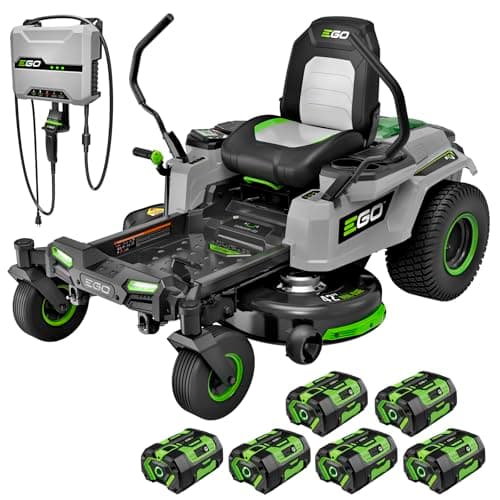
The best electric riding mower for most properties is the EGO Power+ Z6 ZT4214L: a 42-inch zero-turn on the EGO 56V platform, which is the right size for one to two acres and the format that saves the most time on an obstacle-heavy lawn. If you have never driven lap bars and would rather not learn, the EGO Z6 e-Steer gives zero-turn agility through a steering wheel. For open ground and towing, the EGO Power+ TR4204 is a conventional 42-inch lawn tractor with a hitch. And if your property is over two acres, the 52-inch Z6 ZT5216L is the one with enough deck to make a charge count.
What you are buying is the deletion of an entire maintenance routine. A gas rider means fuel stabilizer, oil and filter changes, a spark plug, an air filter, a fuel line that perishes and a carburetor that gums up over winter — and the single most common reason a rider does not start in April is that it was put away in October with fuel in it. An electric rider has none of that. It also starts instantly, runs quietly enough to mow early on a Sunday, and produces no exhaust in your face on a hot afternoon.
The honest limit is acreage per charge. A battery rider has a fixed amount of energy on board, and deck load is what spends it — tall grass, wet grass and thick turf all cost more. On up to about two acres of normal residential turf these machines finish the job with margin. At three acres and up you are relying on everything going right, and at five the answer is a gas machine from the five-acre page. Prices below are live from the price layer with an “as of” date.
Which electric rider for which property
| Property | Format | Deck | Our pick |
|---|
| Half to one acre, obstacles | Zero-turn, lap bars | 42 in | EGO Z6 ZT4214L |
| Half to one acre, first rider | Zero-turn, steering wheel | 42 in | EGO Z6 e-Steer |
| One to two acres, open | Zero-turn, lap bars | 52 in | EGO Z6 ZT5216L |
| Open ground plus towing | Lawn tractor | 42 in | EGO TR4204 |
| Three acres and up | Gas zero-turn | 54–61 in | See the five-acre page |
What a charge really covers, and how to stretch it
Nobody can tell you your runtime, because it depends on grass height, moisture, deck width and how much of the time the blades are actually loaded. What is predictable is the direction of the effects, and they are large: mowing weekly instead of fortnightly roughly halves the work per pass; cutting at a taller height loads the deck less; and mowing dry grass can be the difference between finishing and not. If you are near the limit of what one charge does, raising cut height by half an inch and mowing before the grass gets away from you are both free.
The practical rule: buy a deck wide enough that the job is finished in fewer passes rather than buying for the sake of the width. A 52-inch deck on two acres uses its energy more efficiently than a 42-inch deck doing the same two acres, because fewer passes means fewer overlaps and fewer turns.
Lap bars or a steering wheel?
Lap bars are faster once learned and are what every commercial zero-turn uses. A steering-wheel zero-turn — EGO calls theirs e-Steer — gives you the same pivot agility through a control everyone already understands, which matters if the mower will be driven by more than one person in the household, and behaves better on a slope because the front wheels steer rather than relying on braking one rear wheel. That slope argument is developed in best riding mower for hills and the whole category is in best zero turn mower with a steering wheel.
The honest state of this market
Battery riders are a young category, and the listings reflect it. On Amazon the residential electric rider market is effectively EGO— the four machines on this page are what has a real listing and a verifiable price. Other makers do sell battery riders, mostly through dealers and big-box retail, and we will add them here when there is a listing we can price honestly rather than a number we remembered. That is the same rule as everywhere else on the site: no live price, no number.
Electric rider or robot mower?
A real question at under an acre, and the answer is not obvious. A robot mower cuts a little every day, needs no driver at all, and keeps a lawn in better condition than weekly mowing does because it never removes much leaf at once. An electric rider cuts when you want, handles tall grass a robot would refuse, and does not need boundary setup. If your lawn is under an acre, reasonably simple in shape, and the appeal of electric is mostly that you dislike the chore, read best robot lawn mower before you buy a rider at all.
Running costs, briefly
Electricity to charge a residential battery rider costs a small fraction of the fuel a gas rider burns doing the same work, and the maintenance list is a blade sharpening and a deck scrape. The batteries are the long-term consumable rather than the engine, and they are replaceable. Against that, the purchase price is higher than an equivalent gas machine today. If you intend to keep the mower five years or more and your acreage is inside what a charge covers, the arithmetic favors electric; if you need three-plus acres cut in one go, it does not, and we will say so rather than sell you the wrong machine.
How we picked this
We haven't run this gear through a lab — and we say so
We compiled the published manufacturer specifications — deck width and gauge, drive type, blower CFM, fertilizer NPK, seed species — did the deck-width and nitrogen arithmetic, cross-read the owner manuals, and scored each pick against a published rubric. The scores are judgments from documented research — they are notlab measurements we took, because we don't have a lab and we're not going to pretend we do. Where somebody has genuinely measured this, we link them. You can check every number we publish.