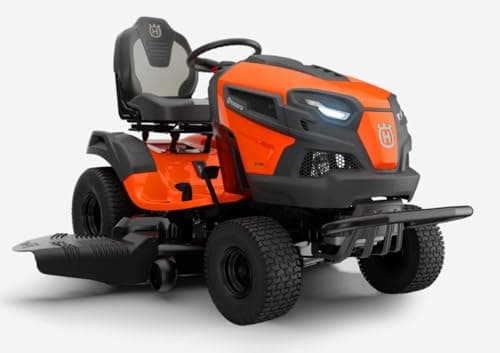
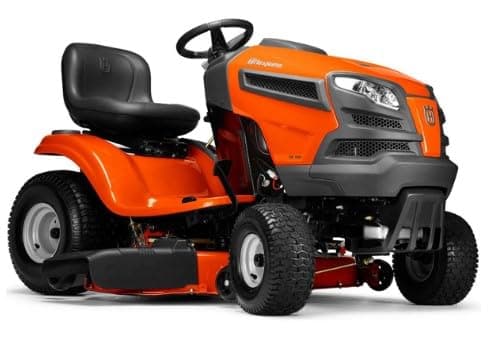
For a sloping lawn the machine to buy is the Cub Cadet Ultima ZTS1 42", and the reason is one published number: Cub Cadet rates it to 20-degree slopes, which is a figure almost nobody else in this market will print. It gets there with four-wheel Synchro-Steer control rather than two braked drive wheels, so it steers with the front wheels and keeps traction pointing where you are going. If you would rather have a conventional tractor, the John Deere X350 sits on a garden-tractor frame with the weight low and a real steering box, and the Husqvarna TS 140Xis the heavier 48-inch alternative. If this is your first slope mower, read the safety section below before the picks — the right machine driven the wrong way up a hill is still the most dangerous thing in lawn care.
Why hills are a different buying problem: a mower on a slope is fighting three separate things. Traction— drive wheels unload as the machine tilts, and a two-wheel-drive machine with a light rear end simply stops climbing. Steering authority— a conventional zero-turn steers by slowing one drive wheel, so when that wheel has no grip the machine does not turn, it slides. And stability— a high center of gravity and a narrow track is what turns a slide into a rollover. Horsepower fixes none of the three.
That is why a steering-wheel zero-turn and a garden-frame tractor lead this list while high-powered lap-bar zero-turns do not. The lap-bar machines on this site are ranked for open acreage in best zero-turn mower, and that is the right page for flat ground. Prices below are live from the price layer; the dealer-channel machines carry a tagged check-price link rather than a number.
Walk-behind mowers on a slope
If the slope is a yard rather than acreage, the machine and the method both change: you want a rear-wheel-drive walk-behind, and you mow across the slope rather than up and down - the exact reverse of the rule for a rider. See the best lawn mowers for hills.
The safety rules, which are not optional
These come from operator manuals and from standard turf-equipment practice, not from us trying anything out, and they are the part of this page to read twice.
With a lawn tractor, mow up and down the slope, never across it. A tractor is at its most stable pointing up or down the fall line. Mowing across a slope puts the whole machine on a side tilt, which is the position rollovers happen from.
With a zero-turn it is the reverse: traction, not tilt, is the danger. A conventional zero-turn has no mechanical brake on a descent beyond the transmissions themselves, and if the rear wheels break loose going downhill you have no steering at all. Go down slowly, keep the drive levers barely open rather than neutral, and never turn across the fall line while descending.
Read the slope limit in your manual and believe it. Most makers publish a maximum gradient and most owners never look. Cub Cadet prints 20 degrees for the Synchro-Steer ZTS1 machines, which is unusually high and unusually specific. Where a maker does not publish a figure, assume the machine is not a slope machine.
Keep tires at spec pressure and never mow a wet slope.A soft tire deforms and reduces the effective track width; wet grass removes most of the friction you were relying on. These two together account for most “the mower just slid” stories.
Steering type decides slope behavior
| Machine type | How it steers | On a slope | Best for |
|---|
| Steering-wheel zero-turn | Four-wheel, front wheels driven into the turn | Keeps steering authority when rear traction drops | Slopes with obstacles |
| Garden tractor | Steering box, low frame | Predictable up and down the fall line | Long, even slopes |
| Lawn tractor | Steering box, lighter frame | Fine on moderate grades, light rear end limits climbing | Gentle slopes |
| Lap-bar zero-turn | Braking one drive wheel | Loses steering with traction; poor descent control | Flat open ground |
| Suspension zero-turn | Lap bars, independent suspension | Keeps tires loaded over rough ground, which helps grip | Rough, undulating ground |
Why the Synchro-Steer machines win this page
A conventional zero-turn turns by slowing or reversing one rear wheel. On a slope that wheel is often the one with least weight on it, so the input that should turn the machine instead spins a wheel and the machine keeps going straight. A four-wheel-steer zero-turn turns the front wheels as well, so the geometry of the turn does not depend on rear traction alone. That is a structural advantage on a hill rather than a marketing one, and it is why Cub Cadet is willing to print a 20-degree rating. Both sizes are ranked here; the 42-inch is the one to buy unless the slope is also large, in which case the 50-inch saves passes. The wider steering-wheel category is covered in best zero turn mower with a steering wheel.
When the answer is not a rider at all
Two honest cases. If the slope is steeper than about 20 degrees — a 1-in-3 grade, where walking up it is work — no residential riding mower belongs on it. That is string-trimmer ground, or a job for a walk-behind brush cutter, and the trimmers are in best string trimmer. And if the slope is a bank rather than a lawn, a robot mower with a published slope rating is a genuinely better answer than any rider, because nobody is sitting on it. The Husqvarna 410iQ publishes a 45 percent slope rating, which is about 24 degrees.
Setup that makes any of these better on a hill
Run tires at the pressure on the sidewall, not by eye. Weight the rear if the maker offers a kit — a light back end is what stops a tractor climbing. Cut the slope at a taller height than the flat, because longer grass roots deeper and holds the soil. Sharpen blades more often than on flat ground, since you are often cutting at an angle to the grass. And mow slopes first, while you are fresh and attentive, rather than last.