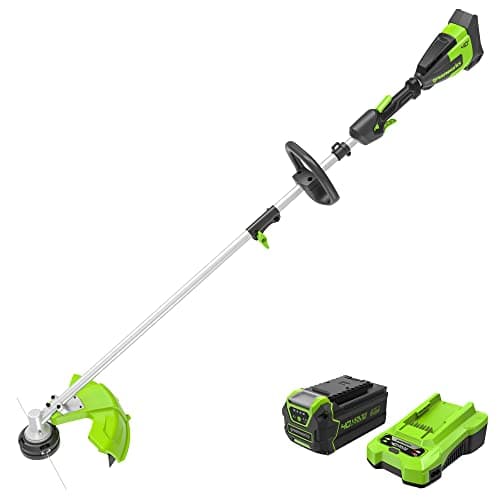
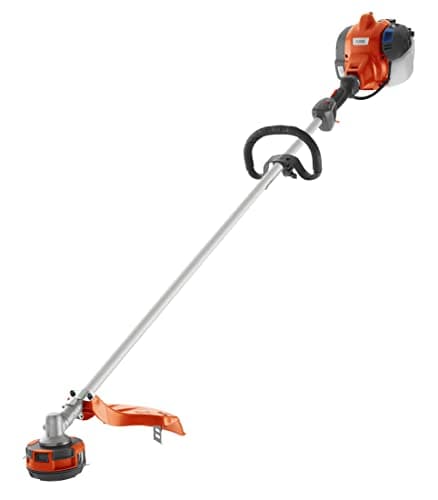
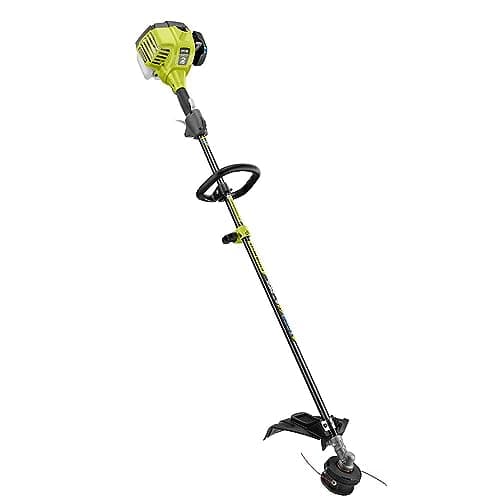
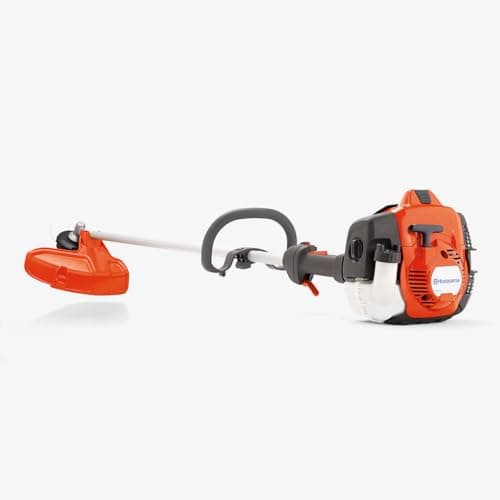
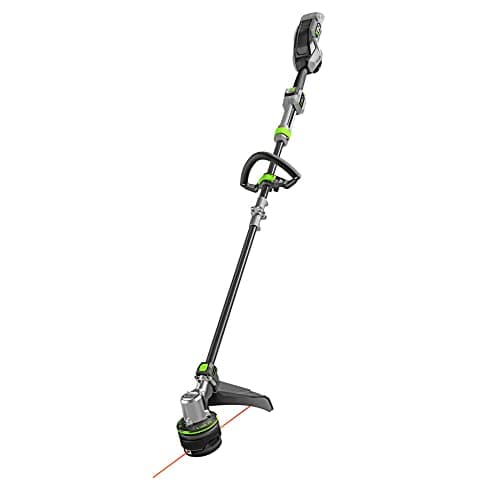
If you trim for less than about half an hour at a time, buy battery and do not think about it again. The pick is the EGO Power+ 16" with POWERLOAD and LINE IQ, which reloads its own spool and feeds line automatically, or the Greenworks 40V 16" if you want the same swath with a 4.0 Ah battery in the box for much less money. If you trim long property lines, ditch banks or rough grass for an hour or more at a stretch, buy gas: the Husqvarna 130L has the widest swath here at 18 inches, the RYOBI 25 cc full-crank is the most displacement per dollar, and the Husqvarna 525L is the one built for daily use.
The format argument is usually framed as power, and that framing is a decade out of date. A good 56V or 80V brushless trimmer cuts ordinary lawn grass and soft weeds as well as a 25 cc two-stroke does. What gas still owns outright is unlimited runtime: when a battery runs flat you stop and charge, and when a tank runs dry you pour more fuel in and keep going. Every other difference follows from that one.
We have cut nothing with these. The comparison reads published cutting swath, voltage or engine displacement, shaft type, line gauge and line-feed mechanism — see how we pick. Prices are live from the price layer with an “as of” date.
Head to head on the things you will actually notice
| | Battery | Gas |
|---|
| Runtime | Limited by the pack; a second battery is the fix | Unlimited - refuel and continue |
| Starting | A trigger | Primer, choke and a pull cord |
| Cutting power in rough growth | Good on 40V and up; fades as the pack drains | Constant until the tank is empty |
| Weight in the hands | Lighter, and the mass sits near the handle | Heavier, with the engine at the top |
| Noise | Quiet enough to use early on a Saturday | Loud enough that you will not |
| Maintenance | Clean it, store the pack above freezing | Fuel mixing, air filter, spark plug, winter storage |
| Running cost | Pennies of electricity; a pack to replace in years | Fuel and oil every tank, plus parts |
| Widest swath available here | 16 inches | 18 inches |
Swaths, voltages and displacements are published figures. The behavioral differences - starting, noise, maintenance - are inherent to the two power sources rather than claims about particular models.
The number that decides it: minutes per session
Forget acreage for a moment and count trimming minutes. A quarter-acre suburban lot with beds, a fence and a couple of trees is usually fifteen to twenty-five minutes of trimming. One decent battery covers that with margin, and the whole gas argument evaporates.
Past about forty minutes of continuous trimming, you are into a second battery — and a second high-capacity pack costs real money, often more than the difference between the battery tool and the gas one. That is the crossover. It is not about whether a battery tool is “powerful enough”; it is about whether you want to own and charge two packs.
And if the honest answer is “my job is a quarter acre of rough grass and a ditch bank”, neither format of handheld is the right tool. A wheeled string trimmer does that in twenty minutes what a handheld does in two hours, because the ground carries the weight instead of your shoulders.
Where battery is clearly better, not just adequate
Line handling.This is the quiet reason to buy battery now. Automatic line feed and powered spool reloading exist almost entirely on battery tools, and they remove the two parts of the job everyone hates. EGO's LINE IQ feeds line as it wears instead of making you bump the head; POWERLOAD winds a fresh spool at the push of a button. Nothing in the gas column does either, with the honorable exception of Echo's Speed-Feed head, which makes reloading fast but still manual.
Starting cold. A trimmer that starts on a trigger gets used for the five-minute jobs. A trimmer that needs priming and three pulls gets left in the shed until the whole lawn needs it.
Platform value.The battery you buy for the trimmer also runs the blower and in many cases the mower. On the Greenworks 40V platform that is exactly the argument — see the Greenworks mower range.
Early mornings and shared fences. Noise is a real constraint in a subdivision and battery solves it.
Where gas is still the right buy
Long sessions. An hour or more without stopping. Refuel and carry on.
Rough, woody growth at the edge of a property.A 25 cc engine holds its speed in material that makes a battery trimmer bog and drain. If the stems have bark on them, note that neither is the right tool — that is a brush cutter, as string trimmer vs weed wacker explains.
Heavier line. Thicker line needs a motor rated for it. Gas machines in this class carry 0.095-inch line and up comfortably; small battery tools are rated for thinner line and overheat if you force it. The trimmer line guide covers the gauge limits.
Daily use. Professional-grade gas tools like the Husqvarna 525L are built around clutches, shafts and heads that survive hours a day. See commercial string trimmers.
Two-stroke or four-stroke, if you do go gas
A two-stroke needs oil mixed into every tank at the stated ratio, and getting it wrong destroys the engine. A four-stroke, like the Troy-Bilt TB304S in the gas roundup, runs on straight gasoline and carries its oil in a sump — no mixing, but oil changes and a tool that has to be kept broadly upright.
One spec is worth more than displacement on an affordable two-stroke: a full crankshaft. It is the difference between a trimmer engine that lasts a decade and one that does not, and it is published. The RYOBI 25 cc is on this page largely because of it.
The verdict
Suburban lawn, under half an hour of trimming: battery, and specifically a 16-inch tool with automatic line feed. The EGO ST1620T.
Same job, less money:the Greenworks 40V 16" with the 4.0 Ah battery included.
Long property lines and rough grass: gas. The Husqvarna 130L for the 18-inch swath, the RYOBI 25 cc for value.
Trimming most days: the Husqvarna 525L, which is built for it.
A field or a ditch rather than a lawn: neither. Buy a wheeled string trimmer.