Skip to content
Fairway&Fescue

The Feed · Fertilizer, Weed Control & Spreaders

The Best Tow-Behind Spreader

Ranked on the three things that decide whether an implement earns its shed space: how much it carries, where the product actually lands, and whether it will hitch to the mower you already own.

By Stephen V.Updated How we pick
#ad

We earn a commission when you buy through our Amazon links, at no extra cost to you. It never changes our rankings — and we'll tell you when the cheaper bag or machine is the better buy. How this works.

The best tow-behind spreader is the Agri-Fab 45-0463 130 lb Tow-Behind Broadcast Spreader: enough hopper to feed an acre without a refill stop, a thrown pattern wide enough that the pass count stops mattering, and the spreader grate kit in the same box rather than sold separately — and it is also the cheapest spreader on this page, so the top pick and the budget pick are the same machine. If you are feeding multiple acres, the Brinly BS36BH-A carries 175 pounds on a universal hitch that fits most riders. If your lawn is cut up by beds and borders rather than wide open, the Agri-Fab 175 lb Tow-Behind Drop Spreader puts product straight down between the wheels and nowhere else. And if your actual job is overseeding, Brinly’s Tow-Behind Combination Aerator Spreader opens the soil and drops the seed on one pass.

Prices on every card are pulled live with an “as of” date rather than written into the prose, because towed implements are discounted seasonally and a typed number would be wrong by spring. We have not pulled these spreaders behind a tractor ourselves. Every judgment here comes from the published hopper capacity, the stated spread width and pattern, the hitch type, and the physics of how each pattern distributes product — all of it checkable on the manufacturer’s own specification. The method is in how we pick.

Start with the honest threshold: below about half an acre, a tow-behind spreader is the wrong purchase.A push broadcast spreader holds 50 to 85 pounds, costs a fraction of these, stores against a wall, and walks a suburban lawn in fifteen minutes. The case for towing appears when the walking becomes the cost — roughly from half an acre up, and decisively past an acre, where a push spreader means three hopper refills and a mile of walking per application. If you are under that line, buy from the best broadcast spreaders instead, or the ones under $200.

The second thing to settle before you spend anything: a tow-behind spreader is useless without a hitch.Lawn tractors almost all have one. Zero-turns often do not, and a hitch kit is model-specific. Check the back of your own machine before you buy an implement for it — this is the single most common reason one of these ends up back in its box. If you are still choosing the mower, the ladder is in the best riding lawn mowers and riding mower attachments.

The short answer

Quick picks

#ProductBest forScorePrice
01
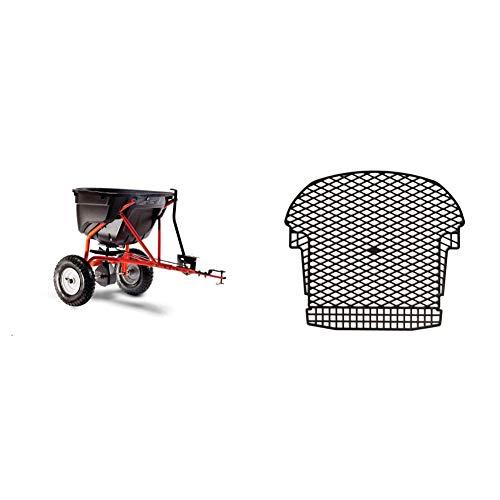
Agri-Fab Agri-Fab 45-0463 Tow-Behind Broadcast Spreader, 130 lb (with grate kit)
Agri-Fab 45-0463 Tow-Behind Broadcast Spreader, 130 lb (with grate kit)

The tow-behind broadcast spreader most acreage owners should buy. A 130 lb hopper, a wide throw, and the grate kit in the same box - which is the part that stops lumpy product bridging the gate.

Best tow-behind broadcast spreader
7.8
$249.98Amazon
02
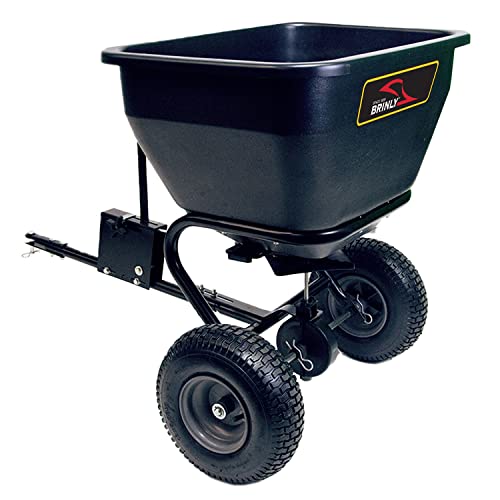
Brinly Brinly BS36BH-A Tow-Behind Broadcast Spreader, 175 lb
Brinly BS36BH-A Tow-Behind Broadcast Spreader, 175 lb

The biggest hopper here, on a universal hitch that fits most riders rather than one brand's. Buy it when the lawn is big enough that refill stops are the thing costing you time.

Largest hopper for multi-acre lawns
7.8
$314.00Amazon
03
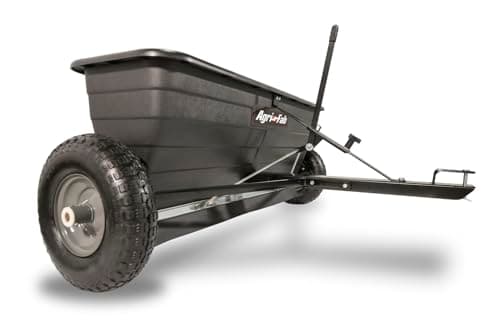
Agri-Fab Agri-Fab Tow-Behind Drop Spreader, 175 lb (42" spread width)
Agri-Fab Tow-Behind Drop Spreader, 175 lb (42" spread width)

The drop spreader for acreage: a 42-inch spread width and a 175 lb hopper behind a rider, which fixes the one real weakness of the pattern - how many passes it takes.

Drop-pattern accuracy over an acre
8.2
$302.39Amazon
04
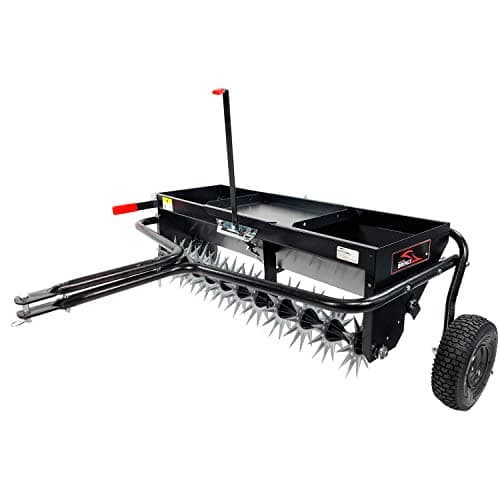
Brinly Brinly Tow-Behind Combination Aerator Spreader, 40" (with weight tray)
Brinly Tow-Behind Combination Aerator Spreader, 40" (with weight tray)

One implement that opens the soil and drops the seed on the same pass, which is exactly the job of an overseeding weekend. The spreader sits ahead of the tines, so seed lands and then gets worked in.

Best aerator and seeder in one tool
7.2
$384.00Amazon

#ad · Live prices from the Amazon Product API, as of November 22, 2026. Where we have no verified live price, we show none — we would rather leave a gap than print a number that has rotted.

In detail

The picks, in full

01
Agri-Fab Agri-Fab 45-0463 Tow-Behind Broadcast Spreader, 130 lb (with grate kit)

Best tow-behind broadcast spreader

Agri-Fab 45-0463 Tow-Behind Broadcast Spreader, 130 lb (with grate kit)

Broadcast pattern130 lb hopperTow-behind hitchIncludes grate kit
7.8/10

The tow-behind broadcast spreader most acreage owners should buy. A 130 lb hopper, a wide throw, and the grate kit in the same box - which is the part that stops lumpy product bridging the gate.

Capacity
8
Speed per acre
9
Placement accuracy
6
Build quality
8
Value
8

Pros

  • A broadcast pattern throws product several feet either side of the machine, so an acre takes a fraction of the passes a drop spreader needs
  • 130 lb is enough hopper to feed an acre without stopping to refill, which is the whole reason to tow rather than push
  • The grate kit comes in the box rather than as an add-on - it breaks up clumped fertilizer before it reaches the gate, and a bridged gate is the most common tow-behind failure

Cons

  • A thrown pattern will put fertilizer into beds, onto paths and down driveways unless you plan the pass order around them
  • Needs a rider or tractor with a hitch; there is no push version of this machine
  • Gate calibration is by test pass and feel, not by a printed setting you can trust across products

Skip this if…

…your lawn has more edge than middle. On a lot cut up by beds, borders and hardscape, a drop spreader's accuracy is worth more than a broadcast spreader's speed.

$249.98View on Amazon

$279.9811% off

Price as of November 22, 2026. Prices change — Amazon's is the one that counts.

#ad · we may earn a commission from this link to Agri-Fab 45-0463 Tow-Behind Broadcast Spreader, 130 lb (with grate kit)

02
Brinly Brinly BS36BH-A Tow-Behind Broadcast Spreader, 175 lb

Largest hopper for multi-acre lawns

Brinly BS36BH-A Tow-Behind Broadcast Spreader, 175 lb

Broadcast pattern175 lb hopperUniversal hitchTow-behind
7.8/10

The biggest hopper here, on a universal hitch that fits most riders rather than one brand's. Buy it when the lawn is big enough that refill stops are the thing costing you time.

Capacity
10
Speed per acre
9
Placement accuracy
6
Build quality
8
Value
6

Pros

  • 175 pounds is 45 more than the Agri-Fab carries, which on a multi-acre property is the difference between one fill and two
  • A universal hitch means it goes behind a lawn tractor, a hitch-equipped zero-turn or an ATV without a brand-specific adapter
  • Rated for seed, fertilizer and ice melt, so the hopper earns shed space outside the growing season

Cons

  • The most expensive spreader on this page, and the extra capacity is only worth paying for above roughly an acre
  • A loaded 175 lb hopper is a lot of weight to pull across soft ground or up a slope - it will rut a wet lawn
  • No grate kit in the box, so clumped product can bridge over the gate

Skip this if…

…you have an acre or less. You will never fill the hopper, and the extra weight and price buy nothing a 130 lb spreader does not already do.

$314.00View on Amazon

$329.005% off

Price as of November 22, 2026. Prices change — Amazon's is the one that counts.

#ad · we may earn a commission from this link to Brinly BS36BH-A Tow-Behind Broadcast Spreader, 175 lb

03
Agri-Fab Agri-Fab Tow-Behind Drop Spreader, 175 lb (42" spread width)

Drop-pattern accuracy over an acre

Agri-Fab Tow-Behind Drop Spreader, 175 lb (42" spread width)

Drop pattern175 lb capacity42" spread widthTow-behind
8.2/10

The drop spreader for acreage: a 42-inch spread width and a 175 lb hopper behind a rider, which fixes the one real weakness of the pattern - how many passes it takes.

Placement accuracy
10
Speed per 1,000 sq ft
8
Capacity
10
Ease of use
7
Value
6

Pros

  • 42 inches of drop width is wider than most tow-behind broadcast spreaders throw usefully, so the pass count stops being the problem
  • 175 lb hopper covers a large lawn without a refill stop
  • Rated for seed, fertilizer, salt and ice melt, so it earns its shed space in winter too

Cons

  • Needs a rider or tractor with a hitch - there is no push version of this machine
  • Far more spreader than a suburban lawn needs, at a price to match

Skip this if…

…you do not already own a riding mower or tractor. This is a tow-behind implement and nothing else; the push drop spreader is the right tool at suburban scale.

$302.39View on Amazon

$359.9916% off

Price as of November 22, 2026. Prices change — Amazon's is the one that counts.

#ad · we may earn a commission from this link to Agri-Fab Tow-Behind Drop Spreader, 175 lb (42" spread width)

04
Brinly Brinly Tow-Behind Combination Aerator Spreader, 40" (with weight tray)

Best aerator and seeder in one tool

Brinly Tow-Behind Combination Aerator Spreader, 40" (with weight tray)

40" working widthAerator + spreader in oneWeight trayTow-behind
7.2/10

One implement that opens the soil and drops the seed on the same pass, which is exactly the job of an overseeding weekend. The spreader sits ahead of the tines, so seed lands and then gets worked in.

Seedbed preparation
9
Compaction relief
5
Working width
8
Ease of use
7
Value
7

Pros

  • Aerating and seeding in one pass halves the work of the single most valuable thing you can do to a thin lawn
  • 40 inches of working width covers a half-acre lawn in a sensible number of laps
  • The weight tray lets you load it down for genuine soil penetration rather than scratching the surface

Cons

  • Needs a riding mower or tractor with a hitch - there is no walk-behind version
  • Spike-style tines open the soil rather than pulling cores, so it is a seedbed tool, not a decompaction tool

Skip this if…

…your real problem is compacted soil. Spikes press soil sideways; a hollow-tine core aerator removes a plug and is the only tool that genuinely fixes compaction.

$384.00View on Amazon

Price as of November 22, 2026. Prices change — Amazon's is the one that counts.

#ad · we may earn a commission from this link to Brinly Tow-Behind Combination Aerator Spreader, 40" (with weight tray)

Broadcast or drop: the decision that comes before capacity

A broadcast spreader drops product onto a spinning disc that throws it in an arc several feet either side of the machine. One pass covers eight to twelve feet, so an acre takes a handful of passes. The cost is control: the arc does not stop at the edge of the lawn, so fertilizer goes into beds, onto paths and down driveways unless you plan the pass order to finish at the boundary and shut the gate before you reach it.

A dropspreader opens a gate along the bottom of the hopper and lets product fall straight down between the wheels. Nothing is thrown anywhere. That makes it the accurate tool — you can run it a foot from a flower bed and nothing lands in the bed — and the slow one, because the spread width is roughly the width of the machine. Every pass has to abut the last exactly or you get a stripe of unfed grass that will be visible for a month.

The rule that actually decides it: count your edges. Wide open acreage with a clean perimeter is broadcast territory. A property carved up by beds, trees, gravel and hardscape rewards the drop pattern, because cleanup and overspray cost more than passes do. The long-form version is in broadcast vs drop spreader.

The criteria, in the order they matter

1. Hopper capacity against your actual acreage.This is why you are towing at all. Work it backwards: a typical granular fertilizer covers 5,000 to 15,000 square feet per bag, so an acre — 43,560 square feet — is roughly 100 to 130 pounds of product. A 130 pound hopper does an acre in one fill. A 175 pound hopper does an acre and a half. Below an acre you will never fill either, and the capacity is dead weight you paid for.

2. Hitch type, which is a hard compatibility question. Most tow-behind spreaders use a pin hitch that fits the standard drawbar on a lawn tractor. A universal hitch widens that to ATVs, UTVs and hitch-equipped zero-turns. Neither will help you if your zero-turn has no hitch at all. Look at the back of your machine first.

3. Whether lumpy product will bridge the gate.This is the failure mode nobody mentions until it happens. Fertilizer that has absorbed moisture clumps, and clumps bridge over the opening so the hopper stops feeding while you keep driving — you find out two passes later. A grate kit sits in the hopper and breaks clumps before they reach the gate. One spreader here includes one; it is a real reason to prefer it.

4. Ground pressure and what it does to a wet lawn. A loaded 175 pound hopper plus the implement is real weight on narrow wheels. On soft spring ground or a slope it will rut, and ruts in a lawn are a leveling job later. Spread when the ground is firm, and size the hopper to the lawn rather than buying the biggest one available. If you have already got ruts, that is how to level a bumpy lawn.

5. Whether it does a second job. A spreader that only spreads earns shed space four weekends a year. A combination aerator-spreader does the overseeding pass in one lap, and a hopper rated for ice melt earns its corner of the garage in winter. Both are legitimate reasons to pay more.

Which tow-behind spreader, by what you are trying to do

Your situationWhat to buyWhy
About an acre of mostly open lawnAgri-Fab 45-0463, 130 lb broadcastOne fill does the acre, and the grate kit is in the box
Two acres or more, or an ATV rather than a tractorBrinly BS36BH-A, 175 lb broadcastBiggest hopper here, on a universal hitch
Acreage cut up by beds, borders and hardscapeAgri-Fab 175 lb tow-behind dropNothing is thrown, so nothing lands where you did not want it
Overseeding a large lawn this fallBrinly combination aerator spreaderOpens the soil and drops seed on the same pass
Under half an acreA push broadcast spreaderCheaper, lighter, stores against a wall, and fast enough at that size
Your zero-turn has no hitchNothing on this page, yetSource a model-specific hitch kit first, or buy a push spreader
You spread ice melt in winter tooEither broadcast spreaderBoth are rated for salt and ice melt as well as seed and fertilizer

Calibration is the whole job, and the setting number is not it

A tow-behind spreader has a gate lever with numbers on it, and those numbers mean nothing across products. Spread rate is a function of gate opening, ground speed and the particle size and density of whatever is in the hopper. The same setting that puts down a correct rate of a fine 16-4-8 at 3 mph will put down half that of a coarse pelletized lime at 5 mph.

The fix is a test pass, and it takes ten minutes. Weigh a known quantity of product into the hopper, run a measured area at the speed you will actually drive, then weigh what comes out. Adjust the gate and repeat until you are within roughly ten percent of the label rate. Do it once per product and write the setting on the bag. University extension services publish the full pan-test method, and the step-by-step version is in how to calibrate a spreader.

Two habits that matter as much as the number: drive a consistent speed, because the gate meters by distance and your throttle meters the rate; and shut the gate before you turn, because a spinner that keeps feeding through a headland turn triple-doses the same strip. A triple-dosed strip on a lawn is a burn mark you will look at for six weeks.

What a tow-behind spreader is not for

It is not for herbicide, and this is the one safety line on the page. A spreader that has carried weed-and-feed or a granular pre-emergent retains residue in the hopper and on the spinner, and the next thing you put through it — grass seed, most obviously — picks that residue up. If you spread both, rinse thoroughly between products or keep a separate hopper for herbicide. Pesticide labels are legally binding directions, not suggestions, and they say this.

It is also not a seeder in the precision sense. A broadcast spreader will throw grass seed, but light seed does not fly like dense fertilizer prill, so the pattern narrows dramatically and the effective swath is far less than the fertilizer swath. Halve your spacing when spreading seed, or you will stripe the lawn with germination. If overseeding is the main job, the combination aerator-spreader and the tools in the best aerator and seeder tools are built for it; the seed itself is ranked in the best fescue seed for overseeding.

And it is not the only way to feed acreage. A tow-behind sprayer puts a liquid concentrate down at a repeatable rate with none of the gate-bridging and triple-dosing problems above, and on a lawn you feed every three or four weeks that is a real alternative — the concentrates are ranked in the best liquid lawn fertilizers.

Finally, a spreader is not a substitute for knowing how much product you need. Spreading is the easy half; working out the quantity is the half people get wrong. The arithmetic is in how much grass seed do I need for seed, and on the label for everything else.
How we picked this

We haven't run this gear through a lab — and we say so

We compiled the published manufacturer specifications — deck width and gauge, drive type, blower CFM, fertilizer NPK, seed species — did the deck-width and nitrogen arithmetic, cross-read the owner manuals, and scored each pick against a published rubric. The scores are judgments from documented research — they are notlab measurements we took, because we don't have a lab and we're not going to pretend we do. Where somebody has genuinely measured this, we link them. You can check every number we publish.

Questions

Frequently asked

What is the best tow-behind spreader?
The Agri-Fab 45-0463 130 lb tow-behind broadcast spreader: one fill covers roughly an acre, the thrown pattern keeps the pass count low, and the grate kit that stops clumped fertilizer bridging the gate is included rather than sold separately. It is also the cheapest spreader here.
How big does a lawn have to be to justify a tow-behind spreader?
Roughly half an acre, and decisively past an acre. Below that a push broadcast spreader is cheaper, lighter, easier to store and fast enough. The case for towing is the walking you stop doing, and under half an acre there is not enough walking to save.
Will a tow-behind spreader fit my zero-turn mower?
Only if the mower has a hitch, and many zero-turns do not come with one. Hitch kits are model-specific. Check the back of your own machine before buying the implement — a universal hitch on the spreader does not help if there is nothing on the mower to attach it to.
Broadcast or drop spreader for a large lawn?
Count your edges rather than your square footage. Wide open acreage with a clean perimeter is broadcast territory — far fewer passes. Acreage carved up by beds, trees and hardscape favors a drop spreader, because nothing is thrown where you did not want it. The full comparison is in broadcast vs drop spreader.
How do you calibrate a tow-behind spreader?
Weigh a known quantity of product in, run a measured area at the speed you will actually drive, and weigh what is left. Adjust the gate and repeat until you are within about ten percent of the label rate. The gate numbers themselves mean nothing across different products. Full method: how to calibrate a spreader.
Can you spread grass seed with a tow-behind spreader?
Yes, but halve your pass spacing. Grass seed is far lighter than fertilizer prill, so a spinner throws it a much shorter distance and the effective swath is narrower than the fertilizer swath. Spread at fertilizer spacing and you will get stripes of germination.
Can I use the same spreader for fertilizer and weed killer?
Only with a thorough rinse between them, and ideally not at all. Granular herbicide residue stays in the hopper and on the spinner, and the next product through — grass seed especially — carries it onto the lawn. Pesticide label directions are legally binding and they address this.

Keep reading

Receipts

Sources

We do not run a testing lab, and we do not pretend to. Every spec number here comes from a manufacturer's published sheet or an official standard, cited above. Where we could not verify something, we say so on the page rather than quietly leaving it out. Read our full method.