Skip to content
Fairway&Fescue

The Feed · Fertilizer, Weed Control & Spreaders

The Best Fertilizer for Fescue Grass

Fescue is a cool-season grass, which changes when you feed it and how much. Ranked on analysis, release rate and the season each product is built for.

By Stephen V.Updated How we pick
#ad

We earn a commission when you buy through our Amazon links, at no extra cost to you. It never changes our rankings — and we'll tell you when the cheaper bag or machine is the better buy. How this works.

The best fertilizer for fescue grass is The Andersons PGF Complete 16-4-8: a balanced analysis with humic acid, a fine particle size that spreads evenly at a low rate, and enough nitrogen to carry a tall fescue lawn through a feeding without forcing a flush of growth that fescue cannot support in heat. The budget pick is Scotts Green Max, which is the cheapest bag here and adds iron for color at a rate most lawns can afford twice a season. If you are feeding a lawn you have just seeded or overseeded, Jonathan Green Green-Up for Seeding & Sodding 12-18-8 carries the phosphorus a new fescue root system actually needs. And if you would rather spray than spread, Simple Lawn Solutions Advanced 16-4-8 puts the same ratio through a hose-end sprayer.

Every price here is pulled live with an “as of” date rather than typed into the page. We have not soil-tested any lawn to produce this ranking; the judgments come from the guaranteed analysis on each label, the stated coverage, the release mechanism, and cool-season agronomy that is published and checkable. The method is in how we pick.

The single thing that separates fescue feeding from everything else is the calendar. Fescue is a cool-season grass: it grows hardest in spring and fall and essentially survives summer rather than thriving in it. That inverts the warm-season program most fertilizer marketing is written around. The heaviest feed of the fescue year belongs in fall, when air is cooling but soil is still warm and the plant is storing carbohydrate in its roots. Feeding fescue heavily in July does the opposite of what you want: it pushes leaf growth the root system cannot support in heat, and it invites brown patch.

The practical rule for a tall fescue lawn is a light feed in spring, as little as you can get away with through summer, and the big one in September or October. That is the opposite of a bermuda program — if you are deciding between the two species, the comparison is in fescue vs bermuda, and the month-by-month version for your lawn is in our lawn fertilizer schedule.

The short answer

Quick picks

#ProductBest forScorePrice
01
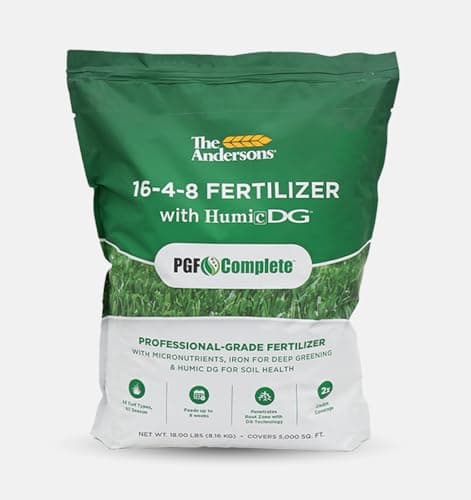
The Andersons The Andersons PGF Complete 16-4-8 with Humic DG (5,000 sq ft)
The Andersons PGF Complete 16-4-8 with Humic DG (5,000 sq ft)

The fertilizer serious lawn people actually use. A balanced 16-4-8 analysis on a very small particle, with 7 percent humic acid — it spreads evenly and waters in without sitting on the surface.

Best all-round lawn fertilizer
8.0
$59.88Amazon
02
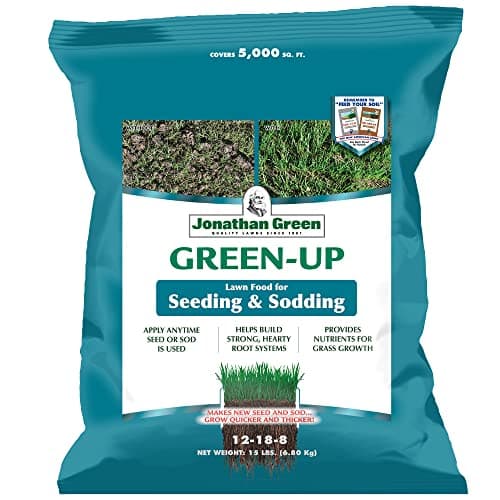
Jonathan Green Jonathan Green Green-Up for Seeding & Sodding 12-18-8 (5,000 sq ft)
Jonathan Green Green-Up for Seeding & Sodding 12-18-8 (5,000 sq ft)

A gentler starter analysis than the high-phosphorus bags - 12-18-8 - which is exactly the point. Less nitrogen means less top growth racing ahead of a root system that has not formed yet.

Gentler starter feed, seed or sod
6.8
$38.94Amazon
03
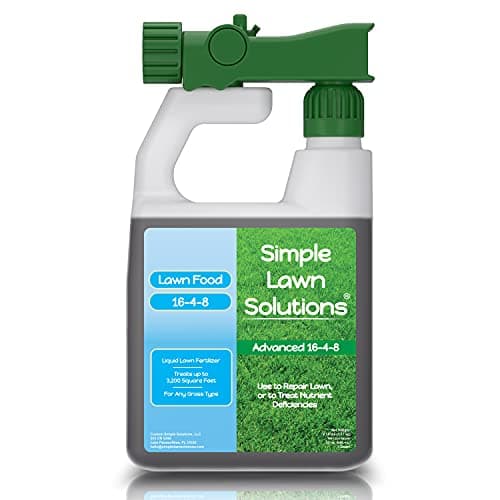
Simple Lawn Solutions Simple Lawn Solutions Advanced 16-4-8 Liquid (32 oz)
Simple Lawn Solutions Advanced 16-4-8 Liquid (32 oz)

A liquid 16-4-8 concentrate you attach to a hose end. The fast option: a liquid feed is taken up through the leaf as well as the root, so the color response is days rather than weeks.

Fast green-up
7.4
$19.01Amazon
04
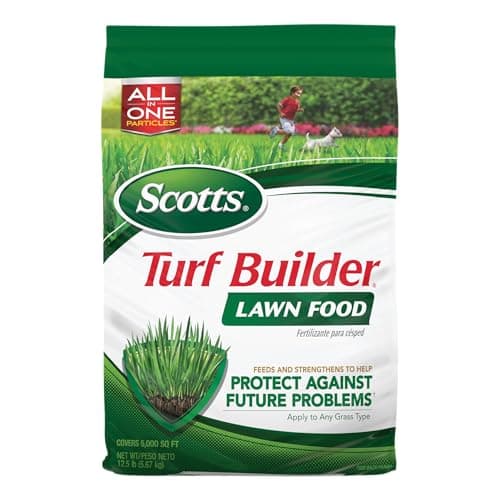
Scotts Scotts Turf Builder Lawn Food (12.5 lb)
Scotts Turf Builder Lawn Food (12.5 lb)

The value pick, and the bag most lawns in America are actually fed with. Cheap, widely stocked, hard to get badly wrong, and perfectly adequate.

Best value lawn fertilizer
7.6
$25.47Amazon
05
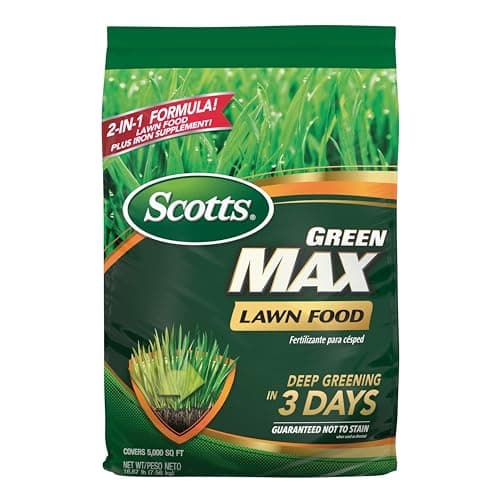
Scotts Scotts Green Max Lawn Food (16.67 lb)
Scotts Green Max Lawn Food (16.67 lb)

Turf Builder with added iron. Iron produces a color response without the extra growth nitrogen alone forces, which is exactly what you want in high summer.

Color without extra mowing
7.2
$18.97Amazon

#ad · Live prices from the Amazon Product API, as of November 22, 2026. Where we have no verified live price, we show none — we would rather leave a gap than print a number that has rotted.

In detail

The picks, in full

01
The Andersons The Andersons PGF Complete 16-4-8 with Humic DG (5,000 sq ft)

Best all-round lawn fertilizer

The Andersons PGF Complete 16-4-8 with Humic DG (5,000 sq ft)

16-4-8 NPK7% Humic DGCovers 5,000 sq ftFine particle size
8.0/10

The fertilizer serious lawn people actually use. A balanced 16-4-8 analysis on a very small particle, with 7 percent humic acid — it spreads evenly and waters in without sitting on the surface.

Analysis quality
10
Spread evenness
10
Coverage per bag
7
Ease of use
7
Value
6

Pros

  • 16-4-8 is the ratio most cool-season lawns want: nitrogen for growth, a little phosphorus, and potassium at half the nitrogen rate for stress tolerance
  • The fine particle size is the quiet advantage — small prills land more per square inch, so you get an even green rather than a striped one
  • At 16 percent nitrogen over 5,000 sq ft, a full bag delivers roughly 0.8 lb of nitrogen per 1,000 sq ft — a textbook single application

Cons

  • Costs several times what a Scotts bag of similar coverage does
  • Fine particles need a spreader with decent calibration; a hand-thrown application wastes it

Skip this if…

…you feed your lawn once a year and are not going to measure anything. The value is in precise, repeatable applications; Scotts Turf Builder does the once-a-year job for a fraction of this.

$59.88View on Amazon

Price as of November 22, 2026. Prices change — Amazon's is the one that counts.

#ad · we may earn a commission from this link to The Andersons PGF Complete 16-4-8 with Humic DG (5,000 sq ft)

02
Jonathan Green Jonathan Green Green-Up for Seeding & Sodding 12-18-8 (5,000 sq ft)

Gentler starter feed, seed or sod

Jonathan Green Green-Up for Seeding & Sodding 12-18-8 (5,000 sq ft)

12-18-8 NPKCovers 5,000 sq ftFor seeding and soddingGranular
6.8/10

A gentler starter analysis than the high-phosphorus bags - 12-18-8 - which is exactly the point. Less nitrogen means less top growth racing ahead of a root system that has not formed yet.

Feeding value
9
Weed control
1
Coverage
9
Ease of use
8
Price
7

Pros

  • Lower nitrogen means seedlings put energy into roots rather than into blade growth they cannot support
  • Works for sod as well as seed, which most starter bags do not state
  • Jonathan Green granules are consistently sized, so a spreader lays them evenly

Cons

  • Less phosphorus than the Andersons bag, so slower root establishment on poor soil
  • Priced above the supermarket starter bags

Skip this if…

…you are seeding into genuinely poor or compacted soil. That is where the higher-phosphorus Andersons 20-27-5 earns its money.

$38.94View on Amazon

Price as of November 22, 2026. Prices change — Amazon's is the one that counts.

#ad · we may earn a commission from this link to Jonathan Green Green-Up for Seeding & Sodding 12-18-8 (5,000 sq ft)

03
Simple Lawn Solutions Simple Lawn Solutions Advanced 16-4-8 Liquid (32 oz)

Fast green-up

Simple Lawn Solutions Advanced 16-4-8 Liquid (32 oz)

16-4-8 NPKLiquid concentrate32 oz bottleHose-end application
7.4/10

A liquid 16-4-8 concentrate you attach to a hose end. The fast option: a liquid feed is taken up through the leaf as well as the root, so the color response is days rather than weeks.

Analysis quality
9
Spread evenness
9
Coverage per bag
4
Ease of use
9
Value
6

Pros

  • Foliar uptake means a visible response in days, which no granular fertilizer can match
  • No spreader needed and nothing to calibrate — the sprayer meters it
  • Easy to apply at a low rate often, which is how the best-looking lawns are actually fed

Cons

  • A 32 oz bottle does not go far — the cost per 1,000 sq ft per application is high
  • No slow-release component, so the effect fades faster than granular

Skip this if…

…you want one application to carry the lawn for two months. Liquid feeding is a little-and-often method; if you want set-and-forget, buy Milorganite or the Andersons bag.

$19.01View on Amazon

$23.7720% off

Price as of November 22, 2026. Prices change — Amazon's is the one that counts.

#ad · we may earn a commission from this link to Simple Lawn Solutions Advanced 16-4-8 Liquid (32 oz)

04
Scotts Scotts Turf Builder Lawn Food (12.5 lb)

Best value lawn fertilizer

Scotts Turf Builder Lawn Food (12.5 lb)

Granular lawn food12.5 lb bagTurf Builder lineAll grass types
7.6/10

The value pick, and the bag most lawns in America are actually fed with. Cheap, widely stocked, hard to get badly wrong, and perfectly adequate.

Analysis quality
7
Spread evenness
6
Coverage per bag
6
Ease of use
9
Value
10

Pros

  • Costs a fraction of the professional-grade bags for a comparable job on a normal lawn
  • In stock everywhere, every season, so your feeding program never depends on a delivery
  • Formulated to be hard to burn a lawn with, which matters if you are spreading by eye

Cons

  • Coarser prills than the Andersons product, so the application is less even
  • A small bag — the 12.5 lb size does not go far on a big lawn

Skip this if…

…you are chasing a genuinely uniform, dark, dense lawn. Particle size and analysis precision are where the Andersons bag earns its premium, and this is the trade you are making.

$25.47View on Amazon

$26.996% off

Price as of November 22, 2026. Prices change — Amazon's is the one that counts.

#ad · we may earn a commission from this link to Scotts Turf Builder Lawn Food (12.5 lb)

05
Scotts Scotts Green Max Lawn Food (16.67 lb)

Color without extra mowing

Scotts Green Max Lawn Food (16.67 lb)

Granular lawn food + iron16.67 lb bagGreen Max lineFast color response
7.2/10

Turf Builder with added iron. Iron produces a color response without the extra growth nitrogen alone forces, which is exactly what you want in high summer.

Analysis quality
7
Spread evenness
6
Coverage per bag
7
Ease of use
8
Value
8

Pros

  • Iron deepens color by helping chlorophyll production rather than by pushing growth — so you get the green without mowing twice a week
  • The right tool for a lawn that is pale but growing fine, which is usually an iron story not a nitrogen one
  • Reasonable bag size and price

Cons

  • Iron stains concrete and paving — overspray on a driveway leaves rust marks that do not wash off
  • Does not replace a proper nitrogen feed, so it is an extra product rather than a substitute

Skip this if…

…your lawn is thin and slow-growing. That is a nitrogen problem, and iron will make a thin lawn a darker thin lawn. Feed it first.

$18.97View on Amazon

$40.4953% off

Price as of November 22, 2026. Prices change — Amazon's is the one that counts.

#ad · we may earn a commission from this link to Scotts Green Max Lawn Food (16.67 lb)

The criteria, in the order they matter for fescue

1. Nitrogen release rate, before the nitrogen number itself. Fescue responds badly to a sudden flood of soluble nitrogen, especially once soil temperatures climb. A slow or controlled-release source feeds steadily over six to eight weeks, which is exactly the behavior a cool-season lawn wants. A fast-release product is not wrong, but it needs to be applied at a lower rate and more often.

2. The analysis, read as a ratio rather than three separate numbers.An established fescue lawn mostly wants nitrogen and potassium; it rarely needs much phosphorus, and in many states phosphorus is restricted on established turf for exactly that reason. A 16-4-8 or similar high-N, low-P ratio is the standard for a lawn that is already growing. A new seeding is the exception — that one wants phosphorus for root development, which is why the seeding product on this page has a different middle number.

3. Particle size, which decides how even the result looks. Fine, uniform granules spread more evenly at low rates than coarse ones, and an even spread is most of what separates a lawn that looks fed from a lawn that looks striped. This matters more on fescue than on a creeping grass, because fescue is a bunch-type grass and does not spread sideways to hide your mistakes.

4. Iron, for color without growth. Iron darkens the leaf without pushing top growth, which is particularly useful on fescue in early summer when you want color but emphatically do not want the lawn growing fast.

5. Coverage against your actual square footage.Measure the lawn once. Most people overestimate, buy too much, and then apply the surplus at a rate that burns. Price per thousand square feet is the only comparison worth making — our cheapest lawn fertilizer page does that arithmetic in full.

The fescue feeding year

SeasonWhat fescue is doingWhat to apply
Early springWaking up, root reserves still carrying itA light feed only - PGF Complete at the low end of the rate, or Green Max for color
Late springPeak growth, mowing twice a weekA normal feed; a slow-release product so it does not all arrive at once
SummerSurviving, not growing; brown patch risk highAs little nitrogen as possible. Iron for color if you want it. Water, not food
Early fallBest growth of the year; seeding windowSeeding? Green-Up 12-18-8. Not seeding? A full feed of PGF Complete
Late fallTop growth slowing, roots still storingThe heaviest feed of the year - see our fall fertilizer roundup

Tall fescue and fine fescue are not fed the same way

Tall fescue is the workhorse: deep-rooted, drought-tolerant for a cool-season grass, and able to use a reasonable amount of nitrogen. Fine fescues — creeping red, chewings, hard fescue — are the opposite. They are low-input grasses that are genuinely happier underfed, and the fastest way to ruin a fine fescue stand is to feed it like a bluegrass lawn. If your shade mix is mostly fine fescue, apply roughly half the rate you would use on tall fescue and skip at least one feeding a year. The difference between the two is set out in tall fescue vs fine fescue.

If you do not know which one you have, the practical test is where it is growing and how it looks: wide, coarse blades in full sun is almost certainly tall fescue; very fine, needle like blades thriving under trees is fine fescue. Most mixed lawns are some of both, in which case feed at the tall fescue rate in sun and ease off under the trees.

Granular or liquid for a fescue lawn

Granular is the default and should be. It is cheaper per pound of nitrogen, it is easier to apply evenly across a large area with a spreader, and the slow-release coatings that suit fescue best only exist in granular form.

Liquid earns its place in two situations. The first is a small lawn, where dragging a spreader out for 2,000 square feet is more trouble than a hose-end sprayer. The second is a quick corrective feed: a liquid is plant-available immediately, so if a lawn has gone pale and you want it green in ten days rather than thirty, liquid is the tool. The trade-off is that it is gone in two to three weeks rather than six to eight. The full comparison is in liquid vs granular fertilizer.

The mistakes that cost fescue lawns the most

Feeding heavily in summer. This is the big one. Nitrogen in July pushes soft leaf growth on a plant that is already heat-stressed, and brown patch does the rest. If a fescue lawn looks tired in August it almost always wants water and a higher mowing height, not food.

Skipping the fall feed. The late-season application is the one that actually builds the lawn, because it goes into root storage rather than into leaf. A lawn fed once a year should be fed in fall.

Spreading unevenly.A bunch grass cannot grow sideways to cover a missed strip, so an uneven spread stays visible for weeks. Calibrate the spreader for the actual product — how to calibrate a spreader takes ten minutes and is the highest-return ten minutes in lawn care. And if the lawn is thin to begin with, feeding will not fix it; seed will. The seed shortlist is the best fescue grass seed.
How we picked this

We haven't run this gear through a lab — and we say so

We compiled the published manufacturer specifications — deck width and gauge, drive type, blower CFM, fertilizer NPK, seed species — did the deck-width and nitrogen arithmetic, cross-read the owner manuals, and scored each pick against a published rubric. The scores are judgments from documented research — they are notlab measurements we took, because we don't have a lab and we're not going to pretend we do. Where somebody has genuinely measured this, we link them. You can check every number we publish.

Questions

Frequently asked

What is the best fertilizer for fescue grass?
The Andersons PGF Complete 16-4-8 - a high-nitrogen, low-phosphorus analysis with humic acid and a fine particle size that spreads evenly at a low rate. Scotts Green Max is the budget pick, and Jonathan Green Green-Up 12-18-8 is the one to use if you are seeding.
When should I fertilize a fescue lawn?
Lightly in spring, as little as possible through summer, and heavily in early to mid fall. Fescue is a cool-season grass that grows hardest in spring and fall, so the fall feed is the one that builds the lawn. If you only feed once a year, feed in fall.
Can you fertilize fescue in summer?
You can, but keep the nitrogen rate low or use iron for color instead. Heavy summer nitrogen pushes soft growth on a heat-stressed plant and is a reliable way to get brown patch in tall fescue. Water and a higher cutting height do more for a fescue lawn in July than any bag will.
What NPK ratio does fescue need?
For an established lawn, a high-nitrogen, low-phosphorus ratio such as 16-4-8. For a new seeding, more phosphorus for root development - something closer to 12-18-8. Several states restrict phosphorus on established turf, so check the label against local rules.
Do fine fescues need less fertilizer than tall fescue?
Considerably less. Fine fescues are low-input grasses that are genuinely happier underfed; roughly half the tall fescue rate, and skip a feeding. Overfeeding a fine fescue stand is one of the easiest ways to thin it out.
Should I use liquid or granular fertilizer on fescue?
Granular for the regular program - cheaper per pound of nitrogen, easier to spread evenly and available with the slow-release coatings fescue prefers. Liquid for a small lawn or a fast corrective feed, where immediate availability is the point.
Can I fertilize and seed fescue at the same time?
Yes, with a starter fertilizer rather than a regular lawn food - a new seeding wants phosphorus for roots. Never pair seeding with a product containing a crabgrass pre-emergent, which will stop your seed too. The starter options are in best starter fertilizer for new grass.

Keep reading

Receipts

Sources

We do not run a testing lab, and we do not pretend to. Every spec number here comes from a manufacturer's published sheet or an official standard, cited above. Where we could not verify something, we say so on the page rather than quietly leaving it out. Read our full method.