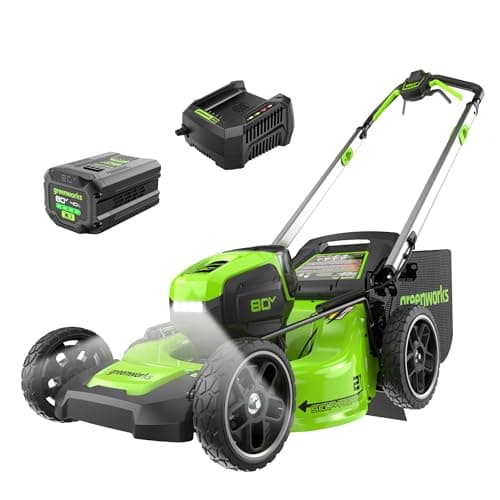
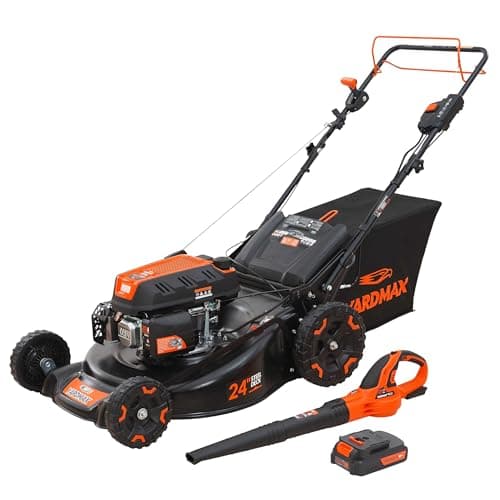
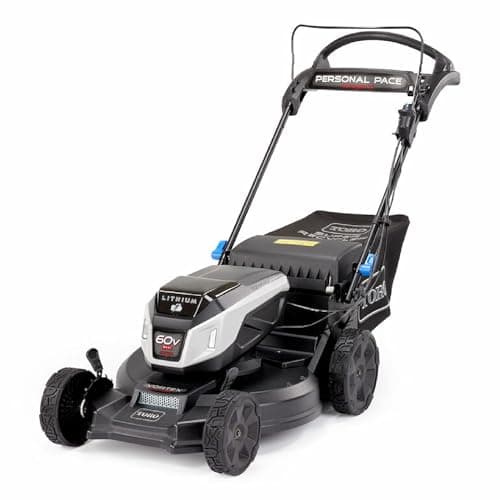
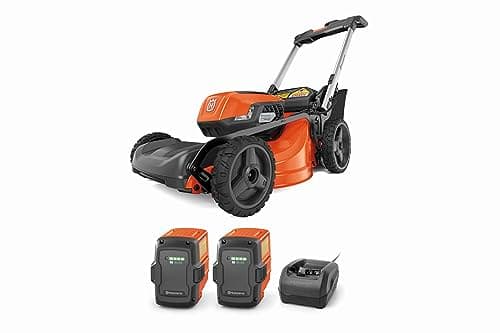
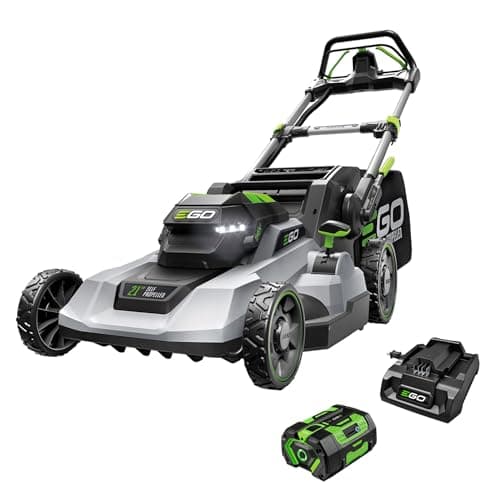
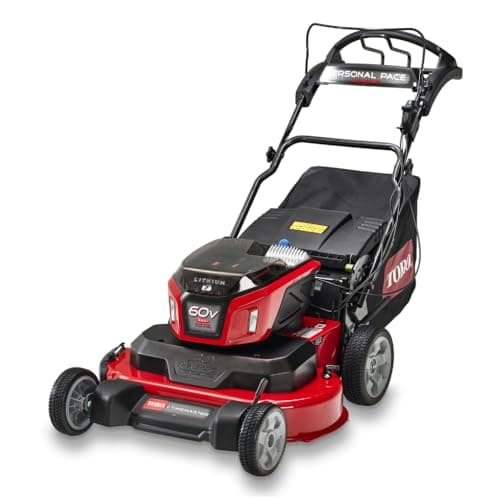
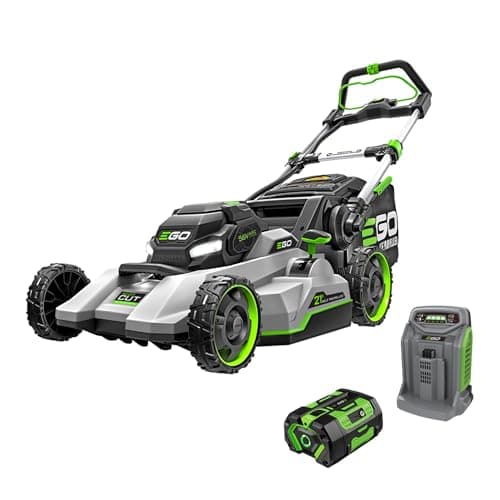
If pulling a starter cord has become the hardest part of mowing, the mower to buy is the EGO Power+ LM2135SP. It is a 21-inch self-propelled battery mower that starts by pressing a button: no cord, no bracing, no stance, no second attempt. It is also self-propelled with a variable-speed drive, so you set the walking pace instead of pushing a 70-pound machine. If budget is the constraint, the Greenworks 80V 21" self-propelled does the same thing for less. And if you specifically want gas with an electric starter— a button and a starter motor rather than a cord — the 24" 201cc electric-start Select PACE is the machine on this list that does it.
Here is the thing the category pages do not say plainly. The phrase people search for is “electric starter”, which in gas-mower language means a starter motor and a battery bolted to a gas engine. That works, and it adds a battery you have to keep charged on top of the fuel, the oil, the filter and the winterizing. A battery mower starts on a button too— and it has no cord, no choke, no primer bulb, no fuel to go stale and nothing to flood. For the buyer whose actual problem is physical effort, the battery machine solves more of the problem than the gas machine with an electric start does. So this page ranks battery first and is explicit about why.
Three other things matter as much as the start, when effort is the constraint. Weight, because you still have to turn the mower at the end of every row. Self-propelled drive, and specifically a drive you can set to a slow walking speed rather than one that pulls you along. And handle adjustment, because mowing with your wrists above your elbows is what makes a shoulder sore. Every pick below is self-propelled. Prices are live from the price layer with an “as of” date.
Buying for an older owner
Push-button start is the single most useful feature on a mower bought for an older owner, and it is rarely the only thing that matters - weight, handle height and a single-lever height adjuster all count too. Those picks are in the best lawn mower for seniors.
The three ways a mower starts, and what each one asks of you
| Start type | The action | Effort | Catches |
|---|
| Battery push-button | Hold a bail, press a button | Almost none | Remember to charge |
| Gas electric start | Turn a key or press a button | Low | A second battery to maintain, plus all gas upkeep |
| Gas recoil (pull cord) | Prime, brace, pull hard | High, and repeatable | Flooding, stale fuel, a cold engine needing several pulls |
The column that matters is the last one. A recoil start is not just one hard pull — it is one hard pull that sometimes becomes five, in July, after the mower has sat for a fortnight. That unpredictability is what pushes people out of mowing their own lawn, more than the pull itself.
Why a battery mower is the real answer to this question
Press and hold a button and the motor spins instantly, every time, at any temperature, after any length of storage. There is no choke to set, no primer to pump, no fuel to go stale over winter and no carburetor to gum up — which is the single most common reason a gas mower will not start in April. A battery mower is also three to ten pounds lighter than the equivalent gas machine in most sizes, and the weight is better balanced because there is no engine block sitting high on one side.
The one real trade is runtime. A charged battery covers a quarter to a half acre comfortably on most of these machines; past that you buy a second battery or step to a twin-battery kit. If your lawn is bigger than half an acre and the pull cord is the problem, read the gas electric-start entry and the 30-inch deck entry below rather than fighting it with batteries.
If you want gas with an electric starter
There is a real reason to want this: gas does not run out mid-lawn, and if you already keep fuel for other machinery there is nothing new to learn. The 24-inch 201cc electric-start Select PACEis the pick here, and the specification is well matched to the buyer — a starter motor instead of a cord, a six-speed CVT rear-wheel drive so you can dial the pace right down, and a 24-inch deck so a big lawn takes fewer laps.
Two honest cautions. The electric starter has its own battery, and a starter battery that is flat has to be charged before the mower will start — so the maintenance list gets longer, not shorter. And a 24-inch gas machine is heavy: easier to start, harder to turn. If your hands are the issue, that is a good trade. If your back is the issue, it may not be.
Weight and handling: the part nobody mentions
Starting is one action a week. Turning the mower is a hundred. When effort is the constraint, look for three things: a rear-wheel-drive self-propel, which keeps traction as you lean into a turn where front-wheel drive loses it; a variable-speed control you can reach without letting go; and large rear wheels, which roll over an uneven lawn instead of stopping against it. Toro's Personal Pace system is worth singling out because it sets the speed from how hard you lean on the handle rather than from a lever, which removes a grip action entirely.
Mow less often, not harder
The cheapest accessibility upgrade is free. Raise the cut height by half an inch: taller grass shades out weeds, roots deeper, needs less water and takes less effort to cut because you are removing less leaf. Mow weekly rather than fortnightly, which keeps each cut light and the deck unloaded. And if the lawn is the problem rather than the mower, a robot mower removes the job completely — genuinely the right answer for some of the people reading this page, and we would rather say so than sell a mower.
What else helps, in order of how much
Keep the blade sharp.A dull blade loads the motor, slows the cut and makes the whole job take longer. It is also the cheapest thing on this list — sharpening tools are in best lawn mower blade sharpener and replacement blades in best lawn mower blades.
Mulch instead of bagging. A bag is the heaviest repeated lift in mowing and emptying it is the part that hurts. Mulching returns the clippings as free nitrogen and deletes the lift entirely; the detail is in best mulching lawn mower.
Store it where you use it. Getting a mower out of a cluttered garage is often harder than mowing. A folding handle, which every mower here has, is what makes that practical.
When a walk-behind is the wrong tool
If the lawn is over three quarters of an acre, no amount of easy starting fixes an hour and a half of walking. That is rider territory, and a rider starts with a key. Start with the best riding mower for 1 acre, or the electric riders if you want the same no-fuel simplicity sitting down.