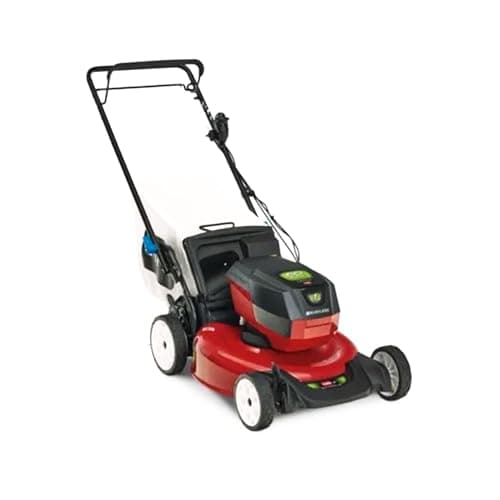
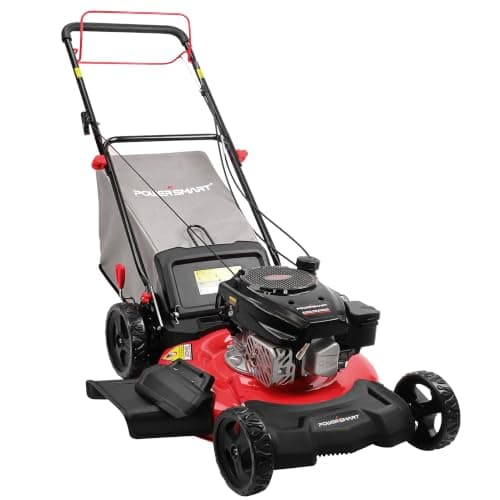
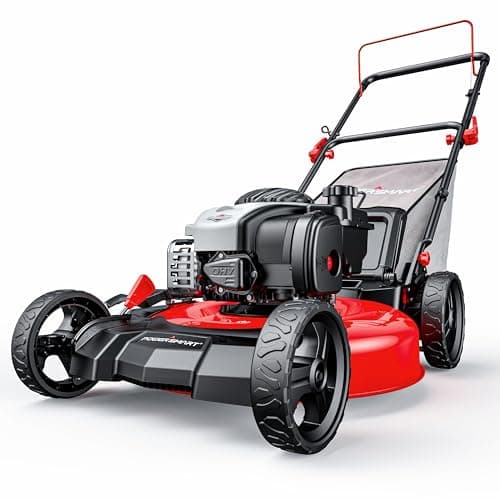
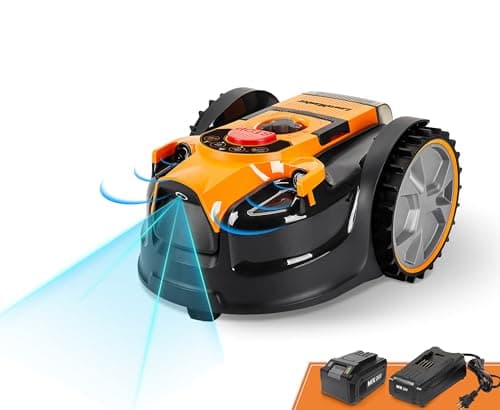
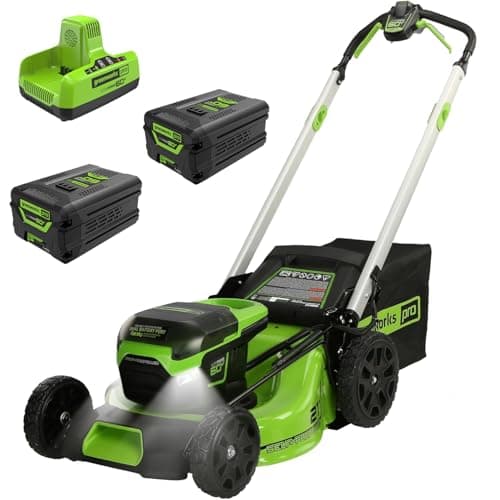
The best lawn mower under $500 is the Greenworks 60V 21" self-propelled two-battery kit, and the reason is that it is the only machine under the line that gets all three of the things that matter at once: a full-size 21-inch deck, a driven wheel, and enough battery in the box to finish a real lawn. If you want a name with a dealer network behind it, the Toro Recycler 21" 60V brings a steel deck for meaningfully less. If you want self-propelled drive for the least money possible, the PowerSmart 21" 170cc does it on gasoline. And if your lawn is small enough, the LawnMaster OcuMow is the only robot mower that fits under this ceiling at all.
Prices on every card are pulled live, so you can see where each mower sits against the $500 line today rather than where it sat the week this page was written. One of these is within a few dollars of the ceiling and will cross it on a bad week. That is the nature of a price-capped list, and we would rather show the live figure than quietly leave a stale one on the page.
What $500 buys that $250 does not is drive and runtime, not cut quality. That is the single most useful thing to understand before you shop this band. A $200 mower and a $450 mower cut grass to the same height with roughly the same quality of finish. What the extra money buys is a wheel that pulls the machine up your slope, a deck wide enough to finish in fewer passes, and a battery large enough that you are not stopping halfway. If your lawn is flat, small and near an outlet, the honest advice is to spend less — our cheap lawn mower roundup is written for the bottom of the market and it is a different list from this one on purpose.
We have mown with none of these. Every judgment here reasons from published figures — deck width, engine displacement, voltage, battery amp-hours, what is stated to be in the box — and never from testing we did not do. The method is set out in how we pick.
The criteria, in the order they matter at this budget
1. Deck width, because it is the only spec that bills you weekly. Deck width decides how many passes your lawn takes, and you pay that number every single cut for the life of the mower. The spread in this price band is 20 to 21 inches on walk-behinds, which sounds trivial and is worth about five percent fewer passes. The real gap is against the band below: a 17-inch budget deck needs roughly 24 percent more passes than a 21-inch one to cover the same lawn. Under $500 you can have the full-size width, so take it.
2. Self-propelled or not, decided by your slope and not your lawn size. A driven wheel is the feature most worth paying for in this band, and it is the one people skip. On flat ground a 21-inch push mower is fine at any lawn size you would use a walk-behind for. On a slope it is work, and work is what makes a mower sit in the garage. Two of the seven picks here are self-propelled and both are under $450, which was not true of this price band a few years ago. The full argument, with the published drive types, is in self-propelled vs push mowers.
3. What is actually in the box. This is where a price cap gets gamed. A bare-tool battery mower at $399 is not a $399 mower: a 4.0 to 6.0 Ah pack and a charger for most platforms run another $150 to $250, which puts the working price well over the ceiling. Every battery pick on this page ships with at least one battery and a charger, and two of them ship with two batteries. We will not rank a bare tool on a price-capped page, because the number on the listing would not be the number you pay.
4. Battery capacity, in amp-hours, not volts. Voltage is how hard the motor can pull; amp-hours are how long it can pull for. A 40V mower with a 6.0 Ah pack stores more energy than a 60V mower with a 2.0 Ah pack, and on a lawn that takes forty minutes, stored energy is the spec that decides whether you finish. The two-battery kits here are the honest answer for anything approaching a quarter acre.
5. Brushless or brushed.A brushless motor is more efficient, runs cooler and has no brushes to wear out. Under $500 it is available rather than guaranteed — three picks here publish it. It is the difference between a battery mower that is still working in year eight and one that is not.
6. Deck material. Steel on a budget battery mower is unusual and worth noticing. Polymer decks do not rust and they are lighter, which is a genuine advantage; what they do not survive is a decade of being dragged over tree roots and curbs. Only one pick here publishes a steel deck.
Under $500 by lawn size
| Your lawn | What to buy under $500 | Why |
|---|
| Under 2,000 sq ft, flat | Spend less than this page | A 17 or 18-inch budget deck finishes in fifteen minutes; the extra $250 buys nothing you will use |
| 1,000-2,000 sq ft, and you would rather not mow | LawnMaster OcuMow robot | The only robot mower under this ceiling. Optical navigation, no boundary wire, hard area limit |
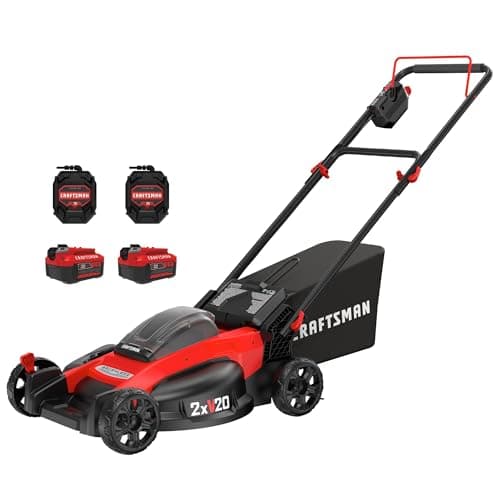
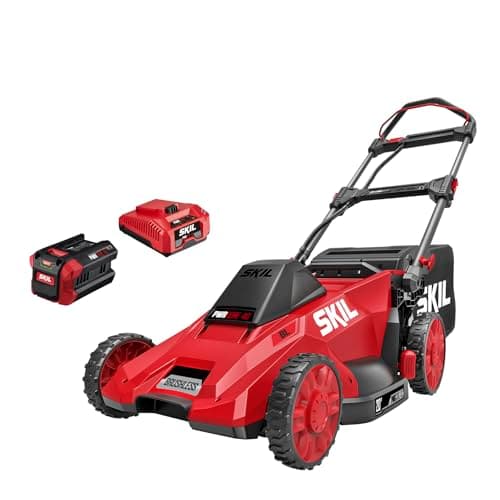
| 2,000-6,000 sq ft, flat | SKIL PWR CORE 40 20" or CRAFTSMAN V20 20" | A 20-inch brushless deck with a large pack included covers this comfortably on one charge |
| 6,000-10,000 sq ft, flat | Toro Recycler 21" 60V | Full 21-inch steel deck, brushless, folds flat for storage |
| 6,000 sq ft and up with any slope | Greenworks 60V 21" self-propelled | Driven wheel plus two 4.0 Ah packs - the only pick here that is both self-propelled and has swap-and-continue runtime |
| Quarter acre and up, or thick damp grass | PowerSmart 21" 170cc self-propelled gas | Gas does not sag when the grass gets heavy and never runs out mid-lawn |
| Half an acre and up | Nothing on this page | That is riding-mower territory and no walk-behind makes it pleasant |
Battery or gas, under $500
This is the band where the argument finally tips toward battery, and the reason is the kits. A few years ago $500 bought a gas self-propelled mower or a battery push mower with a small pack. Today it buys a 21-inch battery self-propelled mower with two 4.0 Ah batteries, and that is a straightforwardly better machine to own for most suburban lawns: no fuel to mix or stabilize, no carburetor to gum up over winter, no pull cord, no annual service, and quiet enough to cut at eight on a Sunday morning.
Gas still wins two specific arguments under $500. The first is cost of drive: the cheapest self-propelled cut in this registry is gas, by a clear margin, and if a driven wheel is the thing your slope needs then gas gets you there for the least money. The second is heavy grass. A four-stroke engine does not lose power as it empties; a battery deck does, in the last few minutes of a pack. On thick, damp, fast-growing grass that difference is real work. The whole comparison, with the published figures on both sides, is in electric vs gas lawn mowers.
What gas costs you is everything the engine brings with it: oil changes, air filters, spark plugs, fresh fuel or a stabilizer, and a machine that is noticeably louder than the neighborhood would prefer. Those are not hypothetical costs. Budget $30 to $50 a year, or buy the battery mower.
The platform question, and why it can decide the ranking for you
A battery mower is a decision about a battery system, not a decision about a mower. If you already own CRAFTSMAN V20 tools, the V20 mower is the best buy on this page for you and it is not close, because the expensive part is already on your shelf. The same logic applies to Greenworks 40V and 60V, SKIL PWR CORE 40 and Toro 60V.
If you own nothing, pick the platform you want to live in and then buy its cheapest useful tool. The practical test is whether the platform carries the other things you will want: a string trimmer, a blower, an edger. Greenworks 40V and 60V and Toro 60V all do. A 20V consumer line will give you a trimmer and a blower but never a 21-inch self-propelled mower, which is the ceiling worth knowing about before you commit. Our sub-$200 leaf blower roundup is the clearest illustration of that: the cheapest cordless blowers there live on exactly these platforms.
What the $500 ceiling still costs you
An EGO or a premium Toro deck.EGO’s 21-inch self-propelled kits and Toro’s Super Recycler sit above this line, and what you are paying for up there is genuinely better — Select Cut multi-blade systems, Personal Pace drive that matches your walking speed, better handle ergonomics and heavier build. Those are real and they are not here.
A 22-inch-plus deck. The wide-deck walk-behinds, including the 30-inch TimeMaster class, start several times above the cap. If your lawn is big enough to want one, read the best mower for a large yard before you buy anything on this page.
A serious robot.The sub-$500 robot is a small-lawn robot with a hard area ceiling. RTK-navigating machines rated to a quarter acre start above this line but not far above it — the full set is in the best robot mowers under $1,000, and if automation is what you actually want, that page is a better use of your money than a cheap walk-behind.
Long warranties and dealer service. Most of what sells under $500 is sold online with a parts-by-mail relationship, not a dealer who will fix it. Toro is the exception in this list. If being able to drive a broken mower somewhere matters to you, that is worth more than a spec.
Making a $500 mower last ten years
Three habits, worth more than the difference between any two mowers here. Sharpen the blade twice a season.A dull blade tears grass instead of cutting it, which browns the tips, invites disease and makes any mower look cheap — it is the single highest-return thing you can do, and a sharpener costs less than a tank of gas. Do not store a battery fully charged or fully flat through winter; most makers specify somewhere around half charge, indoors, above freezing. And on gas, either run the tank dry before storage or use a fuel stabilizer, because stale fuel in a small carburetor is the most common reason a cheap gas mower will not start in April.
One more that is about the lawn rather than the mower: cut high and cut often. Never remove more than about a third of the blade height in one pass. A taller cut shades the soil, holds moisture and crowds out weeds, and it makes a cheap mower look like an expensive one. The height-by-species numbers are in our grass seed guide, and they matter more to how your lawn looks than anything on this page.