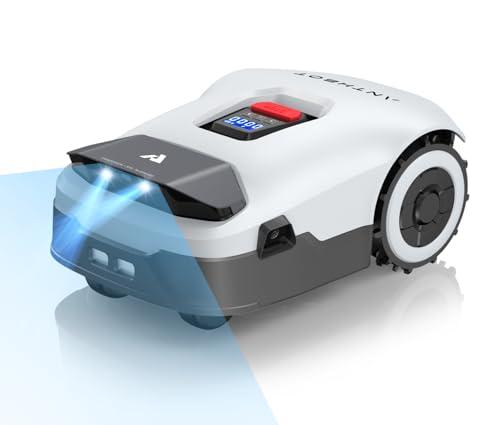
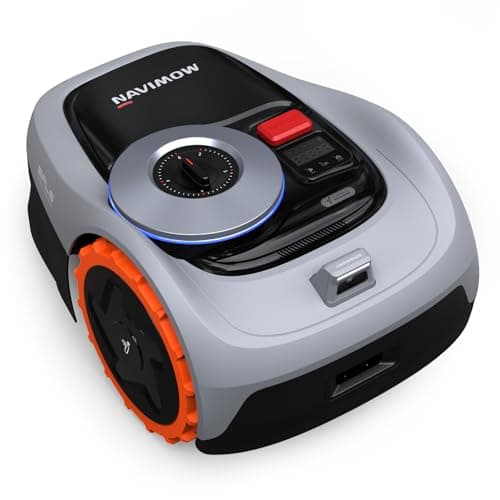
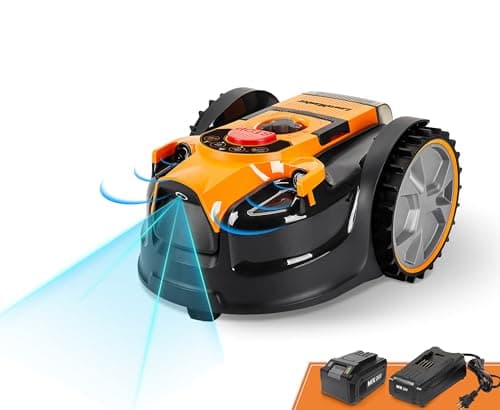
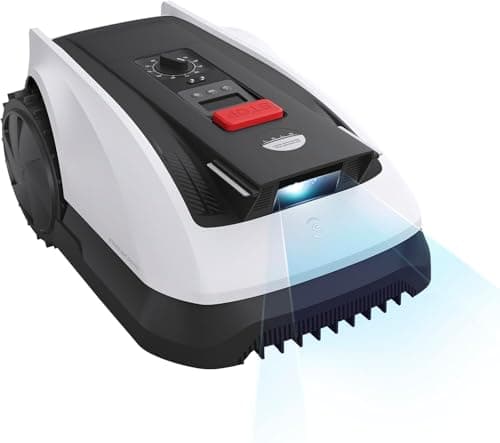
The best robot lawn mower under $1,000 is the ECOVACS Goat O1000, because it combines the largest rated area under the line — ECOVACS states a quarter acre — with the navigation pairing the expensive machines use: RTK satellite positioning plus vision. If you want a rated area close to that from a machine with four cameras instead of two, the ANTHBOT Genie 600 is rated at 0.22 acre. If you want the brand with the longest wire-free track record and the quietest published figure, the Segway Navimow i105N is rated to an eighth of an acre at 58 dB(A). And if your lawn is genuinely small, the LawnMaster OcuMow is the cheapest way into the category by a wide margin.
Prices on every card are pulled live. That matters more on this page than on most, because robot mowers are the most discount-driven product in lawn care: the same machine can sit at $899 one week and $649 the next, and a page with typed-in prices would be lying to you within a month. Where a pick is close to the ceiling, the live figure on the card is the only number worth acting on.
The $1,000 line is the most useful price in this category, and the reason is rated area.Below about $500 a robot mower is a small-lawn appliance with a hard ceiling measured in thousands of square feet. At $650 to $900 you can buy a machine rated for an eighth to a quarter of an acre with real satellite navigation, which covers the majority of American suburban back lawns. Above $1,000 you are buying slope capability, all-wheel drive, LiDAR and half-acre ratings — genuinely better machines for genuinely harder lawns, and money most lawns do not need to spend.
We have not run any of these on a lawn. Every judgment here reasons from published figures — rated area, navigation technology, published noise levels, what the maker states about boundaries and zones — and from nothing else. The method is in how we pick. Before you shop at all, it is worth reading whether a robot mower is worth it, because the honest answer depends on your lawn far more than on your budget.
The criteria, in the order they matter under $1,000
1. Rated area, and respect it as a ceiling rather than a target.A robot mower rated for 5,000 square feet on a 7,000 square foot lawn does not mow slowly — it fails to finish, runs longer every day to try, and wears out sooner doing it. Measure your lawn before you shop. The range under this cap runs from about 2,000 square feet to a quarter acre, which is a fivefold spread and the single biggest difference between these four machines.
2. Navigation, because it decides whether the thing works on your site at all. There are three approaches in this price band and they fail in different places. RTK uses a fixed reference antenna and satellite correction for centimeter-level positioning: the most precise option here, and the one defeated by a closed tree canopy, because the antenna needs sky. Vision uses cameras to recognize grass, edges and obstacles: works under trees, less precise on a complex boundary. Optical-only navigation, on the cheapest machine here, needs no satellites at all and is the least precise of the three. The practical rule: if your lawn is mostly under mature trees, do not buy an RTK-first machine, however good its specification looks. The full technology comparison is in our wire-free robot mower page.
3. Cost per thousand square feet, not sticker price.This is the arithmetic that makes a price-capped robot list useful. Take the live price on the card, divide by the rated area in thousands of square feet, and compare. A quarter-acre machine at the top of this band is dramatically cheaper per square foot of lawn than a 2,000 square foot machine at the bottom of it, and the cheapest machine on the page is consistently the most expensive way to buy coverage. The exception — and it is a real one — is a lawn that genuinely is 1,500 square feet, where paying for a quarter acre of capability buys nothing.
4. Slope rating.Robot mowers are rated as a percentage grade, and the machines under this cap are not slope specialists. If you have a bank steeper than a gentle rise, that is the specification to check on the maker’s own page before buying anything here, and it is the main thing the $1,500 all-wheel-drive machines sell. A robot that cannot climb your slope leaves an unmown strip and reports a happy day’s work.
5. Multi-zone management. If your lawn is a front, a back and a strip down the side, you need a machine that holds several maps and can be carried between them. Three of these four publish multi-zone support. Without it a robot is a one-lawn device.
6. Noise, which is most of the point.The appeal of a robot is that the lawn gets mown while you are not thinking about it — which only works if you can sit outside while it runs. Segway publishing an explicit 58 dB(A) figure is unusually transparent for this category and is a genuine reason to pick it.
Under $1,000 by lawn size
| Your lawn | What to buy under $1,000 | Why |
|---|
| 1,000-2,000 sq ft | LawnMaster OcuMow | Optical navigation, no wire, and far less money than anything else here |
| Up to 5,000 sq ft, and you want it quiet | Segway Navimow i105N | Rated to 1/8 acre with a published 58 dB(A) and the most mature wire-free mapping on the page |
| 5,000-9,500 sq ft | ANTHBOT Genie 600 | Rated 0.22 acre on RTK plus a four-camera vision system, with up to 30 zones |
| Up to a quarter acre | ECOVACS Goat O1000 | The largest rated area under the cap, with RTK plus vision and edge-cutting |
| Mostly under mature trees | LawnMaster OcuMow, or none of these | RTK needs sky. Optical navigation does not care about canopy, but it caps you at a small lawn |
| Half an acre, or a real slope | Nothing on this page | That is the all-wheel-drive and LiDAR tier, and it starts above this ceiling |
What $1,000 does not buy in a robot mower
Slope and all-wheel drive.The machines sold on climbing ability — all-wheel drive, aggressive tires, slope ratings in the high percentages — sit above this line, and the gap is not small. If your lawn has a bank in it, read our mower-for-hills page before deciding a robot is the answer at all.
LiDAR. Laser mapping is the premium navigation option and it does not appear under $1,000. It is the most robust approach on a complicated lawn because it does not depend on satellites or light conditions, and it is why the machines that have it cost what they do.
Half-acre ratings. A quarter acre is the practical ceiling of this price band. If your lawn is larger, the honest options are a bigger robot from the large-yard robot page, or a walk-behind with a 21-inch deck — our sub-$500 mower roundup covers that end, and for a half-acre lawn it is a far better use of the same money than a robot that cannot finish.
A long brand track record, at the cheap end.Two of the four machines here come from companies that did not sell robot mowers five years ago. That is not a reason to avoid them — the specifications are real and the prices reflect the risk — but a robot mower is a product you want supported in year four, and the established names in this category are Husqvarna, Segway and ECOVACS.
Boundary wire, and why none of these have one
The old generation of robot mowers needed a boundary wire pegged or buried around the whole perimeter, including around every bed and tree. It worked, and installing it was the single worst part of owning one: a day of work, and a repair job every time an aerator tine or a spade found the wire.
Every machine on this page is wire-free, which is the main reason this price band is worth shopping at all now rather than three years ago. What replaces the wire is a mapping walk — you drive the mower round the boundary once, by app, and it remembers. That sets up in an afternoon instead of a weekend, and nothing in your lawn can cut through it.
The trade is that the boundary now lives in software, which means it depends on the navigation working. An RTK machine that loses satellite correction under a tree does not know where the bed is. This is the practical reason the navigation section above matters more than any other specification on the page.
What owning one actually changes
A robot mows little and often, typically several times a week, which is a different regime from a weekend cut and it genuinely improves a lawn. Clippings are returned as fine mulch every time rather than as a heavy layer once a week, which recycles nitrogen back into the soil and reduces how much fertilizer the lawn needs — the arithmetic on that is in our fertilizer roundup. Cutting a small amount frequently also keeps the grass at a steady height instead of cycling between shaggy and scalped, and steady height is most of what makes a lawn look cared for.
What it does not do is replace the rest of lawn care. A robot cannot edge, it will not collect leaves, and it mows at one height rather than letting you raise the deck for summer heat. You will still own a trimmer and a blower — the cheap end of both is covered in our sub-$200 blower roundup and our sub-$200 trimmer roundup. And it will not fix a lawn that is thin, compacted or full of weeds; it will just mow it on schedule.
Setting one up so it works
Three things, all of which people skip. Put the base station where the antenna can see skyif the machine uses RTK — against the house under the eaves is the most common siting mistake in this category. Walk the lawn and remove what the mower cannot see: hose ends, dog toys, low wire hoops around beds. Vision systems catch a remarkable amount and they do not catch a green hose on green grass. And set the schedule to mow little and often, not in one long daily run; frequent short cuts are what the little-and-often model is for, and they are easier on the battery.
One more, for the first fortnight: watch where it struggles and fix the lawn, not the schedule. A robot that beaches itself in the same dip every week is telling you the lawn has a hole in it, and leveling that dip solves it permanently in a way no app setting will.