Step 1: find out what is actually making it bumpy
Walk the lawn slowly and push a spade into two or three of the worst spots. You are looking to place the lawn into one of five categories, because they do not share a fix.
Settling and worn hollows. Shallow dips an inch or two deep, often along a line people walk, where a stump was ground out, or over an old trench. Soil has compressed or decomposed and the surface has dropped. This is the case topdressing was invented for, and it is the most common one.
Frost heave and freeze-thaw lumpiness.A lawn that comes out of winter feeling loose and uneven all over, without distinct holes. Water froze, expanded, lifted the turf and then left it sitting high when it drained. This is the one case where a roller is the right tool — one pass in spring on moist, not wet, soil presses it back down.
Thatch and scalped high spots. If the mower is cutting the tops off some areas and missing others, check whether the high spots are soil or a spongy mat of dead stems. Cut a wedge out with a spade and look at the profile. More than about half an inch of brown fibrous layer between the green grass and the soil is thatch, and the fix is a dethatcher, not sand. The aerating vs dethatching page is the two-minute version of that diagnosis.
Mole, vole and ant activity. Raised ridges that run in lines, or small conical mounds. Topdressing over an active run fills it for a week. Deal with the animal first; the surface repair afterwards is trivial.
Tree roots. Hard ridges radiating from a trunk. These are structural and they grow. You cannot level them, you should not cut them, and burying them in soil can suffocate the tree. The honest answer for a root-ridged area is to stop trying to keep it as mown lawn and mulch it instead.
Step 2: choose the material, and ignore the sand advice
This is where most leveling projects go wrong, and the mistake gets repeated everywhere because it is borrowed from golf. Clemson’s extension service makes the point plainly: sand topdressing became popular on home lawns because high-end golf greens and athletic fields use it — and those surfaces are built on engineered sand profiles, not on the native soil a house sits on.
The extension guidance is to match the topdressing to the soil you already have. On genuinely sandy soil, sand is fine. On a sandy loam, a topsoil-and-sand mix is appropriate. On clay, pure sand creates a layered profile — a sand lens sitting on a clay pan — and water moves through the two at different rates, so the interface perches water instead of draining it. You end up with a soggy layer exactly where the roots are.
Practically, that means screened topsoil, or a topsoil-compost blend, for most lawns. Sand only if a spade full of your own soil already crumbles like sand. Whatever you use has to be screened and dry, because damp unscreened material will not sift through a spreader drum and will not flow off a rake plate. It clods, and clods are what smother grass.
Step 3: aerate first if the soil is compacted
Extension guidance notes that topdressing works best alongside core aeration, and the mechanism is simple: the holes give the new material somewhere to go other than sitting on top of the existing grass. On a lawn that is both uneven and hard underfoot, pull cores first, leave the plugs to dry and break down, then topdress. The core aerators are ranked here, and when to aerate your lawn covers the timing. On heavy clay the same argument is made at more length on best lawn aerator for clay soil.
If the lawn is uneven but the soil is loose and healthy, skip the aeration. It is work with no return here.
Step 4: a quarter inch at a time, and the grass must still show
The single number that decides whether leveling works is how thick each layer is. The standard is about a quarter of an inch per pass, with half an inch as the absolute ceiling. The test is visual and you do not need a ruler for it: after you have spread and raked, grass blades must still be visible through the material. If the lawn looks like a dirt patch, you have buried it and that area will die.
A quarter inch feels like almost nothing, and that is the part people refuse to believe. It is also why leveling a genuinely uneven lawn is a two-or-three-season project rather than a weekend. Extension guidance for numerous or deeper low spots is exactly that: thin layers, repeated every week or two through the growing season, letting the grass grow up through each one before the next goes down.
Step 5: spread it, then drag it
Spreading and leveling are two separate motions, and doing them in one go is what produces a lumpy result.
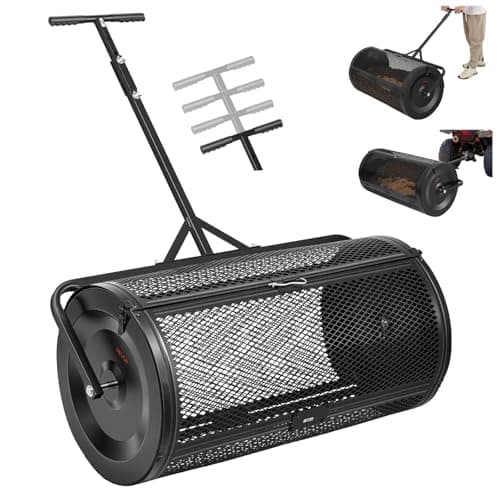
Spread.Shovel small piles across the low area, or run a drum-style compost spreader over it. The drum is a rotating mesh cylinder: you fill it with screened material and roll, and the mesh sifts a thin even layer out as it turns. That is the whole value of it — evenness. A shovel puts down three times as much in some places as others, and the rake then has to move the difference.
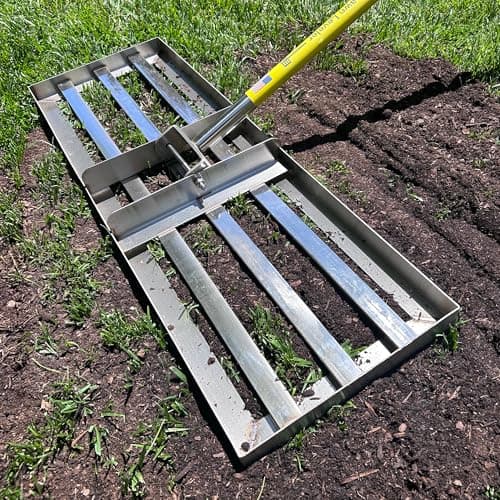
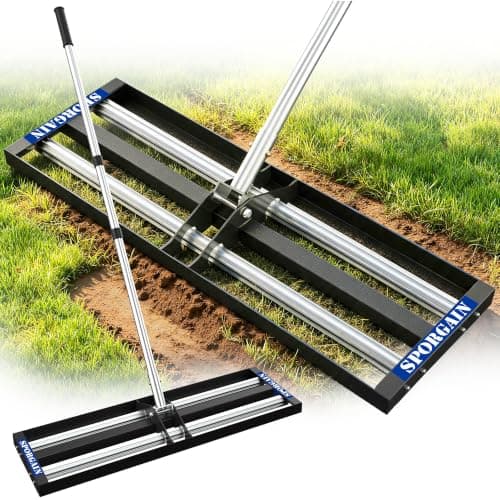
Drag. Pull the leveling rake across the area, changing direction every few passes. The plate rides on the high spots and the material falls into the hollows behind it. Work in two directions at roughly 45 degrees to each other rather than back and forth along one line, which is how you avoid cutting new ridges with the edge of the plate. If your rake has rollers, they work the material down into the grass canopy on the return stroke instead of scraping it off again.
Water. A light watering settles the material into the canopy and down to the soil surface. Do this the same day.
Step 6: seed the bare patches, then feed
Anywhere the layer went thicker than it should have, the grass will thin. Overseed those areas rather than waiting to see — bare topdressing is where weeds start. For cool-season lawns the fescues are the obvious choice and the overseeding seed picks are here; the full method is in how to reseed a lawn, and how long grass seed takes to germinate sets the expectations for the fortnight afterwards. New seed wants a phosphorus-forward starter feed rather than the usual high-nitrogen lawn food, which is the point of the starter fertilizer picks.
When to do it
While the grass is actively growing, never while it is dormant. A dormant lawn cannot grow up through the layer and you will simply smother it. For cool-season grass — tall fescue, fine fescue, bluegrass, ryegrass — early fall is the strongest window, because it pairs with the best overseeding window of the year and the grass has two cool growing months ahead of it. Spring is the second choice. For warm-season grass, early summer, once it has fully greened up.
The deep-hollow exception: lift the turf instead
For a depression deeper than about two inches, topdressing is the wrong method — you would need eight passes over a season to fill it, and extension guidance says so. Cut around the low area with a spade, peel the turf back in strips like carpet, add soil underneath until the grade is right, firm it, and lay the turf back down. Water it in. One afternoon, no waiting, and the grass you already own is the grass that ends up there.
The tools, and which one you actually need
A leveling rake is the non-negotiable one.It is a flat plate, usually steel, 30 to 40 inches wide, on a handle long enough to work standing upright. Nothing else does this job: a garden rake has tines that dig in, and a landscape rake has too many to ride over the high spots. Width is the only thing that makes the work faster, so take the widest head your lawn’s obstacles will allow — 40 inches on open ground, 30 inches if you are working between beds and trees.
A compost spreader is a convenience, not a requirement. It makes the spreading step even and saves a lot of raking, and on anything over a few hundred square feet it pays for itself in time. For one or two hollows, a wheelbarrow and a shovel are genuinely fine.
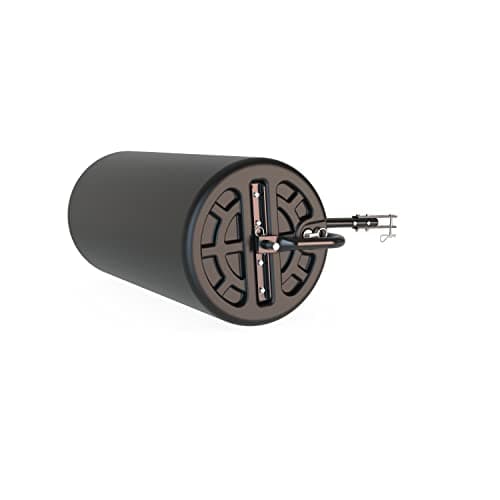
A roller solves a different problem than you think.Rollers press turf into contact with soil — new sod, new seed, frost-heaved spring turf. They do not flatten bumps, because soil that is high is high all the way down, and compressing it just compacts it. Buy one for sod and frost heave; do not buy one expecting it to level a lawn. Get the water-fillable kind, which is 400 pounds in use and nothing to store. The one cosmetic bonus is real, though: a filled roller is also how you stripe a lawn without fitting a kit to the mower, which is ranked in best lawn striping kits.
What we would not buy.Drag mats and chain harrows are made for arenas and sports fields, and on a home lawn they tear turf at the edges. Weighted lawn levelers with no handle-angle adjustment make you work bent over. And a rented ride-on topdresser is real machinery with a real day rate — worth it on an acre, absurd on a back yard.
The honest expectations
A lawn with shallow settling and worn hollows will look visibly better after one season of two or three quarter-inch passes. A genuinely uneven lawn — waves, old fill, a regraded yard — takes two or three seasons, and the reason is arithmetic, not effort: a quarter inch at a time only adds up so fast. If you need it flat this year, the answer is not topdressing. It is stripping the turf, regrading the soil and re-laying or reseeding, and that is a different and much larger project.
The payoff is real, though, and it is the reason this is worth doing at all: a flat lawn can be mowed shorter without scalping. Every mowerrides on its wheels and cuts at a fixed height above them, so on a bumpy lawn the deck dips into the hollows and shaves the crowns off the high spots. Level the surface and the same mower, at the same setting, suddenly cuts evenly — and a lawn mown evenly at a lower height is the whole aesthetic people are chasing when they start reading about this.