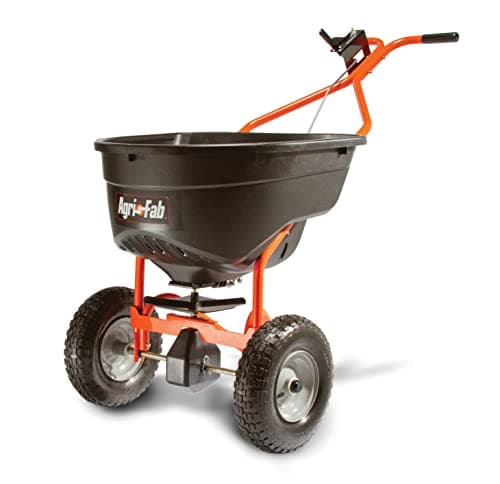
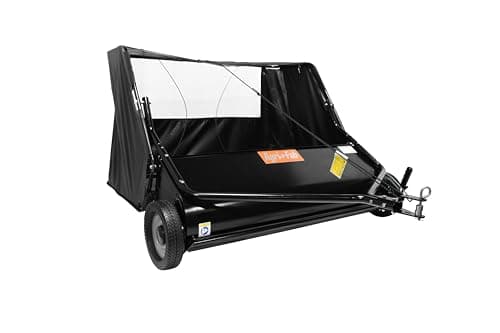
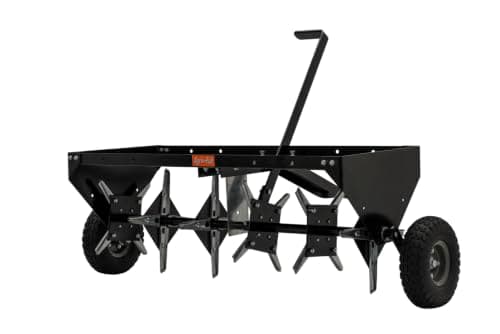
If you own a riding mower and you are buying one attachment, buy the Agri-Fab 45-0303 dump cart. Ten cubic feet of steel bed with a removable tailgate, and it is the only implement here that comes out of the shed every month of the year rather than one weekend a season. After that the order is decided by what your lawn actually needs: a tow-behind broadcast spreader if you feed or seed it, a tow-behind sweeper if you have trees, and the Agri-Fab 40" plug aerator if the ground is hard underfoot. If you are shopping attachments because maintenance is overdue rather than because the lawn needs a job doing, the MoJack EZ MAX lift is the one that unlocks everything else.
The pitch for attachments is that a riding mower is a tractor, and a tractor that only mows is doing one job out of six. That is true, and it is also how people end up with a shed full of implements they used once. So this page is ranked on uses per year first and capability second, because an implement that sits behind the snowblower all season is worse value than a cheaper one you hitch up every few weeks.
Before anything else, three compatibility facts. First, almost every implement here uses a universal hitch— a sleeve and a clevis pin that fit the hitch plate on the back of a residential lawn tractor or zero-turn. Second, a zero-turn is a worse tow vehicle than a lawn tractor: it steers by braking one wheel, so a loaded trailer pushes the back end around in a turn, and many zero-turn manuals set a lower towing limit than a tractor of the same engine size. Third, and this is the one people learn expensively: the limit is traction and transmission, not the hitch. A 350-pound cart of wet topsoil on a slope will spin the wheels of a 19 HP tractor and cook a light hydrostatic transmission trying. Fill carts to the weight the machine can start on your steepest ground, not to the brim. Prices below are live from the price layer with an “as of” date.
What each attachment is for, and how often it gets used
| Attachment | The job | Uses per year | Buy it if |
|---|
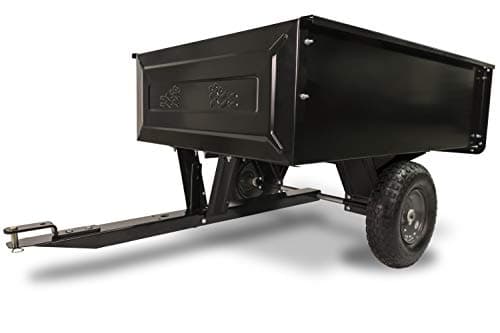
| Dump cart | Hauling anything | 10–30 | Always. This is the first one. |
| Broadcast spreader | Fertilizer, seed, lime | 3–5 | You feed the lawn and it is over half an acre |
| Lawn sweeper | Leaves, clippings, debris | 4–10 | You have mature trees |
| Plug aerator | Relieving compaction | 1–2 | The lawn is hard underfoot |
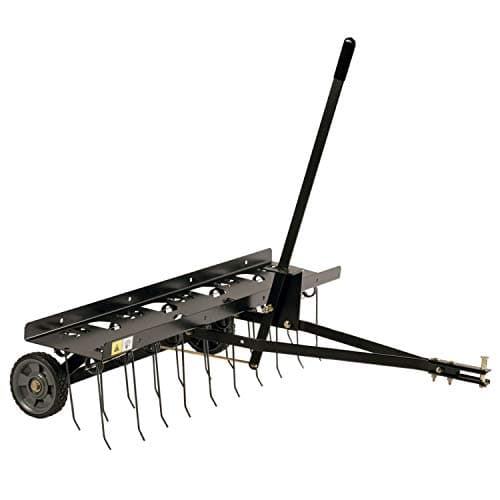
| Dethatcher | Raking out thatch | 1 | Water sits on a spongy layer |
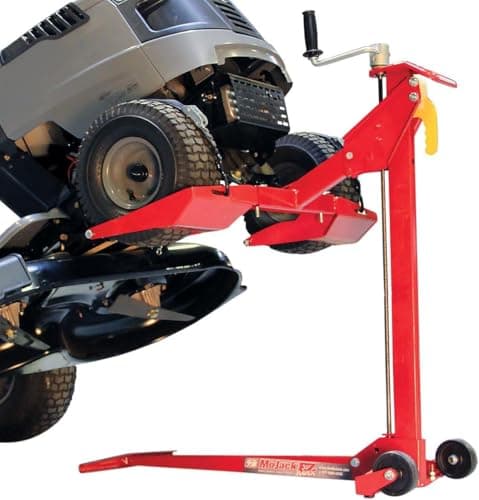
| Mower lift | Blade and underside access | 2–4 | You sharpen your own blades |
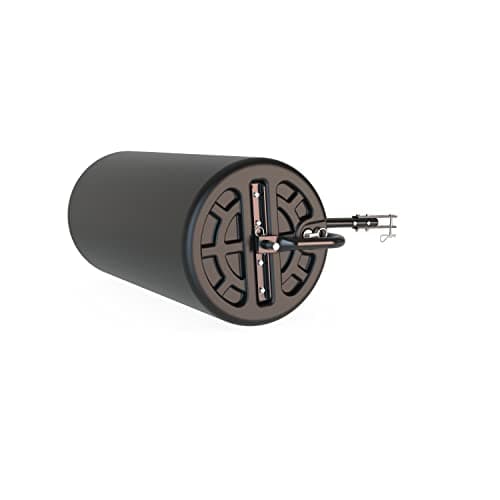
| Lawn roller | Settling sod and seed | 0–1 | You are laying sod or overseeding bare ground |
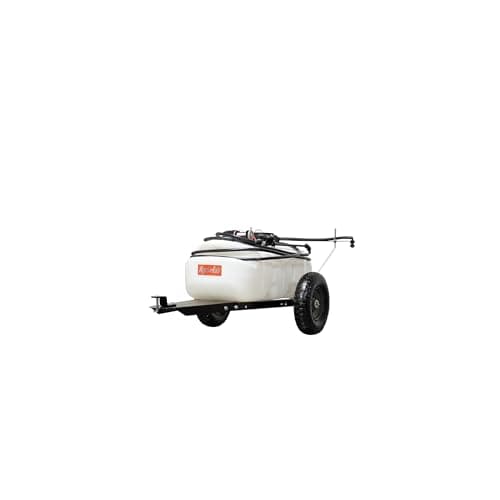
| Tow sprayer | Liquid weed control | 2–4 | You spray an acre or more |
The dump cart is not the boring choice
People skip past the cart to the clever implements and then buy one anyway a year later. A cart is how mulch gets from the driveway to the beds, how bagged fertilizer gets to the far corner, how the debris from dethatching gets off the lawn, and how firewood moves. Ten cubic feet is roughly a third of a cubic yard, so a yard of mulch is three trips instead of thirty wheelbarrow runs. The removable tailgate is the feature that matters: without it you shovel the load out, with it you tip and drive away.
Spreader: the attachment that pays for itself
Fertilizer is sold by coverage area and applied by rate, and a tow-behind hopper holding 130 pounds covers most residential acreage in one fill at a steady tractor speed. The reason this one saves money rather than time is that an even application at the labeled rate uses less product than a nervous hand-spread that stripes the lawn and gets topped up by eye. Pair it with the schedule in the lawn fertilizer schedule and the product list in best lawn fertilizer. If your lawn is small enough to walk, a push spreader is the better tool and the roundup for those is best broadcast spreader.
Sweeper or sprayer: the two that depend entirely on your property
A tow-behind sweeper is brushes driven off its own wheels, flicking leaves and clippings up into a hopper. On a lawn with mature trees it turns a fall weekend into an hour. On a lawn with no trees it is a large object you will resent. The same logic applies to the 15-gallon sprayer: over an acre of broadleaf weeds it replaces eleven backpack refills, and under half an acre it replaces nothing because a backpack already does the job in one fill. Read best weed control for lawns before you buy a sprayer, because the product decides the method.
Aerator and dethatcher: buy the mechanism, not the word
This is where attachment shopping goes wrong most often, so plainly: a plug (core) aerator pulls plugs of soil out and genuinely relieves compaction. A spike aerator pushes solid spikes in, which displaces soil sideways and can make the top inch worse. They sit next to each other at the same store at similar prices. The full comparison is in spike vs plug aerator. A dethatcheris a different machine solving a different problem — thatch is the dead mat above the soil, compaction is the packed soil below it. If you are not sure which you have, cut a wedge out with a spade and read aerating vs dethatching first. Both implements get used once a year at most, which is why they rank below the cart and the spreader despite doing more impressive work.
The honest gap: baggers and mulch kits
The two attachments people most often want are a bagger and a mulching kit, and we do not rank either here, because neither is a universal implement. A bagger bolts to a specific deck — the chute, the mounting brackets and the hood are model-specific, and a two-bin bagger for a 42-inch Cub Cadet will not fit a 42-inch Husqvarna. The same is true of mulch kits, which are a blocking plate plus blades matched to one deck. Buy those by your model number from the manufacturer or a parts dealer, not by deck width from a list. What we can rank is the blade side of the job, in best lawn mower blades.
The lift is maintenance, not an implement, and it changes more than it looks
A mower lift raises the machine so you can reach the underside. That sounds like a convenience and it is actually the gate on three jobs: sharpening blades, scraping the deck, and finding the grease points. Most riding mowers that cut badly are mowers whose blades have not been off in four years, because getting at them means jacking a 600-pound machine. The full comparison of lifts is in best zero turn mower lift, and the sharpening tools are in best lawn mower blade sharpener.
Three rules for towing without breaking anything
Load for the slope, not the hitch. The hitch plate is rarely the weak link. Traction, brakes and transmission are. If the wheels spin on your steepest ground, the load is too heavy for the hill, whatever the rating says.
Turn wide, and never on a slope with a load. A loaded implement pushes the rear of a zero-turn through a tight turn and can jackknife a tractor on a side slope.
Drain, clean and store dry. Spreaders rust from the inside out because fertilizer is hygroscopic salt; sprayers carry herbicide residue into the next tankful; rollers freeze and split if left full. Five minutes with a hose at the end of the job is the difference between ten seasons and three.